
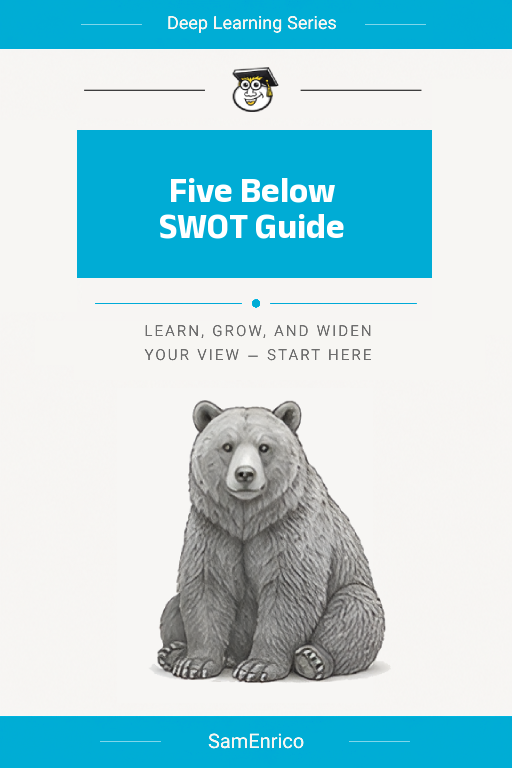
Five Below SWOT Guide Audiobook
Assess teen focus, extreme value, product rotation
by Jansen Joey
Assess teen focus, extreme value, product rotation, and store expansion runway in new markets.
Formats
Free sample
Chapter 1: The Joy Moat...–- On a humid Tuesday afternoon in a suburban Atlanta strip mall, a thirteen-year-old girl named Maya walks into Five Below with twelve dollars in her pocket—her weekly allowance. She has no shopping list, no specific need, and no parent trailing behind her. Twenty-three minutes later, she exits with a squishy LED mushroom lamp (5),apackofscentedgelpens(5), a pack of scented gel pens (5),apackofscentedgelpens(5), and a small bag of sour gummy worms (1.50,tuckedintothecandybinneartheregister).Shehasspent1.50, tucked into the candy bin near the register). She has spent 1.50,tuckedintothecandybinneartheregister).Shehasspent11.50. She is beaming.
She will return next Tuesday, and the Tuesday after that, not because she needs anything, but because she is chasing a feeling. That feeling—cheap, fleeting, and utterly addictive—is the most misunderstood moat in modern retail.This is not a story about low prices. Dollar stores have low prices. This is not a story about teenage rebellion or the mysterious whims of Gen Z. This is a story about something far more durable: the strategic alchemy of turning fun into a barrier to entry.
For decades, business strategists have worshipped at the altar of functional advantages—supply chain efficiency, economies of scale, proprietary technology, network effects. These are real moats, to be sure. But they are also copyable. Amazon can build a faster supply chain. Walmart can negotiate lower prices.
What Amazon and Walmart cannot do—what no algorithm or bulk purchase order can replicate—is make a thirteen-year-old feel like she just discovered a secret treasure chest that belongs only to her. That feeling is the Joy Moat. And Five Below has spent twenty years digging it.The conventional retail playbook says that teenagers are fickle, disloyal, and allergic to brand commitment. The conventional playbook is wrong—or rather, it is correct about what teenagers do when they are bored, but incorrect about what they do when they are delighted. Delight, not price, is the psychological anchor of Five Below's customer relationship.
This chapter dismantles the lazy assumption that "cheap stuff for kids" is a simple value proposition. It reveals, instead, a meticulously engineered ecosystem of emotional spending, stage-of-life targeting, and what behavioral economists call "affordable indulgence." We will dissect the three life stages that fuel Five Below's repeat traffic, explain why the "lipstick effect" works differently for a thirteen-year-old than for a thirty-year-old, and confront the genuine weakness that keeps executives awake at night…
This is the end of the free sample. Get the Audiobook to keep going. Buy now
About this book
Details
- Author
- Jansen Joey
- Publisher
- SamEnrico
- Language
- English
- Genre
- Non-Fiction, Strategic Atlas, Youth Retail
- Released
- 2026-06-01
- Pages (approx.)
- 141
- Available as
- eBook, Audiobook

Listen in the VoxFlicks app
Audiobooks and audio dramas wherever you go. Sign in with your SamEnrico account and press play.
More by Jansen Joey
 Every Character is MeJansen Joey$11.99
 Attempt Survivor Disability StoryJansen Joey$11.99
 Metta for Radiation TherapyJansen Joey$11.99
 Non Discrimination Testing 401kJansen Joey$11.99
 Adoption Disruption Loss SupportJansen Joey$11.99
 The Silk Road’s Last Emperor: The Untold Story of a Trade DynastyJansen Joey$11.99
 Head of PR and CommunicationsJansen Joey$11.99
 Excel for Environmental Economics ExamsJansen Joey$12.99
 Understanding Nephropathy, Familial With GoutJansen Joey$17.99
 A Beginners Guide to Game of the Generals (Volume 1)Jansen Joey$11.99