
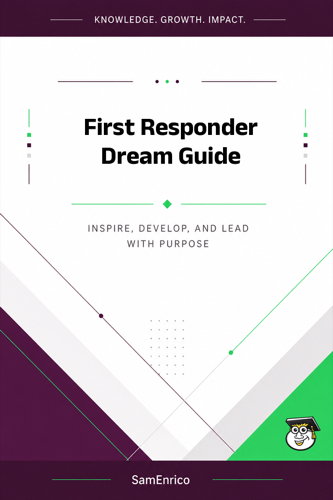
Non-FictionSelf-HelpFirst ResponderEmergency
First Responder Dream Guide eBook
Process work related trauma dreams from emergency
Process work related trauma dreams from emergency services using peer support.
Formats
Free sample
Chapter 1: The Stuck Reel--–- The radio crackled with static, then went silent. Not the usual silence of a shift change or a lull between calls. This was the silence of a dead frequency—the kind that means you are alone. Firefighter Mike Delgado sat up in his bunk at Station 47, heart hammering against his ribs, sweat soaking through his t-shirt despite the air conditioning set to sixty-five degrees. He looked at the clock.
3:07 AM. Same as last Tuesday. Same as the Tuesday before that. Same as every Tuesday for the past four months.He swung his legs over the side of the bed and sat there in the dark, trying to remember if he had actually heard a radio or if the radio had only existed in the dream. The distinction mattered.
On duty, a dead radio is a tactical problem. In a dream, a dead radio is a window into something he had been trying very hard to ignore: the possibility that the call he ran last spring had not ended when the ambulance pulled away.Mike had been a firefighter for eleven years. He had seen burned children, jumpers, drownings, and one motor vehicle collision that required three body bags and a chaplain. He had always been fine. He had the dark humor, the emotional calluses, the ability to eat a sandwich while describing a decapitation.
That was the job. That was the measure of a professional. But six months ago, on a rainy Tuesday in April, he had worked a pediatric arrest—a three-year-old girl who had stopped breathing. They got a pulse back. He remembered that clearly.
He remembered the color returning to her lips. He remembered the paramedic saying, "She's got something."She died in the ICU three days later. Mike did not attend the funeral. That was not his role. His role was to run the next call, then the next, then the next.
But three weeks after the arrest, he started dreaming about his radio. In the dream, he was standing in a burning house—not a real house, not one he recognized, but a house that felt like every house he had ever entered. The smoke was thick, the heat was real, and he could hear a child crying somewhere above him. He keyed his radio to call for backup. Nothing.
He keyed it again. Static. He screamed into the microphone: "Mayday, mayday, mayday!"Silence.He would wake up gasping, his hand reaching for a radio that was not there, his ears ringing with a frequency that did not exist. The first few times, he told himself it was nothing. Just stress.
Just the job. But when the dream started arriving three times a week—always at 3:07 AM, always the same ending, always the same silence—he stopped telling himself anything at all. He just lay in the dark and waited for the alarm to ring.The Lie We Tell Ourselves Every first responder hears the same phrase at some point in their career: "Leave work at work." It is spoken by well-meaning spouses, by veteran officers, by department chaplains, and by peer supporters who genuinely believe they are helping. The phrase is intended as a boundary—a way to preserve the self against the relentless tide of human suffering that defines emergency services work. But the phrase is also a lie.
Not a malicious lie. A biological one.The human brain does not have an on-off switch for trauma. It does not have a filing cabinet labeled "work" and another labeled "home." When a first responder witnesses a violent death, experiences a near-miss, or fails to save a patient despite doing everything correctly, that event is not stored as a simple memory. It is stored as a hot memory—a bundle of sensory fragments, emotional intensity, and physiological arousal that refuses to compress into a neat narrative. The conscious mind, which runs the show during the shift, is very good at suppression.
It can push hot memories into the background long enough to run the next call, eat dinner, and kiss the kids goodnight. But suppression is not deletion. And suppression fails spectacularly during sleep.This chapter dismantles the most destructive myth in emergency services culture: that first responders can simply "shake off" a bad call. It does so not with abstract psychology but with neurobiology, field experience, and a single diagnostic question that any peer can ask. By the end of this chapter, you will understand why your brain forces you to replay the worst moments of your career while you sleep, why some dreams are processing tools and others are distress signals, and how to tell the difference between a dream that means you are healing and a dream that means you are stuck.The Science of Hot Memory To understand trauma dreams, you must first understand how the brain stores ordinary memories versus traumatic ones.
Ordinary memories—what you ate for breakfast, the route you drove to work, the face of a cashier—are processed through the hippocampus, a structure deep in the brain that acts like a librarian. The hippocampus takes sensory information, stamps it with a time and place, and files it away in the neocortex for long-term storage. This process takes about twenty-four to forty-eight hours and occurs primarily during REM sleep. By the time you wake up on Wednesday, your brain has already filed away most of Tuesday's mundane events.Hot memories do not cooperate with the hippocampus. When an event is traumatic—defined not by the event itself but by the brain's response to it—the amygdala (the brain's alarm system) overrides the hippocampus.
The amygdala's job is survival, not organization. It grabs the sensory fragments of the event—the sound of a mother screaming, the smell of smoke, the feel of a small chest compressing under your hands—and locks them away in a raw, unprocessed form. These fragments are not filed by time or place. They are filed by threat level. And because the amygdala cannot tell the difference between a past threat and a present one, it reactivates the same physiological response every time a fragment is triggered.This is why trauma dreams feel different from ordinary nightmares.
An ordinary nightmare—being chased by a monster, falling from a great height, showing up to work without pants—is a product of abstract anxiety. The brain is processing general stress, not specific events. The imagery is symbolic. The monster represents fear, not a real person. The fall represents loss of control, not a real ladder.
You wake up unsettled, but you can usually fall back asleep after a few minutes of deep breathing.A trauma dream is different. A trauma dream replays a specific call with literal imagery, distorted time, and sensory flashbacks that are indistinguishable from the original event. The radio that melted in Mike Delgado's dream did not represent a fear of communication failure—it was a communication failure from the pediatric arrest. The burning house was not a symbol of his anxiety—it was the house he could not fully search because he was trying to manage a cardiac arrest in the living room. The child crying upstairs was the…
This is the end of the free sample. Get the eBook to keep going. Buy now
About this book
Details
- Author
- Dorman Brenna
- Publisher
- SamEnrico
- Language
- English
- Genre
- Non-Fiction, Self-Help, First Responder, Emergency
- Released
- 2026-06-09
- Pages (approx.)
- 149
- Available as
- eBook, Audiobook

Read better in the ZLOADR app
Your eBooks on your phone or tablet. Sign in with your SamEnrico account and start reading.
More by Dorman Brenna
 The Postpartum Anxiety Self Care PlanDorman Brenna$11.99
 Sleep Energy Foundation GuideDorman Brenna$11.99
 Behavioral Addiction in the Deaf CommunityDorman Brenna$11.99
 The Hollow Hill's Bargain: A Fairy King's GambitDorman Brenna$11.99
 The Alchemist's Gamble: The Medieval Quest for the Philosopher's StoneDorman Brenna$11.99
 Arcade GamesDorman Brenna$11.99
 Understanding Hereditary DeafnessDorman Brenna$17.99
 Rwanda Business Registration WorkbookDorman Brenna$12.99
 Edge Cloud Computing OutlookDorman Brenna$12.99
 How to Start a Casks Made of Wood Business (Beginners Guide)Dorman Brenna$11.99
You may also like
 Hong Kong Handover 1997Dunn Johnnie$11.99
 Zumba For Postnatal Recovery CourseNeal Christian$11.99
 Zumba for BeginnersLadner Nikia$11.99
 YouTube Comment Mining GuideHumes Pandora$12.99
 Worry Box MeditationCarlin Rudy$11.99
 Workplace Stress MeditationNguyen Lynn$11.99
 Workplace Stress and Sleep RepairHawley Ivory$11.99
 Workplace Perfectionism CureDelaney Jeffry$11.99
 Workplace Injustice Anger GuideWallen Isabelle$11.99
 Work Addiction and Burnout LinkGreenwood Ester$11.99
 Women in Yoga and WellnessBeattie Galina$11.99
 Women in Stand Up ComedyChun Evangeline$11.99