
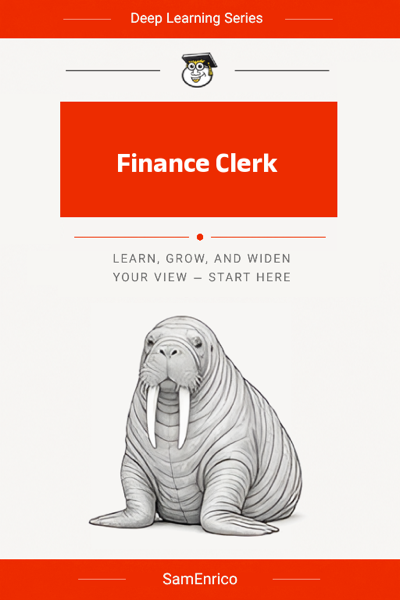
Non-FictionInformativeEducational
Finance Clerk eBook
A Coursebook on Finance Clerk
A Coursebook on Finance Clerk
Formats
Free sample
Chapter 1: The Invisible Gatekeeper...--In the summer of 2019, a finance clerk named Sarah arrived at her desk in a small city council office at 8:47 a.m., just like she had every weekday for the previous eleven years. She made tea, opened her email, and saw a request from the council's chief executive: an urgent wire transfer of £47,000 to a supplier for "emergency roof repairs." The invoice attached looked legitimate. The supplier's name was familiar. The chief executive's email signature was correct.Sarah processed the payment within twenty minutes.That transfer drained the council's emergency reserve fund. The roof was never repaired.
The supplier did not exist. The chief executive's email had been spoofed by a fraudster using AI-generated voice cloning to bypass the bank's verification call. Sarah was not fired—she had followed every procedure correctly—but she carried the weight of that £47,000 for years. She almost quit the profession entirely.Instead, she became a trainer for financial fraud prevention. Today, she teaches Fortune 500 finance teams the lesson she learned the hard way: the finance clerk is not a data entry technician.
The finance clerk is the invisible gatekeeper standing between an organization and financial disaster.This chapter is about who you are, who you can become, and why the work you do matters more than almost anyone in your organization realizes.The Three Worlds of the Finance Clerk Before you can master the craft of the finance clerk, you must understand where you are standing. The daily life of a clerk varies dramatically depending on the type of organization that employs you. This book covers two primary sectors in depth, with a third acknowledged for context.Local Government and Councils (Public Sector)If you work in local government—a parish council, town council, city government, or other public body—your work is governed by transparency laws, public accountability, and the constant scrutiny of elected officials and residents. Your primary concerns are not profitability but legality, propriety, and value for money.A local government clerk must ensure that every pound or dollar spent can be justified to a member of the public who has the legal right to inspect the books. You will process payments for cemetery maintenance, playground equipment, street lighting, and community grants.
You will help prepare the annual budget and, in the United Kingdom, calculate something called the precept—the portion of council tax that funds your authority.The stakes are high. If you make an error in a private company, the company loses money. If you make an error in local government, you may face public humiliation at a council meeting, a qualified audit opinion, or in extreme cases, legal sanctions. But the rewards include knowing that your work directly improves your community.Banking and Financial Institutions If you work in a bank, credit union, or other financial institution, your world is defined by transaction volume, speed, and regulatory compliance. You might process hundreds of wire transfers before lunch.
You will calculate interest on loans and savings accounts. You will verify customer identities to prevent money laundering.The bank clerk sits at the intersection of customer service and risk management. A single missed red flag on a loan application could cost the bank tens of thousands of pounds. A failure to spot a structured transaction—multiple deposits just below the reporting threshold—could bring regulatory fines and even criminal liability.But the banking clerk also sees the human side of finance. You will help a young couple apply for their first mortgage.
You will assist a small business owner with a cash flow problem. You will be the person who catches a fraudulent transaction before it empties an elderly customer's life savings.Private Sector Corporations (Acknowledgment)This book does not provide comprehensive coverage of private sector corporate finance clerks. If you work for a manufacturing company, a retail chain, or a service provider, you will find Chapters 1 through 5, 10, 11, and 12 highly relevant. However, the budgeting, procurement, and governance chapters (6 through 8) focus on local government, while the banking products chapter (9) focuses on financial institutions. Private sector clerks should supplement this book with industry-specific resources on corporate budgeting, inventory accounting, and revenue recognition.Beyond the Job Title: Clerk, Bookkeeper, and RFOOne of the most common sources of confusion for new finance clerks is understanding how their role differs from adjacent positions.
Let us clarify these distinctions once and for all.The Finance Clerk You are the frontline worker of the finance office. Your daily responsibilities typically include:Entering invoices into the accounts payable system Processing payment runs (checks, ACH, wire transfers)Recording receipts from customers, taxpayers, or clients Performing basic bank reconciliations (covered in depth in Chapter 5)Filing and retrieving financial documents Responding to vendor or customer inquiries about payments Preparing standard journal entries under supervision You are not expected to design financial policies, interpret complex accounting standards, or make strategic decisions about organizational finances. But you are expected to execute transactions accurately, completely, and in a timely manner.The Bookkeeper A bookkeeper typically has more responsibility than a clerk but less than a full accountant. Bookkeepers often:Manage the entire general ledger Prepare adjusting entries (accruals, prepayments, depreciation)Run payroll independently Produce trial balances and basic financial statements Liaise with external accountants at year-end Some organizations use the titles interchangeably. In general, if you are making decisions about which accounts to debit and credit without supervision, you are functioning as a bookkeeper.
If you are entering transactions prepared by someone else, you are functioning as a clerk. Many finance clerks eventually become bookkeepers after gaining experience and earning certifications.The Responsible Financial Officer (RFO)In UK local government, the Responsible Financial Officer is a statutory role with legal duties under the Local Government Finance Act 1988 and subsequent regulations. The RFO is personally responsible for the proper administration of the council's financial affairs. Daily duties include:Certifying the annual accounts as true and fair Ensuring all payments have proper authorization Advising the council on financial legality and risk Preparing the budget and precept calculation Responding to internal and external audit findings Signing off the Annual Governance and Accountability Return (AGAR, covered in Chapter 8)A finance clerk may report to an RFO or may be the RFO in a very small council where the clerk wears multiple hats. The RFO role typically requires a professional qualification such as Certificate in Local Council Administration (Ci LCA) or a full accounting designation.The table below summarizes the distinctions at a glance:Role Typical Tasks Supervision Certifications Finance Clerk Data entry, payment runs, basic reconciliation Supervised None required, but AAT Level 2 common Bookkeeper Full ledger, adjusting entries, trial balance Minimal supervision AAT Level 3 or 4RFO (local govt)Legal certification of accounts, budget, audit Reports to council Ci LCA or accounting degree The Two Gatekeepers: Data Integrity and Asset Protection Throughout this book, you will encounter the term "gatekeeper." It appears frequently in finance literature, but often without sufficient precision.
In fact, the finance clerk serves as two distinct types of gatekeeper, and understanding the difference is essential.Gatekeeper of Financial Data (Accuracy Focus)The first gatekeeping function concerns information. Financial data flows through your hands: invoices, receipts, bank statements, ledgers, payroll records. Your role is…
This is the end of the free sample. Get the eBook to keep going. Buy now
About this book
Details
- Author
- Barnhill Mayme
- Publisher
- SamEnrico
- Language
- English
- Genre
- Non-Fiction, Informative, Educational
- Released
- 2026-06-02
- Pages (approx.)
- 151
- Available as
- eBook, Audiobook

Read better in the ZLOADR app
Your eBooks on your phone or tablet. Sign in with your SamEnrico account and start reading.
More by Barnhill Mayme
 Solopreneur ABCDE SystemBarnhill Mayme$11.99
 Rupture and Repair WorkbookBarnhill Mayme$11.99
 Parental Anger Bedtime BattlesBarnhill Mayme$11.99
 Franchising Your Local Brand Across Borders Currency HedgingBarnhill Mayme$11.99
 Intermittent Fasting Calorie LogBarnhill Mayme$11.99
 The Silent Heir: The Untold Story of Prince Harry’s Hidden StruggleBarnhill Mayme$11.99
 Echoes of the Ice: The Day the Arctic SpokeBarnhill Mayme$11.99
 Understanding Deafness Conductive Stapedial Ear Malformation Facial PalsyBarnhill Mayme$17.99
 Community Moderation GuideBarnhill Mayme$12.99
 Form 990 Public DisclosureBarnhill Mayme$12.99
 Ultimate Handbook Guide to St. Helier : (Jersey) Travel GuideBarnhill Mayme$11.99
You may also like
 Hong Kong Handover 1997Dunn Johnnie$11.99
 Zumba For Postnatal Recovery CourseNeal Christian$11.99
 Zumba for BeginnersLadner Nikia$11.99
 YouTube Comment Mining GuideHumes Pandora$12.99
 Worry Box MeditationCarlin Rudy$11.99
 Workplace Stress MeditationNguyen Lynn$11.99
 Workplace Stress and Sleep RepairHawley Ivory$11.99
 Workplace Perfectionism CureDelaney Jeffry$11.99
 Workplace Injustice Anger GuideWallen Isabelle$11.99
 Work Addiction and Burnout LinkGreenwood Ester$11.99
 Women in Yoga and WellnessBeattie Galina$11.99
 Women in Stand Up ComedyChun Evangeline$11.99