
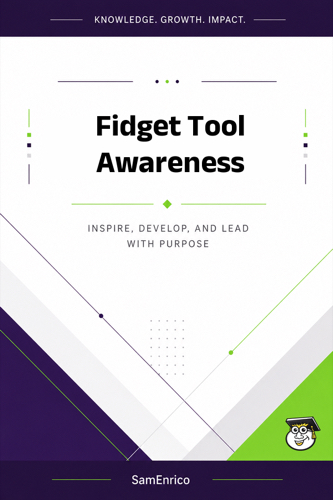
Fidget Tool Awareness eBook
Use a fidget object as a tactile anchor for anxiou
Use a fidget object as a tactile anchor for anxious energy.
Formats
Free sample
Chapter 1: The Stillness Trap--–- The first time I watched a seven-year-old boy named Marcus try to sit still for twenty minutes, I knew the adults in the room had it backwards. Marcus wasn't misbehaving. He wasn't being defiant, lazy, or unfocused. His body was doing exactly what millions of years of evolution had programmed it to do: it was trying to survive. The classroom was brightly lit, slightly too warm, and filled with the low hum of fluorescent lights.
Marcus had been sitting cross-legged on a rug for twelve minutes during morning circle time, and his hands had begun to wander. First, he picked at a loose thread on his sock. Then he began tapping his thumb against each of his fingers in sequence. Then he started rocking gently side to side. Within sixty seconds, a teaching assistant had placed a gentle but firm hand on his shoulder and whispered, "Marcus, sit still, please." His hands dropped to his lap.
His rocking stopped. His shoulders tightened. And for the next eight minutes, Marcus sat perfectly motionless—and perfectly miserable. His cortisol levels, had anyone measured them, would have been climbing. His working memory was degrading by the minute.
And his nervous system was sending silent alarm signals that no one around him could see.This is the stillness trap. It is the quiet, pervasive, and almost entirely unexamined belief that the ability to remain motionless is a sign of virtue, discipline, intelligence, and respect. It is taught in preschools, reinforced in boardrooms, and enforced in courtrooms. It is the reason millions of children are told to "stop fidgeting" every single school day. It is the reason countless adults spend meetings clenching their jaws and pressing their hands flat against their thighs, burning metabolic energy just to suppress the natural urge to move.
And it is wrong.The Hidden Cost of Forced Stillness For most of human history, the expectation of prolonged stillness was rare. Our ancestors moved while they worked. They shifted positions while sitting on uneven ground. They walked, stretched, adjusted, and repositioned constantly throughout the day. The human body evolved to be in near-constant low-level motion.
This is not a design flaw. It is a feature. The nervous system uses movement as a primary means of self-regulation. When you shift your weight in a chair, you are not being restless. You are literally helping your brain maintain blood flow and neural arousal.
When you tap your foot, you are not being distracting. You are providing rhythmic sensory input that helps filter out environmental noise. When you roll a pen between your fingers, you are not being unprofessional. You are giving your prefrontal cortex permission to focus by offloading excess motor energy onto a small, repetitive task.Yet modern institutions have systematically suppressed these natural movements. Consider the typical elementary school classroom: desks arranged in rows, students expected to sit with hands folded, feet flat on the floor, eyes forward.
This model was not designed by neuroscientists or developmental psychologists. It was inherited from nineteenth-century factory training, where the goal was to prepare children for assembly line work that required repetitive stillness and obedience to authority. The same model migrated into office design, meeting etiquette, and even religious and ceremonial settings. The result is an environment that is fundamentally hostile to how human nervous systems actually function.The research on this topic is surprisingly consistent and surprisingly ignored. A 2016 study published in the journal Child Development found that children who were allowed to fidget while completing a working memory task performed significantly better than those who were asked to sit still.
Another study from Texas A&M University found that employees in active workplaces—where standing desks, walking meetings, and movement breaks were encouraged—showed 46 percent higher productivity than those in traditional seated offices. Perhaps most tellingly, researchers at the University of Hertfordshire discovered that individuals who were instructed to suppress their fidgeting during a stressful task showed elevated cortisol levels afterward, while those who were allowed to move naturally showed no such spike.Let me pause here and make something very clear. I am not saying that all movement is always good or that all stillness is always harmful. There are contexts where stillness is appropriate, even necessary. A surgeon performing delicate work needs fine motor control, not full-body rocking.
A cellist in a quiet passage needs stillness in her bow arm. A person meditating may choose stillness as a deliberate practice. The problem is not stillness itself. The problem is forced stillness—stillness imposed by external authority, stillness that contradicts the body's clear signals, stillness that comes at the cost of cognitive and emotional regulation.Extraneous Kinetic Energy: A Better Name for Restlessness One of the most damaging aspects of the stillness trap is the language we use to describe the urge to move. We call it "restlessness," which sounds like a mild pathology.
We call it "fidgeting," which sounds trivial and slightly annoying. We call it "antsy," "twitchy," or "nervous energy." Each of these terms carries a subtle judgment. They suggest that the urge to move is a problem to be solved rather than a signal to be understood.I want to introduce a more accurate, more neutral, and ultimately more useful term: extraneous kinetic energy. This phrase describes exactly what is happening in the nervous system when you feel the urge to tap, shift, or fidget. Your body has generated more neurochemical and muscular activation than is required for your current task or environment.
That excess energy is not a mistake. It is not a symptom of a disorder (though it can be more intense in certain conditions like ADHD or anxiety disorders). It is simply the body's way of saying, "I have more fuel than I need right now, and I need to burn some of it off so the rest of the system can function properly."Think of it like a car idling in cold weather. The engine is running, fuel is being consumed, but the car is not moving. That excess energy has to go somewhere.
It creates vibrations, heat, and noise. Similarly, when you are sitting in a meeting, your nervous system is still running at baseline arousal. If something raises that arousal—anxiety about a presentation, boredom with the topic, caffeine from your morning coffee, even just the natural circadian rhythm of alertness—you suddenly have more energy in the system than the act of sitting still can absorb. That energy does not disappear. It must be discharged.
And the body's preferred method of discharge is small, repetitive, low-stakes movement.The genius of the human nervous system is that it figured out a way to discharge this energy without requiring you to stand up and run around the room. Subtle fidgeting—tapping, shifting, rolling, squeezing, clicking—is precisely calibrated to burn off just enough energy to restore equilibrium. It is an elegant, efficient, and evolutionarily ancient regulatory mechanism. And we have spent decades teaching children, employees, and even ourselves to suppress it.The Physiology of Suppression When you force yourself to sit still against your body's clear signals, you are not actually making the energy disappear. You are simply preventing its discharge.…
This is the end of the free sample. Get the eBook to keep going. Buy now
About this book
Details
- Author
- Hammonds Warner
- Publisher
- SamEnrico
- Language
- English
- Genre
- Non-Fiction, Self-Help, Tactile, Fidget
- Released
- 2026-06-09
- Pages (approx.)
- 146
- Available as
- eBook, Audiobook

Read better in the ZLOADR app
Your eBooks on your phone or tablet. Sign in with your SamEnrico account and start reading.
More by Hammonds Warner
 The Deadline MuseHammonds Warner$11.99
 SAT Essay AI PromptsHammonds Warner$11.99
 Partner Loss to IllnessHammonds Warner$11.99
 The Sleep Dependent Learning GuideHammonds Warner$11.99
 The Sumo Samurai in London: How a Japanese Legend Conquered Victorian EnglandHammonds Warner$11.99
 Wave Financial Reports GuideHammonds Warner$12.99
 Pharma Strategic M&A GuideHammonds Warner$12.99
 Understanding Pityriasis Lichenoides ChronicaHammonds Warner$17.99
 Associate Private BankerHammonds Warner$11.99
 How to Start a Check Valves Business (Beginners Guide)Hammonds Warner$11.99