
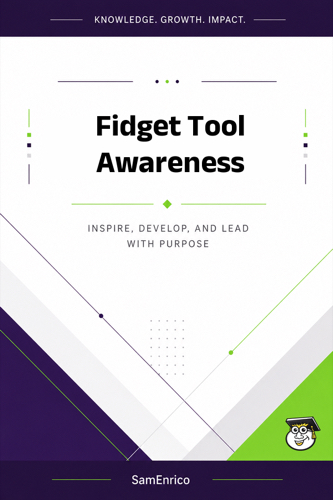
Fidget Tool Awareness Audiobook
Use a fidget object as a tactile anchor for anxiou
Use a fidget object as a tactile anchor for anxious energy.
Formats
Free sample
Chapter 1: The Stillness Trap--–- The first time I watched a seven-year-old boy named Marcus try to sit still for twenty minutes, I knew the adults in the room had it backwards. Marcus wasn't misbehaving. He wasn't being defiant, lazy, or unfocused. His body was doing exactly what millions of years of evolution had programmed it to do: it was trying to survive. The classroom was brightly lit, slightly too warm, and filled with the low hum of fluorescent lights.
Marcus had been sitting cross-legged on a rug for twelve minutes during morning circle time, and his hands had begun to wander. First, he picked at a loose thread on his sock. Then he began tapping his thumb against each of his fingers in sequence. Then he started rocking gently side to side. Within sixty seconds, a teaching assistant had placed a gentle but firm hand on his shoulder and whispered, "Marcus, sit still, please." His hands dropped to his lap.
His rocking stopped. His shoulders tightened. And for the next eight minutes, Marcus sat perfectly motionless—and perfectly miserable. His cortisol levels, had anyone measured them, would have been climbing. His working memory was degrading by the minute.
And his nervous system was sending silent alarm signals that no one around him could see.This is the stillness trap. It is the quiet, pervasive, and almost entirely unexamined belief that the ability to remain motionless is a sign of virtue, discipline, intelligence, and respect. It is taught in preschools, reinforced in boardrooms, and enforced in courtrooms. It is the reason millions of children are told to "stop fidgeting" every single school day. It is the reason countless adults spend meetings clenching their jaws and pressing their hands flat against their thighs, burning metabolic energy just to suppress the natural urge to move.
And it is wrong.The Hidden Cost of Forced Stillness For most of human history, the expectation of prolonged stillness was rare. Our ancestors moved while they worked. They shifted positions while sitting on uneven ground. They walked, stretched, adjusted, and repositioned constantly throughout the day. The human body evolved to be in near-constant low-level motion.
This is not a design flaw. It is a feature. The nervous system uses movement as a primary means of self-regulation. When you shift your weight in a chair, you are not being restless. You are literally helping your brain maintain…
This is the end of the free sample. Get the Audiobook to keep going. Buy now
About this book
Details
- Author
- Hammonds Warner
- Publisher
- SamEnrico
- Language
- English
- Genre
- Non-Fiction, Self-Help, Tactile, Fidget
- Released
- 2026-06-09
- Pages (approx.)
- 146
- Available as
- eBook, Audiobook

Listen in the VoxFlicks app
Audiobooks and audio dramas wherever you go. Sign in with your SamEnrico account and press play.
More by Hammonds Warner
 The Deadline MuseHammonds Warner$11.99
 SAT Essay AI PromptsHammonds Warner$11.99
 Partner Loss to IllnessHammonds Warner$11.99
 The Sleep Dependent Learning GuideHammonds Warner$11.99
 The Sumo Samurai in London: How a Japanese Legend Conquered Victorian EnglandHammonds Warner$11.99
 Wave Financial Reports GuideHammonds Warner$12.99
 Pharma Strategic M&A GuideHammonds Warner$12.99
 Understanding Pityriasis Lichenoides ChronicaHammonds Warner$17.99
 Associate Private BankerHammonds Warner$11.99
 How to Start a Check Valves Business (Beginners Guide)Hammonds Warner$11.99