
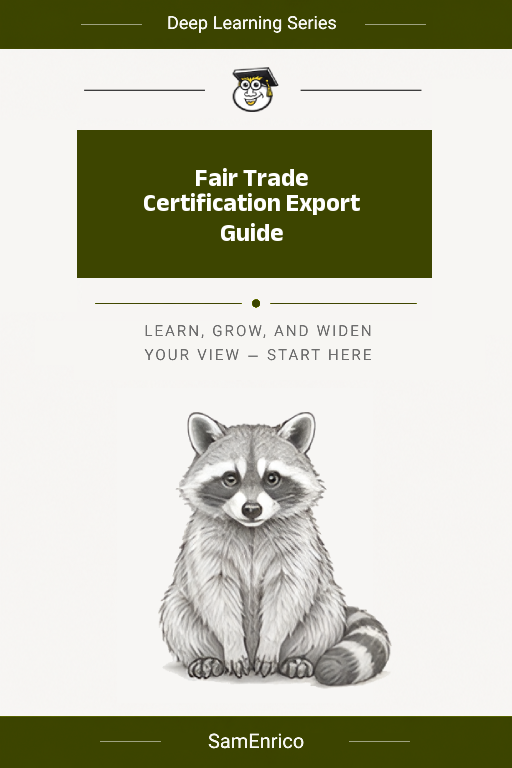
Fair Trade Certification Export Guide eBook
Secure Fairtrade or Fair for Life certification to
by Conrad Tien
Secure Fairtrade or Fair for Life certification to access premium European ethical markets.
Formats
Free sample
Chapter 1: The Ethical Premium...--–- The first time a European buyer asked me whether my cocoa was certified, I almost lost the contract. I had spent months building relationships, sending samples, negotiating prices. The buyer from a mid-sized German chocolate company loved my product. The quality was exceptional. The price was competitive.
Then, five minutes before we were supposed to shake hands, he asked a question I could not answer: "What is your certification status for Fairtrade and EUDR compliance?" I stared at him blankly. He closed his folder, stood up, and walked away. That was the day I learned that in modern European markets, quality and price are no longer enough. You need a license to operate, and that license is called certification.This book is written for every exporter who has experienced that moment of silence. It is for the coffee cooperative in Peru that lost a German buyer to a certified competitor.
It is for the honey packer in Ethiopia who cannot understand why Swiss retailers demand paperwork his grandfather never needed. It is for the cocoa farmer in Ghana who watches his premium-quality beans sell at commodity prices while certified farmers down the road earn double. This guide exists because the rules of global trade have changed, and most exporters are still playing the old game.The old game was simple. You grew a good product. You found a buyer willing to pay a fair price.
You shipped it. The buyer sold it. Everyone profited. That game ended sometime between the launch of the first Fairtrade label in 1988 and the passage of the German Supply Chain Due Diligence Act in 2021. In its place, a new game emerged—one where European consumers demand to know not just where their food came from, but whether the farmer who grew it earned a living wage, whether the land it grew on was deforested, and whether the child who helped harvest it went to school instead of work.This chapter establishes the foundation for everything that follows.
It answers three essential questions. First, why do European buyers pay premiums for certified goods when cheaper uncertified alternatives exist? Second, how have new regulations transformed certification from a marketing tool into a legal requirement? And third, why should you, the exporter, treat certification not as a burden but as your most powerful competitive advantage?If you understand only one thing from this entire book, understand this: the era of selling uncertified agricultural products into premium European markets is ending. The only question is whether you will adapt now, while your competitors are still sleeping, or later, when the door has already closed.The Unseen Engine of European Ethical Markets To understand why European buyers pay more for certified goods, you must first understand the European consumer.
This is not an abstract marketing exercise. It is a matter of survival for your export business. European consumers have fundamentally transformed what they value in the products they buy, and their values have become your compliance requirements.Consider the data. According to Fairtrade International, 90 percent of all Fairtrade cocoa and 70 percent of all Fairtrade coffee sold globally ends up in European shopping carts. Germany alone accounts for more than a third of the global Fairtrade market.
Switzerland, a country of just 8.6 million people, consumes more Fairtrade bananas than the entire continent of North America. These numbers are not accidents of geography. They are the result of decades of consumer education, NGO advocacy, and media scrutiny that have made ethical consumption a mainstream European value.What drives this consumer behavior? Research from the European Commission's Joint Research Centre identifies three primary motivators. First, trust erosion.
European consumers have watched their governments and corporations fail to prevent labor exploitation, environmental destruction, and financial crises. They no longer trust businesses to self-regulate. Certification provides a third-party verification that fills this trust vacuum. When a German shopper sees the blue and green Fairtrade Mark, she knows that an independent auditor has verified the claims on the package. That knowledge is worth a 10 to 25 percent price premium, according to multiple consumer willingness-to-pay studies conducted across the EU.Second, value alignment.
European consumers increasingly define themselves by what they consume. Buying Fairtrade coffee is not just a purchase; it is a statement of identity. It says, "I care about the people who grew this bean. I am not complicit in exploitation. I am part of the solution." This identity-driven consumption is particularly strong among millennials and Gen Z, who now represent the fastest-growing demographic of European food shoppers.
For these consumers, buying uncertified products when certified alternatives exist feels like a moral failure.Third, risk aversion. European consumers have learned that uncertified supply chains hide risks: child labor in West African cocoa, forced labor in Southeast Asian fisheries, deforestation in Brazilian cattle ranches. Buying certified products is a form of insurance against the reputational damage of unknowingly supporting these practices. No German retailer wants to wake up to a television exposé showing that their store brand chocolate was harvested by children. Certification is the cheapest form of reputational insurance available.These consumer preferences do not exist in a vacuum.
They translate directly into buyer behavior. European retailers—Aldi, Lidl, Carrefour, Migros, Coop, Tesco—have all made public commitments to source 100 percent of their key commodities from certified sustainable sources by specific target dates. These are not aspirations. They are contractual requirements embedded in buyer-supplier agreements. If you cannot provide certification, you cannot get onto their shelves.The Regulatory Earthquake Reshaping Global Trade Consumer preferences alone would be enough to drive certification demand.
But something much more powerful has entered the equation in recent years: government regulation. What was once voluntary is becoming mandatory. What was once a marketing advantage is becoming a legal requirement. And exporters who ignore this shift will find their products seized at European ports.The most significant regulatory development is the German Supply Chain Due Diligence Act (Lieferkettensorgfaltspflichtengesetz or Lk SG), which took full effect in 2023. This law requires companies based in Germany to analyze, document, and report on human rights and environmental risks throughout their entire supply chains—not just their direct suppliers, but every tier down to the raw material producer.
If a German company imports cocoa from your cooperative, they are legally responsible for ensuring that no child labor occurred on your farm, that no forced labor occurred in your processing facility, and that no environmental violations occurred on your land. Penalties for non-compliance reach up to two percent of annual global turnover. For a major retailer, that can be hundreds of millions of euros.The practical effect of this law is that German buyers have become paranoid about their supply chains. They will not take your word that your operation is ethical. They will demand evidence: audit reports, certification documents, worker interviews, geolocation data.
And if you cannot provide it, they will find a supplier who can. The law does not explicitly require Fairtrade or Fair for Life certification. But in practice, certification is the most efficient, credible, and cost-effective way for buyers to demonstrate compliance. No buyer wants to build their own verification system from scratch when certification bodies have already…
This is the end of the free sample. Get the eBook to keep going. Buy now
About this book
Details
- Author
- Conrad Tien
- Publisher
- SamEnrico
- Language
- English
- Genre
- Non-Fiction, Business Brief, Fair Trade
- Released
- 2026-05-28
- Pages (approx.)
- 137
- Available as
- eBook, Audiobook

Read better in the ZLOADR app
Your eBooks on your phone or tablet. Sign in with your SamEnrico account and start reading.
More by Conrad Tien
 Book Club for Brain HealthConrad Tien$11.99
 Garden Toxin PreventionConrad Tien$11.99
 Empathic Listening TechniquesConrad Tien$11.99
 Cross Training Injury ShieldConrad Tien$11.99
 The Vanishing Billions: The Amnesiac Heiress and the $2 Billion FraudConrad Tien$11.99
 How to Start a Cottages and Cabins Without Housekeeping Service, Provided In Holiday Centres and HolConrad Tien$11.99
 Rock ClimbingConrad Tien$11.99
 How to Produce a Choke ManifoldConrad Tien$11.99
You may also like
 Cooperative Fair Trade GuidePearson Enrique$11.99
 Fair Trade Export Certification GuideMoses Katia$12.99
 Fairtrade Coffee Export GuidePritchard Terra$12.99Fairtrade Coffee Export GuidePritchard Terra$12.99
 Fair Trade Export GuideVines Charita$12.99
 Fair Trade Certification for ExportersSanborn Suzann$12.99
 Fair Trade Export CertificationLedbetter Luella$12.99