
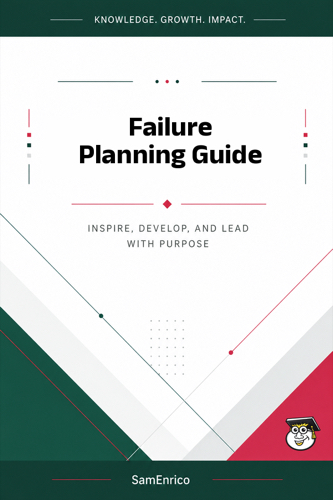
Failure Planning Guide eBook
Plan for setbacks and how to recover.
by Brent Dewitt
Plan for setbacks and how to recover.
Formats
Free sample
Chapter 1: The Expectation Gap--–- The fire alarm shrieked at 2:17 AM. Not the soft chirp of a low battery, but the full-throated scream of a real emergency. I stood in my pajamas on a cold sidewalk, watching water pour from the third-floor windows of my apartment building. A sprinkler head had frozen and burst, flooding not just my unit but the two floors below mine. Every book I owned.
Every photo album. Every notebook from ten years of writing. All of it floating in brown, fire-suppressant sludge.The strange thing was not the loss. The strange thing was what I felt as I stood there: not devastation, not grief, but a weird, buzzing confusion. Because I had planned for this.
I had renter's insurance. I had backed up my digital files. I had done everything right. And yet here I was, watching my life float away.The pain didn't come from the water damage. It came twenty minutes later, when my neighbor asked, "Did you lose anything important?" And I opened my mouth to say "no, it's all backed up" but instead heard myself say, "I lost everything."That gap—between what I expected to feel (calm, prepared, in control) and what I actually felt (exposed, foolish, humiliated)—was the real disaster.
The water ruined my belongings. The expectation gap nearly ruined my ability to think clearly for the next three weeks.This chapter is about that gap. Because the pain of failure rarely comes from the loss itself. It comes from the space between what you thought would happen and what actually happened. And if you can learn to see that gap coming—to anticipate it, to shrink it, to plan for it—you will discover something counterintuitive: planning for failure does not create failure.
It inoculates you against the shock that turns manageable setbacks into career-ending catastrophes.The Neuroscience of Surprise Let me tell you about your brain on bad news. When something unexpected happens—especially something unwanted—a small, almond-shaped region called the amygdala activates. This is your threat detection system, honed by millions of years of evolution to keep you alive. The amygdala does not care about your long-term goals, your reputation, or your financial well-being. It cares about one thing: survival.
So when it detects a threat, it hijacks your entire nervous system.Cortisol and adrenaline surge. Your heart rate spikes. Blood flow redirects from your prefrontal cortex (the rational, planning part of your brain) to your limbs and reflexes. In this state, you are physiologically incapable of making good long-term decisions. You are not thinking clearly.
You are not being rational. You are a chemically flooded organism responding to a perceived existential threat.Here is what most people get wrong about this response: they think it is triggered by the loss itself. The money. The relationship. The failed project.
But the research tells a different story. The amygdala does not activate in proportion to the magnitude of the loss. It activates in proportion to the unexpectedness of the loss.Consider two scenarios. In the first, you invest $10,000 in a venture you know has a 70% chance of failing. It fails.
You lose the money. You feel disappointed, maybe frustrated, but not shattered. In the second, you invest $1,000 in what you believed was a sure thing. It fails. You lose a tenth as much money, but you feel twice as devastated.
Why? Because the second loss was unexpected. The gap between your expectation (certain success) and reality (failure) was enormous, even though the actual loss was smaller.This is the expectation gap. And it is the hidden engine of most failure-related suffering.The Failure Forecast: A Monthly Audit of Your Assumptions If the expectation gap is the problem, then the solution is simple to state but hard to execute: shrink the gap before it happens. Make your implicit assumptions explicit.
Challenge your own certainty before reality does it for you.This is the purpose of the Failure Forecast.The Failure Forecast is a thirty-minute exercise you perform once a month. It requires nothing more than a notebook or a digital document and a willingness to ask yourself one uncomfortable question about every active project, goal, or commitment in your life: What if I am wrong?Here is how it works.First, list every active project or goal you are currently pursuing. Not your dreams or aspirations—the concrete things you are actually spending time, money, or emotional energy on right now. A work project with a deadline. A fitness goal.
A relationship you are trying to improve. A financial target. A creative endeavor. Write them all down. Aim for five to fifteen items.Second, for each item, write down your key assumptions.
These are the things you believe to be true that, if false, would derail your success. Be specific. "The client will pay on time" is an assumption. "My partner knows what I need without me saying it" is an assumption. "The economy will remain stable" is an assumption.
"My body will respond to this training plan the way it did when I was younger" is an assumption.Third, for each assumption, ask: What if this is wrong? Not "could it be wrong?" but "what if it is wrong?" This is not a rhetorical exercise. You are required to imagine the failure concretely. Write down what would happen. Write down how you would know.
Write down what you would do next.Fourth, identify the three most dangerous assumptions across all your projects. These are the assumptions that, if false, would cause the most damage. For each one, create a tripwire: a specific, observable condition that will tell you the assumption is failing before the failure becomes catastrophic. "If the client is more than ten days late on the first payment, I will call a meeting." "If I miss two workouts in a row, I will revise my training plan." "If my partner says 'I'm fine' more than three times in a week, I will initiate a check-in conversation."The Failure Forecast is not pessimism. It is not about expecting the worst or manifesting failure.
It is about reducing the shock of surprise by making the invisible visible. When you have already imagined the failure, it does not hit you like a thunderbolt. It arrives more like a familiar visitor—unwelcome, perhaps, but not shocking.The Planning Fallacy and Why You Keep Misestimating Everything There is a reason most people never ask "What if I'm wrong?" before starting something. It is not laziness or stupidity. It is a cognitive bias so powerful and so universal that psychologists have given it a name: the planning fallacy.The planning fallacy is the tendency to underestimate the time, cost, and risk of future actions while overestimating their benefits.
It is why construction projects run over budget, why software launches are delayed, why New Year's resolutions fail by February, and why you have a drawer full of unused gym memberships.Here is the particularly cruel twist: the planning fallacy is hardest to overcome precisely when you need to overcome it most. When you are excited about a new project, your brain releases dopamine. Dopamine feels great. It also makes you overconfident…
This is the end of the free sample. Get the eBook to keep going. Buy now
About this book
Details
- Author
- Brent Dewitt
- Publisher
- SamEnrico
- Language
- English
- Genre
- Non-Fiction, Self-Help, Failure Planning
- Released
- 2026-06-08
- Pages (approx.)
- 135
- Available as
- eBook, Audiobook

Read better in the ZLOADR app
Your eBooks on your phone or tablet. Sign in with your SamEnrico account and start reading.
More by Brent Dewitt
 Corporate Skills Nonprofits Actually NeedBrent Dewitt$11.99
 Managing Interruptions with ADHDBrent Dewitt$11.99
 Energy Pipeline Dividends GuideBrent Dewitt$11.99
 Burnout And Compassion FatigueBrent Dewitt$11.99
 Upwork Niche Selection GuideBrent Dewitt$11.99
 Benzo Paradoxical ReactionBrent Dewitt$11.99
 Grief and Volunteering After Child LossBrent Dewitt$11.99
 Whispers from the Lost Library of AlexandriaBrent Dewitt$11.99
 Larry & Lenny: The Unlikely Love Story Behind Seinfeld's GeniusBrent Dewitt$11.99
 How to Produce Wireless Networking EquipmentBrent Dewitt$11.99
 How to Produce Medical Alarm SystemsBrent Dewitt$11.99
 A Collector's Handbook to the Oldsmobile ToronadoBrent Dewitt$11.99