
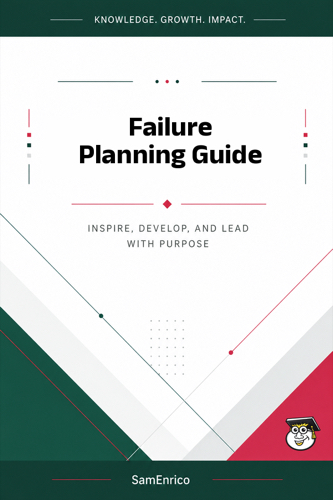
Failure Planning Guide Audiobook
Plan for setbacks and how to recover.
by Brent Dewitt
Plan for setbacks and how to recover.
Formats
Free sample
Chapter 1: The Expectation Gap--–- The fire alarm shrieked at 2:17 AM. Not the soft chirp of a low battery, but the full-throated scream of a real emergency. I stood in my pajamas on a cold sidewalk, watching water pour from the third-floor windows of my apartment building. A sprinkler head had frozen and burst, flooding not just my unit but the two floors below mine. Every book I owned.
Every photo album. Every notebook from ten years of writing. All of it floating in brown, fire-suppressant sludge.The strange thing was not the loss. The strange thing was what I felt as I stood there: not devastation, not grief, but a weird, buzzing confusion. Because I had planned for this.
I had renter's insurance. I had backed up my digital files. I had done everything right. And yet here I was, watching my life float away.The pain didn't come from the water damage. It came twenty minutes later, when my neighbor asked, "Did you lose anything important?" And I opened my mouth to say "no, it's all backed up" but instead heard myself say, "I lost everything."That gap—between what I expected to feel (calm, prepared, in control) and what I actually felt (exposed, foolish, humiliated)—was the real disaster.
The water ruined my belongings. The expectation gap nearly ruined my ability to think clearly for the next three weeks.This chapter is about that gap. Because the pain of failure rarely comes from the loss itself. It comes from the space between what you thought would happen and what actually happened. And if you can learn to see that gap coming—to anticipate it, to shrink it, to plan for it—you will discover something counterintuitive: planning for failure does not create failure.
It inoculates you against the shock that turns manageable setbacks into career-ending catastrophes.The Neuroscience of Surprise Let me tell you about your brain on bad news. When something unexpected happens—especially something unwanted—a small, almond-shaped region called the amygdala activates. This is your threat detection system, honed by millions of years of evolution to keep you alive. The amygdala does not care about your long-term goals, your reputation, or your financial well-being. It cares about one thing: survival.
So when it detects a threat, it hijacks your entire nervous system.Cortisol and adrenaline surge. Your heart rate spikes. Blood flow redirects from your…
This is the end of the free sample. Get the Audiobook to keep going. Buy now
About this book
Details
- Author
- Brent Dewitt
- Publisher
- SamEnrico
- Language
- English
- Genre
- Non-Fiction, Self-Help, Failure Planning
- Released
- 2026-06-08
- Pages (approx.)
- 135
- Available as
- eBook, Audiobook

Listen in the VoxFlicks app
Audiobooks and audio dramas wherever you go. Sign in with your SamEnrico account and press play.
More by Brent Dewitt
 Corporate Skills Nonprofits Actually NeedBrent Dewitt$11.99
 Managing Interruptions with ADHDBrent Dewitt$11.99
 Energy Pipeline Dividends GuideBrent Dewitt$11.99
 Burnout And Compassion FatigueBrent Dewitt$11.99
 Upwork Niche Selection GuideBrent Dewitt$11.99
 Benzo Paradoxical ReactionBrent Dewitt$11.99
 Grief and Volunteering After Child LossBrent Dewitt$11.99
 Whispers from the Lost Library of AlexandriaBrent Dewitt$11.99
 Larry & Lenny: The Unlikely Love Story Behind Seinfeld's GeniusBrent Dewitt$11.99
 How to Produce Wireless Networking EquipmentBrent Dewitt$11.99
 How to Produce Medical Alarm SystemsBrent Dewitt$11.99
 A Collector's Handbook to the Oldsmobile ToronadoBrent Dewitt$11.99