
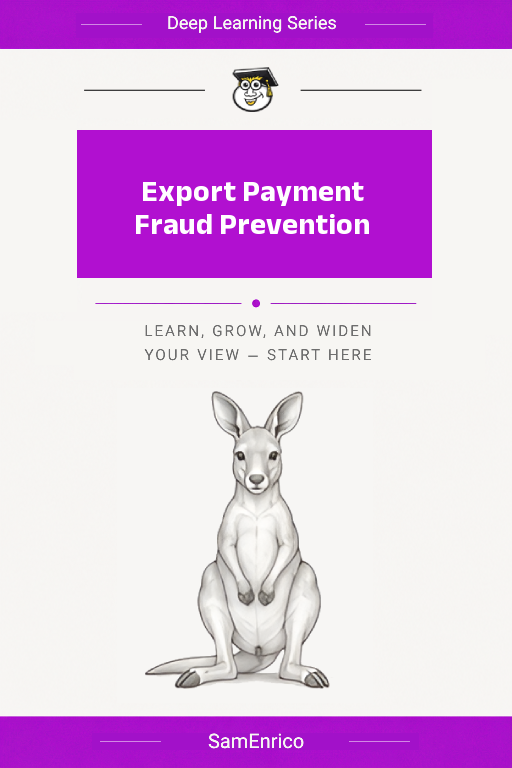
Non-FictionBusiness BriefFintech Guide
Export Payment Fraud Prevention eBook
Avoid payment fraud targeting African exporters. I
Avoid payment fraud targeting African exporters. Invoice fraud, business email compromise, and verification.
Formats
Free sample
Chapter 1: The Open Account Illusion--–- The shipment had left Mombasa three weeks ago. Forty containers of specialty Kenyan coffee, bound for a buyer in Rotterdam who had seemed legitimate in every way—website, corporate registration, trade references, even a video call where a man in a suit walked through a warehouse. Julius Okonkwo, the founder of a mid-sized export company, had done everything right. Or so he believed.The email arrived on a Thursday afternoon. Not from his buyer, but from his bank.
The payment of 847,000thatwassupposedtohavebeencreditedtohisaccounthadbeenreversed.No,thatwasn′tquiteright.Thebankrepresentativestruggledtoexplainit.Thepaymenthadneveractuallyexisted.Thebuyer′sbankhadnorecordofanytransfer.Theshippingdocuments—thebillsoflading,thecommercialinvoices,thecertificatesoforigin—hadallbeenusedtosecurefinancingfromadifferentbankinadifferentcountry.Julius′scoffeewasreal.Hisbuyerwasnot.Andsomewhereinthegapbetweenshippingandpayment,847,000 that was supposed to have been credited to his account had been reversed. No, that wasn't quite right. The bank representative struggled to explain it. The payment had never actually existed. The buyer's bank had no record of any transfer.
The shipping documents—the bills of lading, the commercial invoices, the certificates of origin—had all been used to secure financing from a different bank in a different country. Julius's coffee was real. His buyer was not. And somewhere in the gap between shipping and payment, 847,000thatwassupposedtohavebeencreditedtohisaccounthadbeenreversed.No,thatwasn′tquiteright.Thebankrepresentativestruggledtoexplainit.Thepaymenthadneveractuallyexisted.Thebuyer′sbankhadnorecordofanytransfer.Theshippingdocuments—thebillsoflading,thecommercialinvoices,thecertificatesoforigin—hadallbeenusedtosecurefinancingfromadifferentbankinadifferentcountry.Julius′scoffeewasreal.Hisbuyerwasnot.Andsomewhereinthegapbetweenshippingandpayment,847,000 had vanished into the plumbing of international trade.This is not a cautionary tale from a distant corner of the internet. It is a composite of dozens of real cases documented by the United Nations Economic Commission for Africa, the Financial Action Task Force, and the national fraud units of Kenya, Nigeria, and South Africa.
Julius is fictional, but his story happens every week to real African exporters—small, medium, and large—who fall victim to what is now the largest and fastest-growing category of trade fraud in the developing world.The problem is not that Julius was careless or naive. The problem is the system itself.The 85% Problem Open Account Trade—or OAT, as it is known in banking circles—now governs approximately 85% of all international commerce. To understand why this matters for fraud prevention, one must first understand what OAT replaced and why that replacement created an enormous vulnerability.Before the 1990s, the dominant payment mechanism for cross-border trade was the Letter of Credit, or LC. Under an LC, the buyer's bank issues a guarantee to the seller's bank: present the required documents proving shipment, and the bank will pay. The LC creates a chain of independent verification.
The buyer's bank checks the documents against the terms of the credit. The seller's bank checks the authenticity of the LC. Third-party inspectors may be involved. The process is slow, expensive, and bureaucratic—but it contains multiple points where fraud can be detected before payment is released.Open Account Trade flips this model entirely. Under OAT, the seller ships the goods and extends credit to the buyer for a period of 30, 60, or 90 days.
The buyer receives the goods, inspects them (or not), and then pays. There is no bank in the middle verifying documents. There is no independent scrutiny of the transaction's legitimacy before the goods change hands. The entire system runs on trust: the trust that the buyer is who they say they are, that they have the funds they claim to have, and that they will pay when they promise to pay.For large multinational corporations trading with each other across long-established relationships, OAT works efficiently. For African exporters—many of whom are small to medium enterprises trading with first-time or infrequent buyers—OAT is a fraud vector of catastrophic proportions.The shift to OAT was driven by cost and speed.
LCs can add 2-5% to the cost of a transaction and introduce delays of weeks. In competitive global markets, buyers demanded faster, cheaper terms. African suppliers, eager to win contracts against competitors from Asia and Latin America, agreed. And in doing so, they stepped into a game where the rules favor the fraudster.The Mis-Invoicing Mechanism To understand how fraudsters exploit OAT, one must understand trade mis-invoicing. This is the single most important concept in export payment fraud, and it will appear throughout this book as the foundational mechanism upon which almost all other frauds are built.Trade mis-invoicing is exactly what it sounds like: deliberately invoicing a shipment at a price that does not reflect the true value of the goods.
There are three primary forms:Over-invoicing means the exporter invoices the goods at a price higher than their actual value. If a container of coffee is worth 50,000butisinvoicedat50,000 but is invoiced at 50,000butisinvoicedat80,000, the extra 30,000isafabricatedvaluethatmustbemovedsomehow.Under−invoicingisthereverse:invoicing30,000 is a fabricated value that must be moved somehow. Under-invoicing is the reverse: invoicing 30,000isafabricatedvaluethatmustbemovedsomehow.Under−invoicingisthereverse:invoicing30,000 for $50,000 worth of goods, allowing the difference to be moved out of the country untracked. Phantom shipments are the most extreme form: invoicing for goods that do not exist at all, with no shipment ever taking place.Why does this matter for payment fraud? Because mis-invoicing is the engine that converts a fraudulent transaction into a seemingly legitimate one.
Consider the following scenario, which is drawn from actual case files:A fraudster establishes a shell company in a European jurisdiction with weak corporate transparency laws. They approach an African exporter—let us call her Fatima—with an offer to buy a large quantity of cashews. The price offered is attractive but not implausible. Fatima performs basic due diligence: she checks the company's website, speaks to a representative by phone, and even receives a copy of the company's certificate of incorporation. Everything appears normal.What Fatima does not know is that the shell company is controlled by the same person who will later claim to be the buyer's bank representative, the freight forwarder, and the quality inspector.
The fraudster is playing multiple roles in a theater designed to extract either the goods or the payment—or both.The transaction proceeds. Fatima ships the cashews under open account terms. The fraudster takes possession of the goods, sells them quickly at a discount, and disappears. When Fatima's bank inquires about payment, there is no company to contact, no assets to seize, and no recourse.But that is only the simplest version. More sophisticated fraudsters use mis-invoicing to extract value without ever taking physical possession of goods.
They may over-invoice a real shipment, then submit the inflated invoice to a different bank to secure financing that exceeds the goods' true value. Or they may under-invoice, allowing them to resell the goods at their true value while keeping the difference untaxed and untraced.The scale of this problem is staggering. The United Nations Conference on Trade and Development estimates that trade mis-invoicing drains between 50billionand50 billion and 50billionand80 billion annually from developing economies. For the African continent specifically, the African Development Bank has documented that illicit financial flows—of which trade mis-invoicing is the largest component—often exceed the total annual foreign direct investment received by many African countries. In other words, Africa loses more money to trade fraud than it gains in new investment.The African Exporter's Unique Vulnerability African exporters face a set of circumstances that make them disproportionately vulnerable to OAT-based fraud.
These circumstances are not accidental; they are structural features of the global trading system that fraudsters have learned to exploit.First…
This is the end of the free sample. Get the eBook to keep going. Buy now
About this book
Details
- Author
- Nance Jefferson
- Publisher
- SamEnrico
- Language
- English
- Genre
- Non-Fiction, Business Brief, Fintech Guide
- Released
- 2026-06-01
- Pages (approx.)
- 157
- Available as
- eBook, Audiobook

Read better in the ZLOADR app
Your eBooks on your phone or tablet. Sign in with your SamEnrico account and start reading.
More by Nance Jefferson
 Disability Financial CopingNance Jefferson$11.99
 Carson Daly TRL to TodayNance Jefferson$11.99
 Weekend Email Anger Management WorkbookNance Jefferson$11.99
 Nobel Laureates in Developmental BiologyNance Jefferson$11.99
 The Friend Betrayal ResentmentNance Jefferson$11.99
 The Oxford Plague Chronicles: How Medieval Scholars Defied the Black DeathNance Jefferson$11.99
 Graduate AnalystNance Jefferson$11.99
 Understanding Radial Defect Robin SequenceNance Jefferson$17.99
 Airtable PLG GuideNance Jefferson$12.99
 How to Start a Organo-sulphur Compounds Business (Beginners Guide)Nance Jefferson$11.99
You may also like
 Hong Kong Handover 1997Dunn Johnnie$11.99
 Zumba For Postnatal Recovery CourseNeal Christian$11.99
 Zumba for BeginnersLadner Nikia$11.99
 YouTube Comment Mining GuideHumes Pandora$12.99
 Worry Box MeditationCarlin Rudy$11.99
 Workplace Stress MeditationNguyen Lynn$11.99
 Workplace Stress and Sleep RepairHawley Ivory$11.99
 Workplace Perfectionism CureDelaney Jeffry$11.99
 Workplace Injustice Anger GuideWallen Isabelle$11.99
 Work Addiction and Burnout LinkGreenwood Ester$11.99
 Women in Yoga and WellnessBeattie Galina$11.99
 Women in Stand Up ComedyChun Evangeline$11.99