
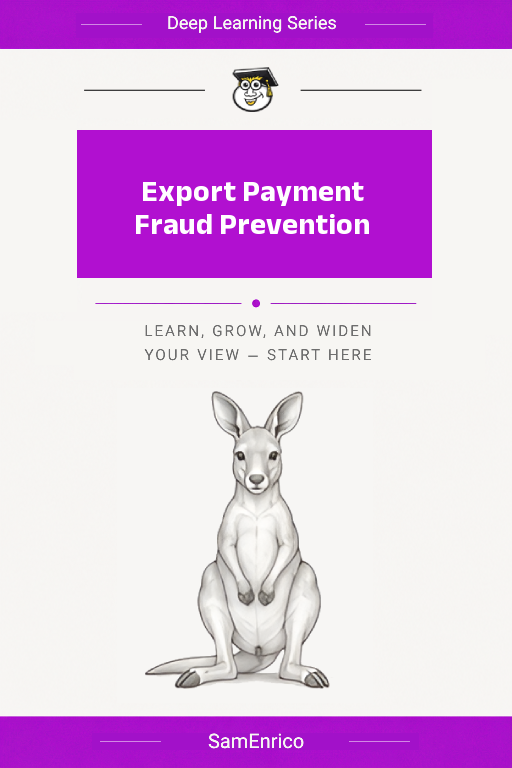
Non-FictionBusiness BriefFintech Guide
Export Payment Fraud Prevention Audiobook
Avoid payment fraud targeting African exporters. I
Avoid payment fraud targeting African exporters. Invoice fraud, business email compromise, and verification.
Formats
Free sample
Chapter 1: The Open Account Illusion--–- The shipment had left Mombasa three weeks ago. Forty containers of specialty Kenyan coffee, bound for a buyer in Rotterdam who had seemed legitimate in every way—website, corporate registration, trade references, even a video call where a man in a suit walked through a warehouse. Julius Okonkwo, the founder of a mid-sized export company, had done everything right. Or so he believed.The email arrived on a Thursday afternoon. Not from his buyer, but from his bank.
The payment of 847,000thatwassupposedtohavebeencreditedtohisaccounthadbeenreversed.No,thatwasn′tquiteright.Thebankrepresentativestruggledtoexplainit.Thepaymenthadneveractuallyexisted.Thebuyer′sbankhadnorecordofanytransfer.Theshippingdocuments—thebillsoflading,thecommercialinvoices,thecertificatesoforigin—hadallbeenusedtosecurefinancingfromadifferentbankinadifferentcountry.Julius′scoffeewasreal.Hisbuyerwasnot.Andsomewhereinthegapbetweenshippingandpayment,847,000 that was supposed to have been credited to his account had been reversed. No, that wasn't quite right. The bank representative struggled to explain it. The payment had never actually existed. The buyer's bank had no record of any transfer.
The shipping documents—the bills of lading, the commercial invoices, the certificates of origin—had all been used to secure financing from a different bank in a different country. Julius's coffee was real. His buyer was not. And somewhere in the gap between shipping and payment, 847,000thatwassupposedtohavebeencreditedtohisaccounthadbeenreversed.No,thatwasn′tquiteright.Thebankrepresentativestruggledtoexplainit.Thepaymenthadneveractuallyexisted.Thebuyer′sbankhadnorecordofanytransfer.Theshippingdocuments—thebillsoflading,thecommercialinvoices,thecertificatesoforigin—hadallbeenusedtosecurefinancingfromadifferentbankinadifferentcountry.Julius′scoffeewasreal.Hisbuyerwasnot.Andsomewhereinthegapbetweenshippingandpayment,847,000 had vanished into the plumbing of international trade.This is not a cautionary tale from a distant corner of the internet. It is a composite of dozens of real cases documented by the United Nations Economic Commission for Africa, the Financial Action Task Force, and the national fraud units of Kenya, Nigeria, and South Africa.
Julius is fictional, but his story happens every week to real African exporters—small, medium, and large—who fall victim to what is now the largest and fastest-growing category of trade fraud in the developing world.The problem is not that Julius was careless or naive. The problem is the system itself.The 85% Problem Open Account Trade—or OAT, as it is known in banking circles—now governs approximately 85% of all international commerce. To understand why this matters for fraud prevention, one must first understand what OAT replaced and why that replacement created an enormous vulnerability.Before the 1990s, the dominant payment mechanism for cross-border trade was the Letter of Credit, or LC. Under an LC, the buyer's bank issues a guarantee to the seller's bank: present the required documents proving shipment, and the bank will pay. The LC creates a chain of…
This is the end of the free sample. Get the Audiobook to keep going. Buy now
About this book
Details
- Author
- Nance Jefferson
- Publisher
- SamEnrico
- Language
- English
- Genre
- Non-Fiction, Business Brief, Fintech Guide
- Released
- 2026-06-01
- Pages (approx.)
- 157
- Available as
- eBook, Audiobook

Listen in the VoxFlicks app
Audiobooks and audio dramas wherever you go. Sign in with your SamEnrico account and press play.
More by Nance Jefferson
 Disability Financial CopingNance Jefferson$11.99
 Carson Daly TRL to TodayNance Jefferson$11.99
 Weekend Email Anger Management WorkbookNance Jefferson$11.99
 Nobel Laureates in Developmental BiologyNance Jefferson$11.99
 The Friend Betrayal ResentmentNance Jefferson$11.99
 The Oxford Plague Chronicles: How Medieval Scholars Defied the Black DeathNance Jefferson$11.99
 Graduate AnalystNance Jefferson$11.99
 Understanding Radial Defect Robin SequenceNance Jefferson$17.99
 Airtable PLG GuideNance Jefferson$12.99
 How to Start a Organo-sulphur Compounds Business (Beginners Guide)Nance Jefferson$11.99
You may also like
 Hong Kong Handover 1997Dunn Johnnie$11.99
 Zumba For Postnatal Recovery CourseNeal Christian$11.99
 Zumba for BeginnersLadner Nikia$11.99
 YouTube Comment Mining GuideHumes Pandora$12.99
 Worry Box MeditationCarlin Rudy$11.99
 Workplace Stress MeditationNguyen Lynn$11.99
 Workplace Stress and Sleep RepairHawley Ivory$11.99
 Workplace Perfectionism CureDelaney Jeffry$11.99
 Workplace Injustice Anger GuideWallen Isabelle$11.99
 Work Addiction and Burnout LinkGreenwood Ester$11.99
 Women in Yoga and WellnessBeattie Galina$11.99
 Women in Stand Up ComedyChun Evangeline$11.99