
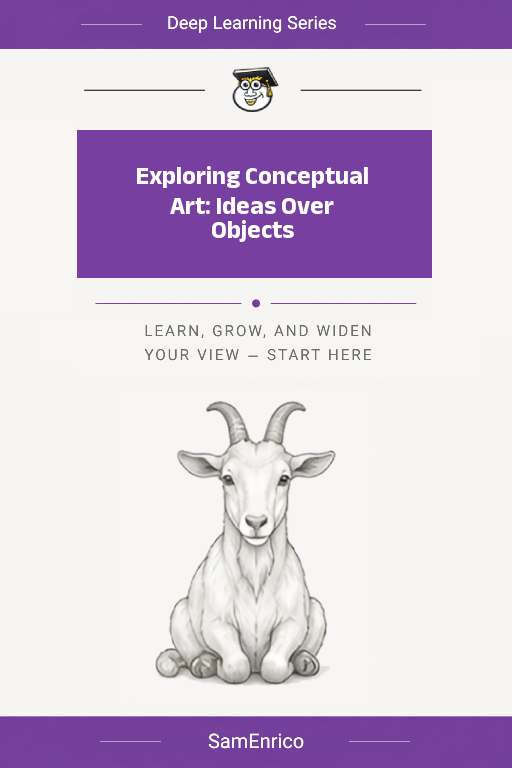
Non-FictionInformativeEducational
Exploring Conceptual Art: Ideas Over Objects eBook
This publication, published by SamEnrico, covers E
This publication, published by SamEnrico, covers Exploring Conceptual Art: Ideas Over Objects
Formats
Free sample
Chapter 1: The Urinal That Broke Art--–- In 1917, a porcelain urinal signed "R. Mutt" was submitted to an exhibition in New York. The judges rejected it. The artist, a Frenchman named Marcel Duchamp, resigned from the board in protest. And then—nothing happened for fifty years.
The urinal was lost, probably thrown out as trash. No one bought it. No one collected it. No one called it a masterpiece. It was, for all practical purposes, a failed provocation.But today, that urinal—or rather, its replicas, since the original is gone—hangs in major museums around the world.
A 1964 replica sold for over $1.7 million in 1999. Art historians call Fountain the most influential artwork of the 20th century. And here is the strangest part: Duchamp did not make it. He bought it. He did not sculpt it, carve it, or paint it.
He selected it. He signed a false name. He submitted it. And in doing so, he asked a question that would take fifty years for the art world to fully hear: What if the idea is the art?This is the question that broke art. And this book is about everything that came after.The Urinal as Origin Story Every movement needs an origin story.
For conceptual art, that story is Fountain. But origin stories are dangerous. They make the messy, complicated reality of history feel clean and inevitable. Duchamp did not wake up in 1917 and invent conceptual art. He was a painter first, a decent one, influenced by Cézanne and the Cubists.
He painted Nude Descending a Staircase, No. 2 in 1912, which caused a scandal at the Armory Show in New York because Americans thought it looked like "an explosion in a shingle factory." That painting was abstract. It was challenging. But it was still a painting. It still hung on a wall.
It still required skill to make.What happened between 1912 and 1917? Duchamp got bored. He said later that he had "lost interest in making art." Not in art itself—in making. In the physical act of applying paint to canvas. He wanted to get away from what he called "retinal art": art that is only about pleasing the eye.
He wanted art that served the mind.This is the first and most important distinction. Retinal art is about sensation. You look at a sunset, a beautiful face, a well-composed painting—your retina sends signals to your brain, and you feel pleasure. That pleasure is real. It is not shallow.
But Duchamp thought it was limited. He wanted art that irritated the brain, not just the eye. He wanted questions, not comfort.The readymade was his answer. A readymade is an ordinary, mass-produced object that the artist selects and designates as art. That is the entire operation.
No transformation. No craftsmanship. Just choice. Duchamp's first readymade was a bicycle wheel mounted on a stool, made in 1913. But Fountain was the one that stuck.
He bought the urinal from the J. L. Mott Iron Works company. He turned it on its side. He signed it "R.
Mutt" (a pun on the German word Armut, meaning poverty, and the Mott company's name). He tried to submit it to the Society of Independent Artists, which had famously declared that it would accept any work as long as the artist paid the fee. They made an exception for Fountain. They hid it behind a partition. Duchamp quit.The art world went back to business as usual.
But something had changed. Duchamp had demonstrated, in a single gesture, that the definition of art is not fixed. It is not a property of objects. It is a decision made by people. If a urinal can be art, then anything can be art.
And if anything can be art, then the traditional categories—painting, sculpture, drawing—are not laws of nature. They are conventions. And conventions can be broken.Why Duchamp Is Not a Conceptual Artist Here is where most books get it wrong. They call Duchamp the first conceptual artist. He was not.
He was the precursor to conceptual art, the person who made it possible. But he did not belong to the movement that emerged in the 1960s, and the difference matters.Duchamp was a provocateur. He enjoyed confusion. He made contradictory statements about his own work. He said he chose readymades with "a kind of visual indifference," but he also admitted that he liked some objects more than others.
He spent the last twenty years of his artistic life playing chess, which he called his "real" passion. He was not trying to build a system or found a school. He was trying to amuse himself and irritate everyone else.The conceptual artists of the 1960s—Sol Le Witt, Joseph Kosuth, Lawrence Weiner, and others—were different. They were serious. They wrote manifestos.
They built logical systems. They wanted to define conceptual art, not just perform it. Le Witt's 1967 essay "Paragraphs on Conceptual Art" is a clear, almost legalistic document. Kosuth's "Art After Philosophy" (1969) is a dense philosophical argument. These artists were not Duchampian pranksters.
They were intellectuals. They wanted to replace the art object with the art idea, and they wanted to explain exactly how that replacement worked.But they could not have done any of it without Duchamp. He broke the frame. He showed that the emperor had no clothes—that the art world's reverence for craft and skill was a social convention, not a universal truth. The conceptual artists took that insight and ran with it.
They built the cathedral. Duchamp just threw the first brick and walked away.The Readymade as Philosophical Machine To understand conceptual art, you have to understand what the readymade does. It is not just a joke. It is not just a provocation. It is a machine for producing questions.Here is how it works.
Stand in front of Fountain in a museum. You see a urinal. Your brain says: That is not art. That is a plumbing fixture. But the museum says: This is art.
We put it here. We labelled it. You paid admission to see it. Two competing claims, equally forceful, equally reasonable. Which one wins?This is not an easy question.
If you say the museum wins, then you are conceding that art is whatever institutions say it is. That is a comfortable answer—it lets you stop thinking. If you say your own perception wins, then you are claiming that art has some essential property that the urinal lacks. But what property? Beauty?
Fountain is not beautiful. Skill? No skill was involved. Expression? Duchamp was not expressing anything except boredom.
Uniqueness? The urinal was mass-produced.The readymade forces you into this trap. You cannot resolve it. You can only live inside the tension. And that, for Duchamp, was the point.
Art should not give you answers. It should give you better questions.This is why the readymade is the true ancestor of conceptual art. The conceptual artists took Duchamp's question—What if the idea is the art?—and turned it into a working method. Le Witt wrote instructions. Weiner made language sculptures.
Kosuth investigated the nature of meaning. They did not just ask the question. They tried to live inside it.The Other…
This is the end of the free sample. Get the eBook to keep going. Buy now
About this book
Details
- Author
- Turley Shirlene
- Publisher
- SamEnrico
- Language
- English
- Genre
- Non-Fiction, Informative, Educational
- Released
- 2026-06-02
- Pages (approx.)
- 136
- Available as
- eBook, Audiobook

Read better in the ZLOADR app
Your eBooks on your phone or tablet. Sign in with your SamEnrico account and start reading.
More by Turley Shirlene
 Menopause Diet CookbookTurley Shirlene$11.99
 Twitter Anxiety Comparison GuideTurley Shirlene$11.99
 The Personal Brand Photoshoot GuideTurley Shirlene$11.99
 Weekly Declutter ReviewTurley Shirlene$11.99
 Coming Out Later in LifeTurley Shirlene$11.99
 Meeting Minutes One PagerTurley Shirlene$11.99
 Scheduling Strategies for ADHDTurley Shirlene$11.99
 Failure Resilience HypnosisTurley Shirlene$11.99
 The Unseen Hand: How a 19th-Century Tea Merchant Built a Global EmpireTurley Shirlene$11.99
 The Forger's Gambit: Wolfgang Beltracchi and the Art World's Greatest HeistTurley Shirlene$11.99
 Mastering Salt Tax: Gabelle & LeviesTurley Shirlene$11.99
 How to Produce Play YardsTurley Shirlene$11.99
You may also like
 Hong Kong Handover 1997Dunn Johnnie$11.99
 Zumba For Postnatal Recovery CourseNeal Christian$11.99
 Zumba for BeginnersLadner Nikia$11.99
 YouTube Comment Mining GuideHumes Pandora$12.99
 Worry Box MeditationCarlin Rudy$11.99
 Workplace Stress MeditationNguyen Lynn$11.99
 Workplace Stress and Sleep RepairHawley Ivory$11.99
 Workplace Perfectionism CureDelaney Jeffry$11.99
 Workplace Injustice Anger GuideWallen Isabelle$11.99
 Work Addiction and Burnout LinkGreenwood Ester$11.99
 Women in Yoga and WellnessBeattie Galina$11.99
 Women in Stand Up ComedyChun Evangeline$11.99