
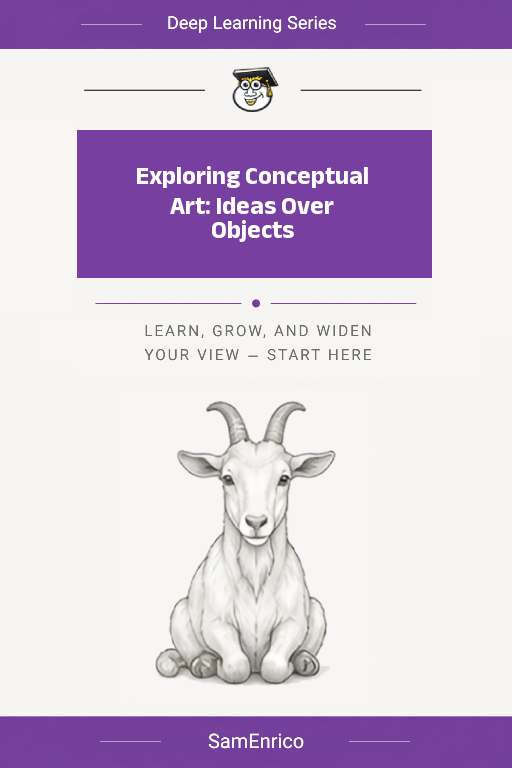
Non-FictionInformativeEducational
Exploring Conceptual Art: Ideas Over Objects Audiobook
This publication, published by SamEnrico, covers E
This publication, published by SamEnrico, covers Exploring Conceptual Art: Ideas Over Objects
Formats
Free sample
Chapter 1: The Urinal That Broke Art--–- In 1917, a porcelain urinal signed "R. Mutt" was submitted to an exhibition in New York. The judges rejected it. The artist, a Frenchman named Marcel Duchamp, resigned from the board in protest. And then—nothing happened for fifty years.
The urinal was lost, probably thrown out as trash. No one bought it. No one collected it. No one called it a masterpiece. It was, for all practical purposes, a failed provocation.But today, that urinal—or rather, its replicas, since the original is gone—hangs in major museums around the world.
A 1964 replica sold for over $1.7 million in 1999. Art historians call Fountain the most influential artwork of the 20th century. And here is the strangest part: Duchamp did not make it. He bought it. He did not sculpt it, carve it, or paint it.
He selected it. He signed a false name. He submitted it. And in doing so, he asked a question that would take fifty years for the art world to fully hear: What if the idea is the art?This is the question that broke art. And this book is about everything that came after.The Urinal as Origin Story Every movement needs an origin story.
For conceptual art, that story is Fountain. But origin stories are dangerous. They make the messy, complicated reality of history feel clean and inevitable. Duchamp did not wake up in 1917 and invent conceptual art. He was a painter first, a decent one, influenced by Cézanne and the Cubists.
He painted Nude Descending a Staircase, No. 2 in 1912, which caused a scandal at the Armory Show in New York because Americans thought it looked like "an explosion in a shingle factory." That painting was abstract. It was challenging. But it was still a painting. It still hung on a wall.
It still required skill to make.What happened between 1912 and 1917? Duchamp got bored. He said later that he had "lost interest in making art." Not in art itself—in making. In the physical act of applying paint to canvas. He wanted to get away from what he called "retinal art": art that is only about pleasing the eye.
He wanted art that served the mind.This is the first and most important distinction. Retinal art is about sensation. You look at a sunset, a beautiful face, a well-composed painting—your retina sends signals to your brain, and…
This is the end of the free sample. Get the Audiobook to keep going. Buy now
About this book
Details
- Author
- Turley Shirlene
- Publisher
- SamEnrico
- Language
- English
- Genre
- Non-Fiction, Informative, Educational
- Released
- 2026-06-02
- Pages (approx.)
- 136
- Available as
- eBook, Audiobook

Listen in the VoxFlicks app
Audiobooks and audio dramas wherever you go. Sign in with your SamEnrico account and press play.
More by Turley Shirlene
 Menopause Diet CookbookTurley Shirlene$11.99
 Twitter Anxiety Comparison GuideTurley Shirlene$11.99
 The Personal Brand Photoshoot GuideTurley Shirlene$11.99
 Weekly Declutter ReviewTurley Shirlene$11.99
 Coming Out Later in LifeTurley Shirlene$11.99
 Meeting Minutes One PagerTurley Shirlene$11.99
 Scheduling Strategies for ADHDTurley Shirlene$11.99
 Failure Resilience HypnosisTurley Shirlene$11.99
 The Unseen Hand: How a 19th-Century Tea Merchant Built a Global EmpireTurley Shirlene$11.99
 The Forger's Gambit: Wolfgang Beltracchi and the Art World's Greatest HeistTurley Shirlene$11.99
 Mastering Salt Tax: Gabelle & LeviesTurley Shirlene$11.99
 How to Produce Play YardsTurley Shirlene$11.99
You may also like
 Hong Kong Handover 1997Dunn Johnnie$11.99
 Zumba For Postnatal Recovery CourseNeal Christian$11.99
 Zumba for BeginnersLadner Nikia$11.99
 YouTube Comment Mining GuideHumes Pandora$12.99
 Worry Box MeditationCarlin Rudy$11.99
 Workplace Stress MeditationNguyen Lynn$11.99
 Workplace Stress and Sleep RepairHawley Ivory$11.99
 Workplace Perfectionism CureDelaney Jeffry$11.99
 Workplace Injustice Anger GuideWallen Isabelle$11.99
 Work Addiction and Burnout LinkGreenwood Ester$11.99
 Women in Yoga and WellnessBeattie Galina$11.99
 Women in Stand Up ComedyChun Evangeline$11.99