
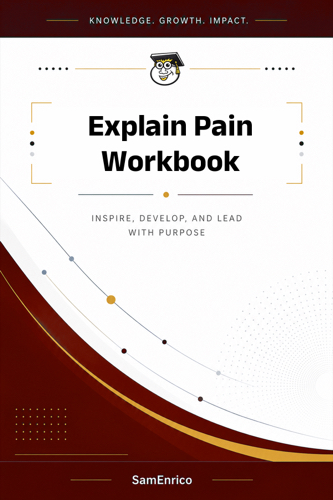
Non-FictionHealth & WellnessWorkbook
Explain Pain Workbook eBook
Complete exercises to internalize pain neuroscienc
Complete exercises to internalize pain neuroscience concepts.
Formats
Free sample
Chapter 1: The Protection Paradox...--–- Emma had spent three years believing her lower back was broken. Three years of MRI reports showing “mild disc degeneration”—a finding so common in pain-free people that radiologists call it the “gray hair of the spine.” Three years of avoiding bending, lifting, twisting, and the simple joy of picking up her nephew. Three years of waking up each morning and performing the same terrified inventory: Does it still hurt? Yes. Then I am still broken.–- Emma is not real.
But her story is lived by millions.–- If you are reading this workbook, you likely share a version of Emma’s belief. Somewhere along the way—perhaps from a doctor, a scan, a well-meaning family member, or your own terrified logic—you learned that pain equals tissue damage. That a hurting body part is a damaged body part. That until the “injury” heals, you must protect, brace, avoid, and fear.–- That belief is the single greatest obstacle to recovery from chronic pain.–- This chapter will dismantle that belief. Not with positive thinking or spiritual platitudes, but with neuroscience, clinical evidence, and a series of exercises that will fundamentally change how you understand every sensation in your body.
By the end of this chapter, you will no longer ask “What is broken?” You will ask “Why is my brain protecting me right now?” That shift—from tissue to brain, from damage to protection—is the foundation of everything that follows.The Most Expensive Mistake in Medicine–- Let us begin with a paradox so counterintuitive that most people reject it the first time they hear it: You can have severe tissue damage without pain, and you can have severe pain without any tissue damage.–- Consider the battlefield. Studies of soldiers wounded in combat consistently show that up to 65% of those with major limb injuries—open fractures, penetrating wounds, severed muscles—report little to no pain at the time of injury. Not because they are “tough.” Because their brains, in the context of a firefight where survival requires running and fighting, decide that pain would be a liability. Pain is expensive. It demands attention, rest, and protection.
In a life-or-death scenario, the brain consciously overrides the pain signal.–- Now consider the opposite. Place a tourniquet on your upper arm and pump it up. Within minutes, you will experience escalating pain—burning, throbbing, eventually unbearable—despite the fact that no tissue is being damaged. The pain is real. But the cause is not injury.
The cause is your brain interpreting the “danger signal” of restricted blood flow as a threat requiring immediate action.–- The most expensive mistake in modern medicine—costing billions in unnecessary surgeries, procedures, and disability payments—is the assumption that pain intensity reflects tissue damage. It does not. Pain intensity reflects the brain’s estimation of threat, which is influenced by damage, yes, but also by emotion, memory, context, stress, sleep, nutrition, past trauma, and a hundred other factors we will explore throughout this workbook.The Security System Model: A Better Metaphor–– In previous pain education materials, the “fire alarm” metaphor has been widely used: pain is a fire alarm that can go off even when there is no fire. While useful, this metaphor is binary (the alarm is either on or off) and fails to capture the graded, fluctuating nature of chronic pain.–– This workbook introduces a more accurate metaphor: your body’s security system.–– Imagine your brain as the control panel for a sophisticated home security system. Wires run from every corner of your body—joints, muscles, skin, organs—back to this panel.
These wires carry data, not pain. They carry information about temperature, pressure, stretch, chemical balance, and inflammation. The security system analyzes all of this data and asks one question: Am I in danger?–– If the answer is YES, the system activates an output: pain.–– Notice what this means. Pain is not coming from your back, your knee, your shoulder, or your head. Pain is coming from your brain’s security panel.
The sensation in your lower back is the output. The cause is the brain’s evaluation.–– Now, consider how a security system works. It has a sensitivity dial. Turn the dial to LOW, and only major intrusions trigger the alarm—a smashed window, an open door. Turn the dial to HIGH, and the alarm triggers when a leaf touches the window, when a cat walks across the lawn, when the wind shakes the frame.–– Chronic pain is a security system with the sensitivity dial stuck on HIGH.
Your brain has learned, through repeated or intense experiences, that the body part in question is a source of danger. The wires are still sending the same data—normal movement, normal pressure, normal stretch. But the system now interprets that normal data as a threat.–– This is not “all in your head” in the dismissive sense. The pain is real. The security system is genuinely triggering.
But the cause is a hypersensitive alarm, not ongoing tissue destruction.The Master Hierarchy: Who Controls Whom?–– Before we go further, we must establish a critical piece of neuroscience that will guide every subsequent chapter. Many people with chronic pain develop a dualistic model of their nervous system: The brain decides IF pain happens, but the spinal cord decides HOW MUCH.–– This is incorrect.–– The hierarchy is clear: The brain modulates the spinal cord. The brain sends commands DOWN to the spinal cord to increase or decrease the volume of incoming signals. Your spinal cord does not have a rogue “volume knob.” It follows the brain’s instructions.–– Think of the spinal cord as a microphone. The brain is the sound engineer.
The microphone picks up signals from the body. But the engineer decides whether to amplify those signals (turn up the gain) or dampen them (turn down the volume). The engineer can also send signals back down to the microphone to change its sensitivity.–– This is called descending modulation. The brain has pathways—through the periaqueductal gray (PAG) and the rostral ventromedial medulla (RVM)—that directly control spinal cord excitability.–– Why does this matter? Because it means you are not a victim of your spinal cord.
Your brain—specifically, your prefrontal cortex, the seat of attention, belief, and cognitive control—is the CEO. And the CEO can learn to turn down the volume.–– The graphic on the following page (Master Hierarchy Diagram) shows this flow: Brain (CEO) → Descending Commands → Spinal Cord (Microphone) → Ascending Signals → Brain’s Evaluation → Pain Output.–– Keep this diagram in mind. We will return to it in every chapter.The Body Matrix: Why You Are a Simulation–– The security system metaphor explains what pain is. But to understand why your pain is unique to you, we need a deeper concept: the Body Matrix.–– Your brain does not have direct access to your body. It never sees your tissues, your organs, or your limbs.
All it receives are electrical signals traveling along nerves—signals that are indirect, noisy, and subject to interpretation.–– To make sense of this noise, your brain builds a simulation of your body. This simulation—the Body Matrix—integrates sensory data (touch, temperature, stretch), memory…
This is the end of the free sample. Get the eBook to keep going. Buy now
About this book
Details
- Author
- Gannon Herlinda
- Publisher
- SamEnrico
- Language
- English
- Genre
- Non-Fiction, Health & Wellness, Workbook
- Released
- 2026-06-08
- Pages (approx.)
- 142
- Available as
- eBook, Audiobook

Read better in the ZLOADR app
Your eBooks on your phone or tablet. Sign in with your SamEnrico account and start reading.
More by Gannon Herlinda
 Value Momentum Physical Shelf ScoreGannon Herlinda$11.99
 Anger And Child Substance UseGannon Herlinda$11.99
 Learning Time Blocking GuideGannon Herlinda$11.99
 The Lobbyist Who Broke the Internet: How a Billion-Dollar Campaign Reshaped Global TechGannon Herlinda$11.99
 The Architects of the Divine: Building the Temples of NubiaGannon Herlinda$11.99
 How to Become a Chest-painting And Sealing SupervisorGannon Herlinda$11.99
 Digital Wallet Technology GuideGannon Herlinda$12.99
 Government Employment ManualGannon Herlinda$12.99
 Understanding Hyperornithinemia, Hyperammonemia, Homocitrullinuria SyndromeGannon Herlinda$17.99
 Tenant Services RepresentativeGannon Herlinda$11.99
You may also like
 Hong Kong Handover 1997Dunn Johnnie$11.99
 Zumba For Postnatal Recovery CourseNeal Christian$11.99
 Zumba for BeginnersLadner Nikia$11.99
 YouTube Comment Mining GuideHumes Pandora$12.99
 Worry Box MeditationCarlin Rudy$11.99
 Workplace Stress MeditationNguyen Lynn$11.99
 Workplace Stress and Sleep RepairHawley Ivory$11.99
 Workplace Perfectionism CureDelaney Jeffry$11.99
 Workplace Injustice Anger GuideWallen Isabelle$11.99
 Work Addiction and Burnout LinkGreenwood Ester$11.99
 Women in Yoga and WellnessBeattie Galina$11.99
 Women in Stand Up ComedyChun Evangeline$11.99