
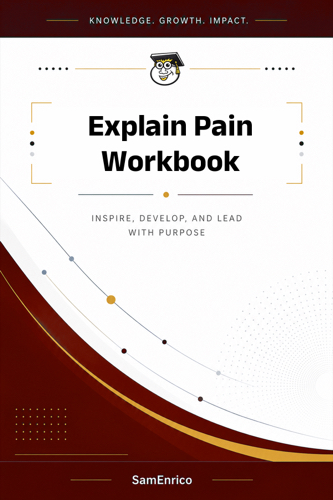
Non-FictionHealth & WellnessWorkbook
Explain Pain Workbook Audiobook
Complete exercises to internalize pain neuroscienc
Complete exercises to internalize pain neuroscience concepts.
Formats
Free sample
Chapter 1: The Protection Paradox...--–- Emma had spent three years believing her lower back was broken. Three years of MRI reports showing “mild disc degeneration”—a finding so common in pain-free people that radiologists call it the “gray hair of the spine.” Three years of avoiding bending, lifting, twisting, and the simple joy of picking up her nephew. Three years of waking up each morning and performing the same terrified inventory: Does it still hurt? Yes. Then I am still broken.–- Emma is not real.
But her story is lived by millions.–- If you are reading this workbook, you likely share a version of Emma’s belief. Somewhere along the way—perhaps from a doctor, a scan, a well-meaning family member, or your own terrified logic—you learned that pain equals tissue damage. That a hurting body part is a damaged body part. That until the “injury” heals, you must protect, brace, avoid, and fear.–- That belief is the single greatest obstacle to recovery from chronic pain.–- This chapter will dismantle that belief. Not with positive thinking or spiritual platitudes, but with neuroscience, clinical evidence, and a series of exercises that will fundamentally change how you understand every sensation in your body.
By the end of this chapter, you will no longer ask “What is broken?” You will ask “Why is my brain protecting me right now?” That shift—from tissue to brain, from damage to protection—is the foundation of everything that follows.The Most Expensive Mistake in Medicine–- Let us begin with a paradox so counterintuitive that most people reject it the first time they hear it: You can have severe tissue damage without pain, and you can have severe pain without any tissue damage.–- Consider the battlefield. Studies of soldiers wounded in combat consistently show that up to 65% of those with major limb injuries—open fractures, penetrating wounds, severed muscles—report little to no pain at the time of injury. Not because they are “tough.” Because their brains, in the context of a firefight where survival requires running and fighting, decide that pain would be a liability. Pain is expensive. It demands attention, rest, and protection.
In a life-or-death scenario, the brain consciously overrides the pain signal.–- Now consider the opposite. Place a tourniquet on your upper arm and pump it up. Within minutes, you will experience escalating pain—burning, throbbing…
This is the end of the free sample. Get the Audiobook to keep going. Buy now
About this book
Details
- Author
- Gannon Herlinda
- Publisher
- SamEnrico
- Language
- English
- Genre
- Non-Fiction, Health & Wellness, Workbook
- Released
- 2026-06-08
- Pages (approx.)
- 142
- Available as
- eBook, Audiobook

Listen in the VoxFlicks app
Audiobooks and audio dramas wherever you go. Sign in with your SamEnrico account and press play.
More by Gannon Herlinda
 Value Momentum Physical Shelf ScoreGannon Herlinda$11.99
 Anger And Child Substance UseGannon Herlinda$11.99
 Learning Time Blocking GuideGannon Herlinda$11.99
 The Lobbyist Who Broke the Internet: How a Billion-Dollar Campaign Reshaped Global TechGannon Herlinda$11.99
 The Architects of the Divine: Building the Temples of NubiaGannon Herlinda$11.99
 How to Become a Chest-painting And Sealing SupervisorGannon Herlinda$11.99
 Digital Wallet Technology GuideGannon Herlinda$12.99
 Government Employment ManualGannon Herlinda$12.99
 Understanding Hyperornithinemia, Hyperammonemia, Homocitrullinuria SyndromeGannon Herlinda$17.99
 Tenant Services RepresentativeGannon Herlinda$11.99
You may also like
 Hong Kong Handover 1997Dunn Johnnie$11.99
 Zumba For Postnatal Recovery CourseNeal Christian$11.99
 Zumba for BeginnersLadner Nikia$11.99
 YouTube Comment Mining GuideHumes Pandora$12.99
 Worry Box MeditationCarlin Rudy$11.99
 Workplace Stress MeditationNguyen Lynn$11.99
 Workplace Stress and Sleep RepairHawley Ivory$11.99
 Workplace Perfectionism CureDelaney Jeffry$11.99
 Workplace Injustice Anger GuideWallen Isabelle$11.99
 Work Addiction and Burnout LinkGreenwood Ester$11.99
 Women in Yoga and WellnessBeattie Galina$11.99
 Women in Stand Up ComedyChun Evangeline$11.99