
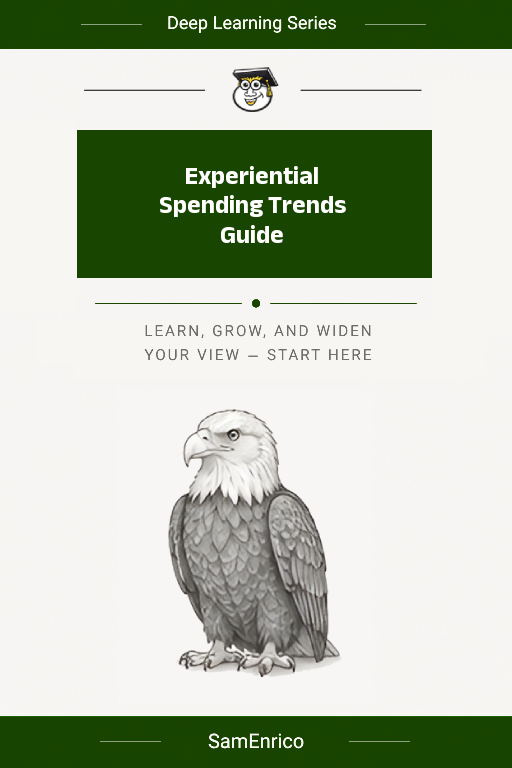
Non-FictionForecast & OutlookExperience Spending
Experiential Spending Trends Guide eBook
Analyze concerts, festivals, dining, and travel vs
by Stearns Yang
Analyze concerts, festivals, dining, and travel vs. goods spending post-pandemic shift.
Formats
Free sample
Chapter 1: The Great Unlearning...--In the spring of 2020, a thirty-four-year-old marketing executive named Sarah found herself standing in her living room, staring at a $4,000 road bike she had just purchased online. She had never ridden a road bike. She had never expressed interest in cycling. She lived in a cramped Manhattan apartment with nowhere to store a bicycle, let alone ride one safely. But she bought it anyway, along with a Peloton, three jigsaw puzzles, a bread-making kit, and enough loungewear to outfit a small army.Sarah was not irrational.
She was not suffering from a spending addiction or a midlife crisis. She was, like nearly every consumer in the developed world, trapped inside her home with no end in sight, a growing bank account due to cancelled travel and closed restaurants, and a primal, desperate need for something—anything—that resembled agency, progress, or joy.Two years later, Sarah sold the road bike for a fraction of its purchase price, gave away the jigsaw puzzles, and spent $3,500 on a six-day silent meditation retreat in the mountains of Colorado. She did not buy a single piece of clothing that year. She took her mother to Japan for two weeks. She attended four concerts.
She stopped caring about her credit card points and started caring about her memory bank.Sarah is not an outlier. She is the post-pandemic consumer. And her story is the story of the most profound reallocation of household spending since the introduction of the credit card.This book is about that reallocation. It is about why consumers like Sarah have stopped buying things and started buying experiences that change them. It is about what happened to the global economy when the hedonic treadmill broke, when status symbols lost their luster, and when YOLO stopped being a joke and became an economic thesis.
But before we can understand where we are going, we must first understand how we got here. We must revisit the ashes of 'stuff'—the great collapse and subsequent reawakening of the post-pandemic wallet.The Great Freeze: When the Economy Stopped but the Savings Rate Soared The numbers are now familiar, almost numbingly so. In April 2020, the United States personal savings rate hit 33.8 percent, according to the Bureau of Economic Analysis. To put that in perspective, the average savings rate in the decade before the pandemic hovered between 5 and 8 percent. The previous recorded high—during the 1973 oil crisis—was 17 percent.
The 2008 financial crisis peaked at 12 percent. The pandemic produced a number more than double any other modern economic shock.But the savings rate alone does not tell the full story. The story is not about how much money sat idle; it is about why it could not move. Consumer spending, which accounts for roughly 68 percent of U.S. GDP, collapsed by 12 percent in the second quarter of 2020—the largest quarterly drop on record.
Travel and tourism fell by 90 percent in some regions. Restaurant bookings vanished overnight. Live entertainment ceased to exist as an industry. For the first time in modern history, consumers had money but nowhere to spend it.Consider the math. In 2019, the average American household spent approximately 3,500annuallyondiningout,3,500 annually on dining out, 3,500annuallyondiningout,2,800 on travel, and $1,200 on live entertainment (concerts, theater, sporting events).
In 2020, those categories collectively fell by nearly 75 percent. That money did not disappear. It accumulated. It sat in checking accounts, money market funds, and—for the more intentional—vacation savings buckets labeled "someday."But here is the critical insight that most economic analyses missed in real time: the money did not simply wait. It transformed.
The pent-up demand of 2020 and early 2021 did not release in a simple spigot-turning moment when vaccines arrived. Instead, it underwent a psychological alchemy. Scarcity converted into priority. Forbidden fruit became essential nutrition. The things consumers could not do became the only things they wanted to do.The Barbell Recovery: Why Home Gyms Boomed While Dresses Died To understand what happened next, we need to abandon the intuitive model of economic recovery—the idea that when restrictions lift, spending returns to pre-pandemic patterns.
It did not. Instead, economists observed what came to be known as the "barbell recovery." At one end of the barbell, certain durable goods exploded. At the other end, apparel and accessories collapsed. The middle—casual dining, mid-tier retail, routine services—simply vanished.Let us examine the heavy end first. As lockdowns began in March 2020, consumers turned inward.
But they did not turn inward toward passive consumption. They turned toward active nesting. Peloton, which had been a niche luxury product for wealthy fitness enthusiasts, became a cultural phenomenon. The company's revenue grew by 100 percent year-over-year in 2020. Wait times for delivery stretched to three months.
The stock price increased 400 percent.Home improvement spending followed a similar trajectory. Lowe's and Home Depot reported same-store sales growth of 30 percent in the second quarter of 2020. Consumers were not just fixing leaky faucets; they were building home offices, converting basements into gyms, constructing backyard decks, and installing home theaters. The logic was simple and rational: if you are going to be trapped inside for an indeterminate period, you might as well make the cage comfortable.Office furniture sales soared. Not the sleek, minimalist desks of We Work, but functional, ergonomic, stay-in-this-chair-for-ten-hours office furniture.
Herman Miller, a brand previously unknown outside design circles, became a household name. The Aeron chair—$1,500 retail—sold out repeatedly. Consumers who had never considered their home setup beyond a laptop on the kitchen table were suddenly investing thousands of dollars in proper workstations.E-commerce, already growing at 15 percent annually, accelerated to 40 percent growth in six months. Amazon added 400,000 new employees in 2020 just to keep up with demand. Shopify, the platform that powers millions of small online stores, saw its valuation increase tenfold between March 2020 and November 2021.
The digital transaction became not just convenient but mandatory.Now consider the other end of the barbell. Apparel spending collapsed by 35 percent in 2020. Formal wear—suits, dresses, dress shoes—fell by nearly 80 percent. Why would anyone buy a suit when the only social contact was a Zoom screen visible only from the chest up? Accessories, handbags, jewelry, watches—all the traditional markers of status and taste—became irrelevant.
There was no one to impress. There was nowhere to go.Department stores, already struggling before the pandemic, entered a death spiral. J.C. Penney filed for bankruptcy. Neiman Marcus followed.
Century 21, a New York institution for seventy years, closed its doors forever. The indoor mall, which had been America's third place for generations, became a ghost town. Not because consumers hated shopping, but because shopping for status goods had lost its raison d'être.The barbell recovery revealed something profound about consumer psychology. When faced with existential uncertainty, humans do two things: they fortify their immediate environment (the home gym, the office chair, the deck), and they abandon performative consumption (the suit, the handbag, the watch). The middle ground—casual spending on routine pleasures—simply disappears.
It is not mourned. It is not missed. It is replaced by something else entirely.The Bridge Not the Destination: Rethinking E-Commerce's Role One of the most persistent misconceptions about the pandemic spending shift is that e-commerce "replaced" physical life. According to this narrative…
This is the end of the free sample. Get the eBook to keep going. Buy now
About this book
Details
- Author
- Stearns Yang
- Publisher
- SamEnrico
- Language
- English
- Genre
- Non-Fiction, Forecast & Outlook, Experience Spending
- Released
- 2026-05-29
- Pages (approx.)
- 157
- Available as
- eBook, Audiobook

Read better in the ZLOADR app
Your eBooks on your phone or tablet. Sign in with your SamEnrico account and start reading.
More by Stearns Yang
 Phobia Catastrophic ThinkingStearns Yang$11.99
 Habit Stacking Goal MethodStearns Yang$11.99
 Snapchat Spotlight ComparisonStearns Yang$11.99
 The Assertive ApologyStearns Yang$11.99
 The Alcohol Freedom Evening RoutineStearns Yang$11.99
 The Vanishing Act of the Blackbeard’s ShadowStearns Yang$11.99
 A Beginners Guide to Blokus (Volume 1)Stearns Yang$11.99
 Understanding Intercellular Cholesterol Esterification DiseaseStearns Yang$17.99
 Desk Escape Movement PlanStearns Yang$12.99
 CoronerStearns Yang$11.99
You may also like
 Hong Kong Handover 1997Dunn Johnnie$11.99
 Zumba For Postnatal Recovery CourseNeal Christian$11.99
 Zumba for BeginnersLadner Nikia$11.99
 YouTube Comment Mining GuideHumes Pandora$12.99
 Worry Box MeditationCarlin Rudy$11.99
 Workplace Stress MeditationNguyen Lynn$11.99
 Workplace Stress and Sleep RepairHawley Ivory$11.99
 Workplace Perfectionism CureDelaney Jeffry$11.99
 Workplace Injustice Anger GuideWallen Isabelle$11.99
 Work Addiction and Burnout LinkGreenwood Ester$11.99
 Women in Yoga and WellnessBeattie Galina$11.99
 Women in Stand Up ComedyChun Evangeline$11.99