
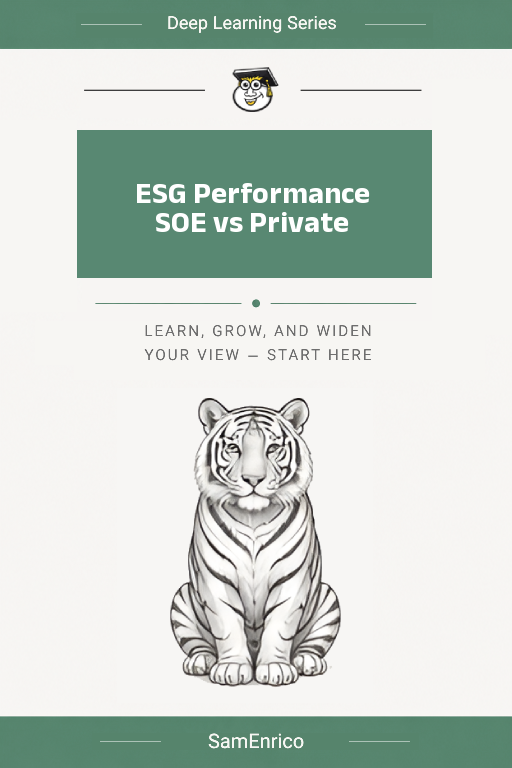
Non-FictionStrategic AtlasState Ownership
ESG Performance SOE vs Private eBook
Compare state-owned enterprise ESG scores against
Compare state-owned enterprise ESG scores against privately owned public firms in same sectors.
Formats
Free sample
Chapter 1: The Ownership Paradox--For more than four decades, a single assumption has governed the way investors, policymakers, and business leaders think about corporate ownership. That assumption—elegant in its simplicity and devastating in its consequences—holds that private enterprise is inherently superior to state-owned enterprise across virtually every dimension that matters. Private firms are more efficient, more innovative, more responsive to customers, and more disciplined with capital. State-owned firms, by contrast, are bloated, politically captured, stagnant, and indifferent to performance. This belief system has justified trillions of dollars in privatization deals, shaped the conditionalities of the International Monetary Fund, and influenced the governance reforms of scores of nations from Argentina to Zimbabwe.There is only one problem.
It is wrong.Not entirely wrong, to be fair. In many respects, private firms do outperform their state-owned counterparts. They are generally faster at bringing new products to market. They tend to have lower operating costs. Their capital allocation decisions are typically more disciplined by market forces.
But on the specific set of metrics that have come to define corporate responsibility in the twenty-first century—environmental performance, social impact, and governance transparency—a growing body of evidence suggests that state-owned enterprises often do better. Sometimes much better. And this finding, which runs directly counter to the dominant ideology of the past half-century, demands a fundamental rethinking of how we evaluate ownership structures, how we design ESG investment strategies, and how we understand the relationship between the state and the market.This chapter lays the groundwork for that rethinking. It traces the intellectual history of the anti-SOE consensus, introduces the empirical puzzle that this book aims to solve, and previews the argument that will unfold across the remaining eleven chapters. The thesis is straightforward: the relative ESG performance of state-owned versus private enterprises depends critically on the regulatory environment in which they operate, the nature of the ESG metric in question, and the political economy of the country in question.
In emerging markets with weak private-sector regulation, SOEs consistently outperform on environmental compliance and social stability. In mature markets with strong universal mandates, the gap narrows. And in voluntary, unregulated domains, private firms often lead—though whether that leadership is substantive or merely performative is a question we will address in Chapter 10.But before we can understand why SOEs sometimes beat private firms on ESG, we must first understand how the opposite assumption became so deeply entrenched in the first place.The Neo-Liberal Revolution and the Privatization Wave The intellectual foundations of the anti-SOE consensus were laid in the 1970s and 1980s by a group of economists associated with the Chicago School, the Virginia School of political economy, and the London School of Economics. Milton Friedman, James Buchanan, and their intellectual allies argued that state ownership inevitably produces inefficiency for three interrelated reasons. First, without the profit motive, managers lack sufficient incentive to minimize costs or maximize revenues.
Second, without a market for corporate control, poorly performing SOEs cannot be acquired and turned around by more competent private owners. Third, and most fundamentally, SOEs are subject to political interference that distorts their decision-making away from economic rationality and toward the preferences of incumbent politicians.The empirical evidence available at the time appeared to support these claims. Comparative studies of airline, telecommunications, and electricity industries in the 1970s and 1980s consistently found that private firms had lower costs, higher productivity, and better service quality than their state-owned counterparts. The few studies that examined environmental performance found mixed results, but the dominant narrative was clear: private ownership was superior, and the burden of proof rested on anyone who claimed otherwise.This intellectual consensus provided the justification for the largest transfer of public assets to private hands in human history. Between 1980 and 2000, more than one hundred countries privatized tens of thousands of state-owned enterprises.
The United Kingdom under Margaret Thatcher sold off British Telecom, British Gas, British Airways, and the water and electricity utilities. Chile under Augusto Pinochet privatized hundreds of firms previously owned by the state. Japan privatized its national railway and tobacco monopolies. Even China, which remained nominally communist, began restructuring its state-owned sector, closing or selling thousands of small and medium-sized SOEs while retaining control of the largest firms in strategic industries.The results of this massive experiment were, by most measures, positive for efficiency. Privatized firms generally reduced costs, increased output, and improved service quality.
But the question of ESG performance was largely ignored in the early waves of privatization. Environmental regulations were weaker in the 1980s than they are today. Social considerations were often framed as impediments to efficiency rather than legitimate corporate objectives. And governance metrics had not yet been systematized. The privatization wave occurred before the rise of ESG investing, and consequently, the environmental and social consequences of ownership transfer were undertheorized and understudied.The Race to the Bottom Theory One of the most influential frameworks for understanding the relationship between ownership and ESG performance emerged from the field of international political economy.
The "race to the bottom" theory, developed primarily by environmental economists and trade scholars in the 1990s, argued that global competition would pressure firms to externalize environmental and social costs. The logic was simple: if one firm invests in expensive pollution control equipment while its competitors do not, the responsible firm faces higher costs and loses market share. In a competitive market with weak regulation, the only stable equilibrium is one in which no firm voluntarily invests in ESG beyond the absolute minimum required by law.The race to the bottom theory made a clear prediction about ownership structure. Private firms, being more exposed to competitive pressures than SOEs, should be more likely to cut corners on environmental and social performance. State-owned firms, by contrast, face softer budget constraints.
They can absorb the costs of pollution control because they are not under the same pressure to maximize quarterly profits. They can maintain employment during downturns because their political mandate includes social stability, not just financial returns. And they can make long-term investments in green technology because their time horizons are determined by political cycles, not by the demands of activist hedge funds.This theoretical framework suggests that SOEs should outperform private firms on environmental and social metrics, particularly in contexts where private-sector regulation is weak. But there are also countervailing forces. SOEs may be less innovative than private firms, which could hurt their ability to develop and deploy new green technologies.
SOEs may be more prone to corruption because their managers are political appointees rather than professional executives accountable to independent boards. And SOEs may be less transparent because they can hide behind state secrecy laws and political privilege.The race to the bottom theory therefore provides a useful starting point but not a complete answer. It predicts SOE advantage on compliance-based ESG metrics in weakly regulated environments, but it does not predict SOE advantage on all metrics in all environments. The relationship between ownership and ESG performance is contingent, context-dependent, and complex.Shareholder Capitalism vs. Stakeholder Capitalism Underlying the debate about ownership and ESG is a deeper philosophical divide about the purpose of the corporation.
Shareholder capitalism, most famously articulated by Milton Friedman in his 1970 New York Times essay, holds that the sole social…
This is the end of the free sample. Get the eBook to keep going. Buy now
About this book
Details
- Author
- Chong Lovella
- Publisher
- SamEnrico
- Language
- English
- Genre
- Non-Fiction, Strategic Atlas, State Ownership
- Released
- 2026-06-02
- Pages (approx.)
- 145
- Available as
- eBook, Audiobook

Read better in the ZLOADR app
Your eBooks on your phone or tablet. Sign in with your SamEnrico account and start reading.
More by Chong Lovella
 Post Surgical Pain MindfulnessChong Lovella$11.99
 Free Creator Copyright CheckerChong Lovella$11.99
 Order Solar Temple Media Coverage PrimerChong Lovella$11.99
 LBO Modeling Video DatabaseChong Lovella$11.99
 Weekend Trips From DubaiChong Lovella$12.99
 Mindfulness for Chemo Brain FogChong Lovella$11.99
 The Lost Kingdoms of Borneo: Alfred Russel Wallace and the Jungle’s Hidden SecretsChong Lovella$11.99
 Shadows in the Kremlin: The Untold Assassination of Leon TrotskyChong Lovella$11.99
 Aventurine (Variety of Quartz) MiningChong Lovella$11.99Weekend Trips From DubaiChong Lovella$12.99
 How to Become a Automatic-door MechanicChong Lovella$11.99
 Understanding Cerebelloolivary AtrophyChong Lovella$17.99
You may also like
 Hong Kong Handover 1997Dunn Johnnie$11.99
 Zumba For Postnatal Recovery CourseNeal Christian$11.99
 Zumba for BeginnersLadner Nikia$11.99
 YouTube Comment Mining GuideHumes Pandora$12.99
 Worry Box MeditationCarlin Rudy$11.99
 Workplace Stress MeditationNguyen Lynn$11.99
 Workplace Stress and Sleep RepairHawley Ivory$11.99
 Workplace Perfectionism CureDelaney Jeffry$11.99
 Workplace Injustice Anger GuideWallen Isabelle$11.99
 Work Addiction and Burnout LinkGreenwood Ester$11.99
 Women in Yoga and WellnessBeattie Galina$11.99
 Women in Stand Up ComedyChun Evangeline$11.99