
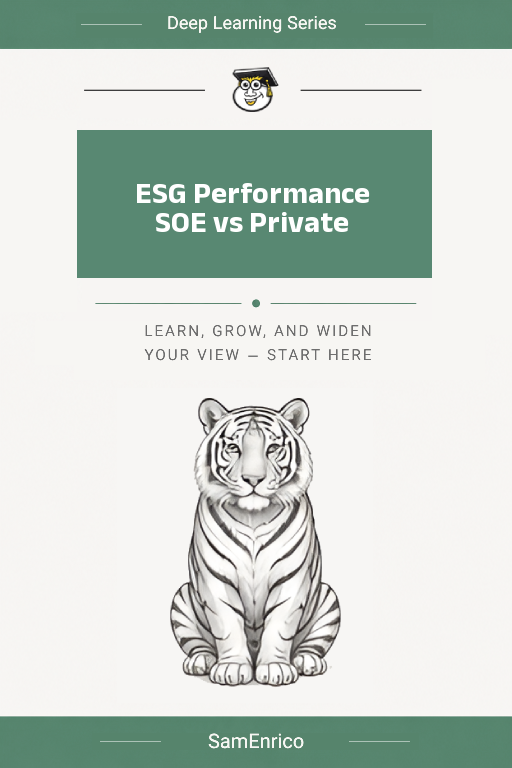
Non-FictionStrategic AtlasState Ownership
ESG Performance SOE vs Private
Compare state-owned enterprise ESG scores against
Compare state-owned enterprise ESG scores against privately owned public firms in same sectors.
Formats
About this book
Free sample
Chapter 1: The Ownership Paradox--For more than four decades, a single assumption has governed the way investors, policymakers, and business leaders think about corporate ownership. That assumption—elegant in its simplicity and devastating in its consequences—holds that private enterprise is inherently superior to state-owned enterprise across virtually every dimension that matters. Private firms are more efficient, more innovative, more responsive to customers, and more disciplined with capital. State-owned firms, by contrast, are bloated, politically captured, stagnant, and indifferent to performance. This belief system has justified trillions of dollars in privatization deals, shaped the conditionalities of the International Monetary Fund, and influenced the governance reforms of scores of nations from Argentina to Zimbabwe.There is only one problem.
It is wrong.Not entirely wrong, to be fair. In many respects, private firms do outperform their state-owned counterparts. They are generally faster at bringing new products to market. They tend to have lower operating costs. Their capital allocation decisions are typically more disciplined by market forces.
But on the specific set of metrics that have come to define corporate responsibility in the twenty-first century—environmental performance, social impact, and governance transparency—a growing body of evidence suggests that state-owned enterprises often do better. Sometimes much better. And this finding, which runs directly counter to the dominant ideology of the past half-century, demands a fundamental rethinking of how we evaluate ownership structures, how we design ESG investment strategies, and how we understand the relationship between the state and the market.This chapter lays the groundwork for that rethinking. It traces the intellectual history of the anti-SOE consensus, introduces the empirical puzzle that this book aims to solve, and previews the argument that will unfold across the remaining eleven chapters. The thesis is straightforward: the relative ESG performance of state-owned versus private enterprises depends critically on the regulatory environment in which they operate, the nature of the ESG metric in question, and the political economy of the country in question.
In emerging markets with weak private-sector regulation, SOEs consistently outperform on environmental compliance and social stability. In mature markets with strong universal mandates, the…
This is the end of the free sample. Get the eBook to keep going. Buy now
Contents
- Chapter 1
- Chapter 2
- Chapter 3
- Chapter 4
- Chapter 5
- Chapter 6
- Chapter 7
- Chapter 8
- Chapter 9
- Chapter 10
- Chapter 11
- Chapter 12
Details
- Author
- Chong Lovella
- Publisher
- SamEnrico
- Language
- English
- Genre
- Non-Fiction, Strategic Atlas, State Ownership
- Released
- 2026-06-02
- Pages (approx.)
- 145
- Available as
- eBook, Audiobook

Read better in the ZLOADR app
Your eBooks on your phone or tablet. Sign in with your SamEnrico account and start reading.
More by Chong Lovella
 Post Surgical Pain MindfulnessChong Lovella$11.99
 Free Creator Copyright CheckerChong Lovella$11.99
 Order Solar Temple Media Coverage PrimerChong Lovella$11.99
 LBO Modeling Video DatabaseChong Lovella$11.99
 Weekend Trips From DubaiChong Lovella$12.99
 Mindfulness for Chemo Brain FogChong Lovella$11.99
 The Lost Kingdoms of Borneo: Alfred Russel Wallace and the Jungle’s Hidden SecretsChong Lovella$11.99
 Shadows in the Kremlin: The Untold Assassination of Leon TrotskyChong Lovella$11.99
 Aventurine (Variety of Quartz) MiningChong Lovella$11.99Weekend Trips From DubaiChong Lovella$12.99
 How to Become a Automatic-door MechanicChong Lovella$11.99
 Understanding Cerebelloolivary AtrophyChong Lovella$17.99
You may also like
 Hong Kong Handover 1997Dunn Johnnie$11.99
 Zumba For Postnatal Recovery CourseNeal Christian$11.99
 Zumba for BeginnersLadner Nikia$11.99
 YouTube Comment Mining GuideHumes Pandora$12.99
 Worry Box MeditationCarlin Rudy$11.99
 Workplace Stress MeditationNguyen Lynn$11.99
 Workplace Stress and Sleep RepairHawley Ivory$11.99
 Workplace Perfectionism CureDelaney Jeffry$11.99
 Workplace Injustice Anger GuideWallen Isabelle$11.99
 Work Addiction and Burnout LinkGreenwood Ester$11.99
 Women in Yoga and WellnessBeattie Galina$11.99
 Women in Stand Up ComedyChun Evangeline$11.99