
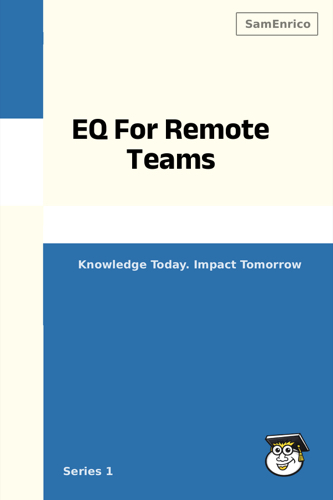
Non-FictionSelf-HelpRemote Work
EQ For Remote Teams eBook
Addresses emotional connection, trust-building, an
by Gamboa Mika
Addresses emotional connection, trust-building, and conflict resolution in distributed work environments.
Formats
Free sample
Chapter 1: The Green Dot Lie--–- The Slack status was green. The cursor hadn’t moved in eleven minutes. But upstairs, in a quiet bedroom converted into an office, a senior marketing director named Priya was not working. She was staring at the same spreadsheet, rereading the same three rows, while her pulse pounded in her temples. Three back-to-back Zoom calls had just ended.
Two more were scheduled after lunch. Eleven unread Slack messages glowed in the sidebar. Her team had replied to everything within minutes—rapid fire, efficient, professional. By every metric of remote work, Priya was “crushing it.”But she wasn’t. She was drowning.The problem wasn’t Priya.
The problem was the silent, invisible tax that every remote worker pays but almost no leader measures. It’s the cognitive load of inferring tone from punctuation. The anxiety of a “K.” instead of “Got it, thanks!” The emotional labor of smiling through a frozen Zoom face when your actual face is exhausted. And it is all hidden beneath a single, seductive illusion: the belief that busyness equals productivity, and that efficiency means more, faster, always on.This chapter dismantles that illusion. We call it The Green Dot Lie—the false promise that a lit-up status indicator means a functioning team.
In reality, the always-on culture of remote work is quietly destroying the very emotional reserves your team needs to collaborate, innovate, and trust one another. But there is a cure. And it begins with thirty seconds of silence before every meeting.The Hidden Cognitive Tax of Virtual Work Let’s start with a neuroscience fact that will reframe everything you think you know about remote efficiency. The human brain did not evolve to process emotional information through text or disembodied video. For 200,000 years, we read one another through posture, pupil dilation, breath rate, and micro-expressions—what scientists call “non-verbal leakage.” In an office, these cues are automatic.
You glance at a colleague, see their shoulders slump, and know without a word: they’re having a rough morning. You adjust. You offer coffee. You give them space.In remote work, those cues vanish.And your brain—brilliant, ancient, and paranoid—does not tolerate a vacuum. It fills the blank space with worst-case assumptions.Drawing from Bradberry and Greaves’ Emotional Intelligence 2.0, this chapter introduces the concept of emotional labor without reward.
Every time you read a Slack message that says “Let’s circle back on this” without a timestamp, your brain begins a quiet war. Did they mean tomorrow? Next week? Are they angry? Did I miss something?
You spend cognitive energy—real, finite, depleting energy—on inference rather than work. And you receive no credit for it. No one says, “Great job inferring that ambiguous message, Priya.” They just expect the next reply.This is the tax. It compounds with every notification. By 3pm, your team has spent more mental fuel on emotional guesswork than on strategic thinking.Why “Always-On” Is Actually Always-Draining Consider the typical remote workday.
It begins with a Slack check before coffee. Then a quick “standup” on Zoom where three people speak while seven listen. Then an hour of asynchronous document review (each comment requiring tone-decoding). Then back-to-back calls with no buffer—because back-to-back looks efficient on a calendar. Then a “quick” Slack thread that becomes a forty-five-minute fire drill.
Then the guilt of unanswered messages after 6pm. Then the phone by the bedside, just in case.This is not efficiency. This is continuous partial attention—a term coined by Linda Stone to describe the state of being perpetually alert but never fully present. In remote work, continuous partial attention has become the default operating system. And its symptoms are now epidemic: decision fatigue, low-grade anxiety, emotional numbness, and a creeping sense that you’re always behind even when you’ve worked ten hours.The data is staggering.
A 2023 study of 10,000 remote workers found that the average employee spends 42% of their cognitive energy on emotional inference—trying to read between the lines of digital communication. Only 58% remains for actual problem-solving. Worse, leaders systematically overestimate their team’s well-being. When managers were asked “How is your team’s morale?” they rated it 7.8 out of 10. The same team members rated their own morale 4.2.The gap is the Green Dot Lie.
Leaders see green dots and rapid replies. They mistake activity for connection, volume for trust.The Core Problem: Mistaking Busyness for Productivity Here is the uncomfortable truth that this book will return to again and again: Most remote leaders are managing the wrong metric. They track response time (faster is better), meeting attendance (more is better), and Slack volume (higher is better). But these are not productivity metrics. They are anxiety metrics.
A team that replies to every message within four minutes is not a high-performing team. It is a team that is terrified of silence.Why? Because silence in an office is neutral. A paused conversation means thinking. A quiet hallway means focus.
But silence on Slack reads as abandonment, anger, or incompetence. As we will explore in detail in Chapter 2, the human brain cannot tolerate ambiguity in asynchronous communication. So teams overcompensate. They reply instantly to prove they’re working. They add exclamation points to prove they’re friendly.
They send “Just checking in!” messages to prove they care. And every single one of these behaviors comes with a hidden cost.The cost of rapid replies: When you answer a non-urgent Slack message within sixty seconds, you train your team to expect that speed forever. You also fragment your own attention, losing an average of twenty-three minutes to “task-switching recovery” every time you interrupt deep work.The cost of back-to-back meetings: Neuroscientists have found that it takes the brain approximately seven minutes to fully disengage from one meeting and re-engage with the cognitive demands of the next. Back-to-back calls mean you never hit that seven-minute mark. You spend your entire day in a state of partial cognitive hangover.The cost of emotional labor without reward: Every time a team member writes a message that requires tone-guessing, the reader pays a tax.
The writer pays no tax. This asymmetry means that leaders—who send more messages than anyone else—often have no idea how costly their communication style has become.The EQ Skill: Self-Awareness as a Leadership Weapon If you are a leader reading this, you are likely the highest contributor to your team’s cognitive tax. Not because you are malicious. Because you are invisible in ways you cannot perceive.Consider this: When you send a message that says “Can we talk about this later?” you know what you mean. You mean: I’m in a flow state right now, and I want to give you my full attention, so let’s schedule time.
But your remote employee does not know that. They see four words. Their brain, starved of non-verbal cues, supplies its own context: They’re annoyed. They think my question was stupid. They’re going to forget.
I should follow up aggressively.This is why the first EQ skill for remote leadership is not empathy or conflict resolution. It is self-awareness—the ability to recognize how your own communication patterns land on the…
This is the end of the free sample. Get the eBook to keep going. Buy now
About this book
Details
- Author
- Gamboa Mika
- Publisher
- SamEnrico
- Language
- English
- Genre
- Non-Fiction, Self-Help, Remote Work
- Released
- 2026-06-07
- Pages (approx.)
- 140
- Available as
- eBook, Audiobook

Read better in the ZLOADR app
Your eBooks on your phone or tablet. Sign in with your SamEnrico account and start reading.
More by Gamboa Mika
 Photoshop Awareness Self EsteemGamboa Mika$11.99
 Values Clarification After Childhood WorkbookGamboa Mika$11.99
 Improvement Depreciation RulesGamboa Mika$11.99
 Emotional Intelligence in Romantic RelationshipsGamboa Mika$11.99
 The Silk and the Scissors: The Copycat Murders That Changed Forensic ScienceGamboa Mika$11.99
 Understanding Maffucci SyndromeGamboa Mika$17.99
 Logistics OperatorGamboa Mika$11.99
 One Hour Strategy Meeting Agenda GuideGamboa Mika$12.99
 Tail Spend Management PlaybookGamboa Mika$12.99
 How to Start a Hobby in Stand-Up ComedyGamboa Mika$11.99
You may also like
 Hong Kong Handover 1997Dunn Johnnie$11.99
 Zumba For Postnatal Recovery CourseNeal Christian$11.99
 Zumba for BeginnersLadner Nikia$11.99
 YouTube Comment Mining GuideHumes Pandora$12.99
 Worry Box MeditationCarlin Rudy$11.99
 Workplace Stress MeditationNguyen Lynn$11.99
 Workplace Stress and Sleep RepairHawley Ivory$11.99
 Workplace Perfectionism CureDelaney Jeffry$11.99
 Workplace Injustice Anger GuideWallen Isabelle$11.99
 Work Addiction and Burnout LinkGreenwood Ester$11.99
 Women in Yoga and WellnessBeattie Galina$11.99
 Women in Stand Up ComedyChun Evangeline$11.99