
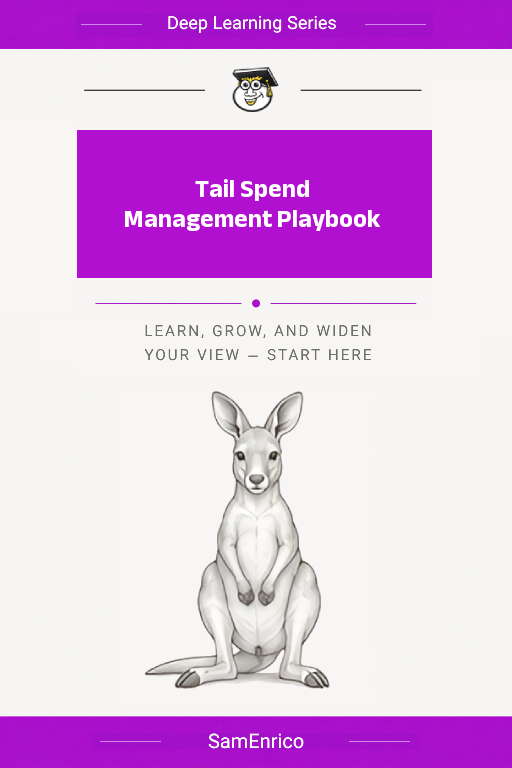
Non-FictionOperational Efficiency ManualSpend Management
Tail Spend Management Playbook
Controls low-value, high-volume purchasing through
by Gamboa Mika
Controls low-value, high-volume purchasing through catalog ordering, procurement cards, and streamlined approval workflows.
Formats
About this book
Free sample
Chapter 1: The Long Tail Problem--–- Every procurement leader has heard the 80/20 rule: 80% of your spend comes from 20% of your suppliers. It is the mantra of strategic sourcing, the justification for category management, and the reason your team spends Monday mornings negotiating with your top ten vendors. But here is what no one tells you: the other 80% of your suppliers—the long tail—is slowly draining your profitability, and you cannot see it happening.The problem is not that tail spend is large in absolute terms. By definition, it is not. The problem is that tail spend is invisible, fragmented, and governed by rules designed for an entirely different scale of transaction.
Your procurement team was built to hunt elephants. But your company is being eaten by ants.Consider this: a mid-sized manufacturing company with 500millioninannualrevenuetypicallyprocessesbetween50,000and100,000tailtransactionsperyear.Eachtransactioncostsbetween500 million in annual revenue typically processes between 50,000 and 100,000 tail transactions per year. Each transaction costs between 500millioninannualrevenuetypicallyprocessesbetween50,000and100,000tailtransactionsperyear.Eachtransactioncostsbetween50 and 100toprocesswhenyouaccountforrequisition,approval,POcreation,suppliercommunication,invoicematching,andpayment.Thatis100 to process when you account for requisition, approval, PO creation, supplier communication, invoice matching, and payment. That is 100toprocesswhenyouaccountforrequisition,approval,POcreation,suppliercommunication,invoicematching,andpayment.Thatis2.5 million to $10 million annually just in transaction costs—before you even pay for the goods themselves. And that is the visible cost.
The invisible costs—maverick buying, duplicate suppliers, missed volume discounts, fraud, and compliance risk—often double that figure.The purpose of this chapter is to give you a complete, unflinching diagnosis of the long tail problem. You will learn why traditional procurement neglects tail spend, how hidden costs accumulate beneath the surface, and why post-pandemic supply chain pressures have made tail spend management a strategic imperative rather than a back-office cleanup project. By the end of this chapter, you will understand exactly what you are losing—and you will be ready to do something about it.The 80/20 Rule: A Blessing and a Curse The Pareto Principle is one of the most durable insights in business management. Vilfredo Pareto observed in 1906 that 80% of the land in Italy was owned by 20% of the population. Management consultant Joseph Juran later…
This is the end of the free sample. Get the eBook to keep going. Buy now
Contents
- Chapter 1
- Chapter 2
- Chapter 3
- Chapter 4
- Chapter 5
- Chapter 6
- Chapter 7
- Chapter 8
- Chapter 9
- Chapter 10
- Chapter 11
- Chapter 12
Details
- Author
- Gamboa Mika
- Publisher
- SamEnrico
- Language
- English
- Genre
- Non-Fiction, Operational Efficiency Manual, Spend Management
- Released
- 2026-05-30
- Pages (approx.)
- 156
- Available as
- eBook, Audiobook

Read better in the ZLOADR app
Your eBooks on your phone or tablet. Sign in with your SamEnrico account and start reading.
More by Gamboa Mika
 Photoshop Awareness Self EsteemGamboa Mika$11.99
 Values Clarification After Childhood WorkbookGamboa Mika$11.99
 Improvement Depreciation RulesGamboa Mika$11.99
 EQ For Remote TeamsGamboa Mika$11.99
 Emotional Intelligence in Romantic RelationshipsGamboa Mika$11.99
 The Silk and the Scissors: The Copycat Murders That Changed Forensic ScienceGamboa Mika$11.99
 Understanding Maffucci SyndromeGamboa Mika$17.99
 Logistics OperatorGamboa Mika$11.99
 One Hour Strategy Meeting Agenda GuideGamboa Mika$12.99
 How to Start a Hobby in Stand-Up ComedyGamboa Mika$11.99
You may also like
 Hong Kong Handover 1997Dunn Johnnie$11.99
 Zumba For Postnatal Recovery CourseNeal Christian$11.99
 Zumba for BeginnersLadner Nikia$11.99
 YouTube Comment Mining GuideHumes Pandora$12.99
 Worry Box MeditationCarlin Rudy$11.99
 Workplace Stress MeditationNguyen Lynn$11.99
 Workplace Stress and Sleep RepairHawley Ivory$11.99
 Workplace Perfectionism CureDelaney Jeffry$11.99
 Workplace Injustice Anger GuideWallen Isabelle$11.99
 Work Addiction and Burnout LinkGreenwood Ester$11.99
 Women in Yoga and WellnessBeattie Galina$11.99
 Women in Stand Up ComedyChun Evangeline$11.99