
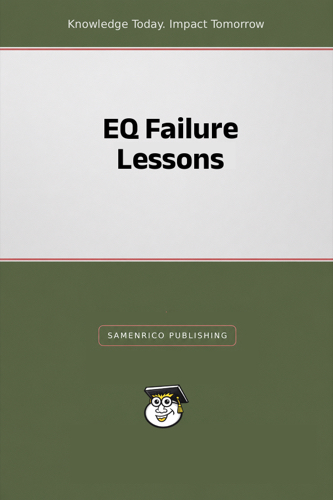
Free sample
Chapter 1: The Last Good Day...--–- Before the explosion, there was always a Tuesday. That is the first thing to understand about emotional failure. It does not announce itself with thunder or warning lights. It arrives dressed as an ordinary moment—a budget meeting, a traffic jam, a comment at dinner—and by the time you realize what is happening, the damage is already done.The father in the Zimbabwe case study had been having a perfectly normal day. He was a university lecturer, respected by his colleagues, adored by his students.
His wife would later describe him as “the gentlest man I ever knew.” That Tuesday, they argued about a late bill. The details are so mundane that they almost offend: a miscommunication about a payment, a sharp word, a defensive response. Then another word. Then a pause. Then, in less time than it takes to read this sentence, he crossed the room and committed an act of domestic violence that destroyed his family forever.Neighbors said, “That’s not who he is.” His lawyer argued temporary insanity.
His children stopped speaking to him. His wife filed for divorce from her hospital bed. And the lecturer—the smart, gentle, educated man—sat in a jail cell trying to understand what had happened. He could not. His memory of those seconds was a fog.
His prefrontal cortex, the seat of logic and self-control, had gone offline. His amygdala, the ancient alarm system buried deep in the brain, had seized control. In six seconds, he had become someone else.This book is about those six seconds.Not because you are violent. Statistically, you are not. But because every emotional failure—every explosion, every silence, every severed relationship, every derailed career—happens in the space between trigger and response.
That space is small. It is measured in heartbeats. But within that space lives everything that matters: your reputation, your relationships, your future. Master the six seconds, and you master the failure. Ignore them, and they will master you.Most books about emotional intelligence tell you what to do.
They offer frameworks, quizzes, and aspirational goals: be more self-aware, practice empathy, regulate your emotions. These are good things. They are also, for most people, utterly useless in the moment of crisis. You cannot learn to regulate your emotions while your amygdala is on fire. That is like learning to swim while drowning.
The learning must happen before. The practice must happen in calm water. The six seconds are the test, not the…
This is the end of the free sample. Get the Audiobook to keep going. Buy now
About this book
Details
- Author
- Mcgowan Melani
- Publisher
- SamEnrico
- Language
- English
- Genre
- Non-Fiction, Self-Help / Lessons
- Released
- 2026-06-08
- Pages (approx.)
- 134
- Available as
- eBook, Audiobook

Listen in the VoxFlicks app
Audiobooks and audio dramas wherever you go. Sign in with your SamEnrico account and press play.
More by Mcgowan Melani
 Child Overdose Death HealingMcgowan Melani$11.99
 Window Glass ForensicsMcgowan Melani$11.99
 Cognitive Restructuring for BurnoutMcgowan Melani$11.99
 The Hair Loss MicronutrientMcgowan Melani$11.99
 Deck Organization SystemsMcgowan Melani$11.99
 Post Injury Return HypnosisMcgowan Melani$11.99
 Sibling Grief After Baby LossMcgowan Melani$11.99
 Love in the Margins: The Secret Correspondence of the First A&R LegendMcgowan Melani$11.99
 The Golden Quill of the Persian Court: The Black Poets Who Shaped an EmpireMcgowan Melani$11.99
 A Collector's Handbook to the Austin A70 HampshireMcgowan Melani$11.99
 Building a Private Tutoring Client BaseMcgowan Melani$12.99
 Jumia Customer Feedback GuideMcgowan Melani$12.99