
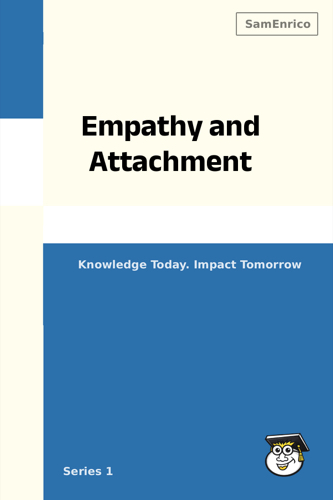
Non-FictionSelf-Help / Attachment
Empathy and Attachment eBook
undefined
by Boykin Buddy
undefined
Formats
Free sample
Chapter 1: The Dependency Lie...--–- Every child ever born arrives in this world unfinished. Unlike a foal that struggles to its feet within an hour of birth or a sea turtle that scrambles into the ocean alone, the human infant emerges with a brain barely one-quarter of its adult size. This is not a design flaw. It is a brilliant evolutionary trade-off: a narrow pelvis for upright walking required that our species be born earlier, more vulnerable, and entirely dependent for far longer than any other mammal. That dependency is not weakness.
It is the very engine of human becoming.For decades, Western culture has sold us a seductive lie: that healthy adulthood means wanting less, needing less, and leaning on no one. We celebrate the self-made millionaire, the lone wolf, the stoic who sheds no tears at funerals. We praise babies who “sleep through the night” (translation: who have learned that crying brings no response) and toddlers who “are so independent” (translation: who have stopped asking for help). We have confused isolation with strength, and in doing so, we have abandoned the most fundamental truth of human biology: we are attachment machines. We need each other to survive, to regulate, and to become fully ourselves.This book is about two capacities that are often treated as separate but are, in fact, two sides of the same coin.
Empathy is the ability to feel with another person—to resonate with their joy or pain as if it were your own. Attachment is the instinctual bond that drives us to seek proximity to safe others when we are distressed. You cannot have one without the other. Insecure attachment numbs empathy; secure attachment grows it. And empathy, when practiced deliberately, can rewire an insecure attachment style into what researchers call “earned security.”Over the next twelve chapters, you will learn how your early relationships shaped your brain, your nervous system, and your default responses to conflict, closeness, and fear.
You will identify your attachment style—Secure, Anxious, Avoidant, or Disorganized—without shame or blame, understanding that each is a logical strategy you invented to survive your specific environment. You will learn the three forms of empathy (cognitive, affective, and compassionate) and discover where your personal “empathy gaps” lie. You will practice co-regulation, repair, and the art of setting boundaries without losing connection. And by the final chapter, you will have built what attachment researchers call a “coherent narrative” of your life—a story that acknowledges pain without being ruled by it, and that points toward a future of earned secure attachment.But before we can heal, we must understand. And to understand, we must go back to the beginning.The 25% Brain: Why Nature Intended You to Need Others Let us start with a simple fact that changes everything: the human newborn’s brain is only 25% of its adult volume.
Compare this to other primates: a newborn chimpanzee’s brain is already 45% of its adult size; a macaque’s is 70%. This means that most of your brain growth—the wiring of your emotional centers, your stress-response systems, your capacity for empathy and self-regulation—occurred outside the womb, in the presence of your early caregivers. Your mother’s heartbeat, your father’s tone of voice, the rhythm of being fed and held—these were not mere comforts. They were the architects of your neural architecture.When an infant cries and a caregiver responds with warmth and consistency, something remarkable happens inside the baby’s brain. The stress hormone cortisol, which rises during distress, begins to fall.
The vagus nerve (the body’s long relaxation cable) strengthens its tone. The orbitofrontal cortex—the brain region responsible for empathy, impulse control, and emotional regulation—grows denser connections. The infant is not merely being soothed; they are being built.When an infant cries and no one comes, or comes inconsistently, or comes with anger, a different architecture emerges. The amygdala (the brain’s alarm system) becomes hyper-reactive. The stress-response system learns to stay on high alert, or alternatively, to shut down entirely.
The infant adapts to an unreliable world by becoming either hypervigilant (Anxious) or self-sufficient (Avoidant). Neither is a character flaw. Both are brilliant survival strategies for a specific environment that did not meet the infant’s biological needs.This is the core argument of attachment theory, first developed by British psychiatrist John Bowlby in the 1950s and later expanded by American psychologist Mary Ainsworth. Bowlby observed that children who were separated from their caregivers during wartime evacuations showed profound distress not because they were weak, but because they had been separated from their secure base—the person who regulated their nervous system. Ainsworth’s “Strange Situation” experiment (in which infants were briefly separated from and reunited with their mothers) identified three primary attachment patterns: Secure, Anxious, and Avoidant.
A fourth pattern, Disorganized, was later identified by Mary Main for children who had experienced frightening caregiving—often abuse or unresolved trauma.These patterns are not destiny. But they are powerful. And they persist into adulthood, shaping how you fight with your partner, how you parent your own children, how you react when a friend doesn’t text back, and how you feel when you are alone at night.The Proximity Seeking Instinct: Your Hidden Survival Program Imagine you are walking through a dark parking lot and you hear footsteps behind you. What is your immediate, involuntary response? You speed up.
You look for a light. You reach for your phone. But most of all, you feel a surge of wanting to be near someone safe. You might call a friend, even if they can’t physically help. You might hurry toward a store clerk.
This is your attachment system activating. It is as automatic as your heartbeat.Bowlby called this “proximity seeking”—the innate drive to move toward a safe, familiar person when you perceive threat or distress. It is not a learned behavior; it is a biological program that runs in the background of every human being. When the program works well (you find a safe person, you are soothed, you return to exploration), you learn that the world is mostly safe and that you are worthy of comfort. When the program fails repeatedly (you seek proximity and are rejected, ignored, or punished), you learn either to seek louder (Anxious) or to stop seeking at all (Avoidant).Here is what most people misunderstand: the attachment system does not turn off in adulthood.
It goes dormant during moments of safety, but it reactivates instantly during moments of threat, loss, illness, or even mild social rejection. That feeling of wanting to call your partner after a bad day at work? Attachment system. That urge to crawl into bed with your spouse after a nightmare? Attachment system.
That ache you feel when your best friend seems distant? Attachment system.Our culture tells us that these feelings are needy, childish, or pathological. They are not. They are evidence that your brain is working exactly as evolution designed it. The problem is not that you need others.
The problem is that you may have learned, through painful experience, to hide that need or to amplify it desperately. Both are…
This is the end of the free sample. Get the eBook to keep going. Buy now
About this book
Details
- Author
- Boykin Buddy
- Publisher
- SamEnrico
- Language
- English
- Genre
- Non-Fiction, Self-Help / Attachment
- Released
- 2026-06-07
- Pages (approx.)
- 130
- Available as
- eBook, Audiobook

Read better in the ZLOADR app
Your eBooks on your phone or tablet. Sign in with your SamEnrico account and start reading.
More by Boykin Buddy
 Remote Work for Social WorkersBoykin Buddy$11.99
 Design Thinking for Vision SettingBoykin Buddy$11.99
 Veteran Sleep MeditationBoykin Buddy$11.99
 Willingness vs WillfulnessBoykin Buddy$11.99
 The Twelve Step Beginner PrimerBoykin Buddy$11.99
 NVC in Schools GuideBoykin Buddy$11.99
 Catherine Territorial ExpansionBoykin Buddy$11.99
 The Resurrectionists: Canada's Victorian Grave Robbery ScandalBoykin Buddy$11.99
 The Armored Train of the Red Army: Tsaritsyn's Iron GambitBoykin Buddy$11.99
 A Collector's Handbook to the Hillman Minx (1940-44)Boykin Buddy$11.99
 10 Ways to Use Hyssop (Recipe Book)Boykin Buddy$11.99
 Service Providers Guide to Cosmetic DentistryBoykin Buddy$11.99
You may also like
 Hong Kong Handover 1997Dunn Johnnie$11.99
 Zumba For Postnatal Recovery CourseNeal Christian$11.99
 Zumba for BeginnersLadner Nikia$11.99
 YouTube Comment Mining GuideHumes Pandora$12.99
 Worry Box MeditationCarlin Rudy$11.99
 Workplace Stress MeditationNguyen Lynn$11.99
 Workplace Stress and Sleep RepairHawley Ivory$11.99
 Workplace Perfectionism CureDelaney Jeffry$11.99
 Workplace Injustice Anger GuideWallen Isabelle$11.99
 Work Addiction and Burnout LinkGreenwood Ester$11.99
 Women in Yoga and WellnessBeattie Galina$11.99
 Women in Stand Up ComedyChun Evangeline$11.99