
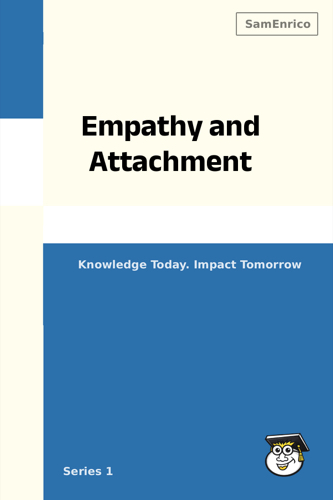
Non-FictionSelf-Help / Attachment
Empathy and Attachment Audiobook
undefined
by Boykin Buddy
undefined
Formats
Free sample
Chapter 1: The Dependency Lie...--–- Every child ever born arrives in this world unfinished. Unlike a foal that struggles to its feet within an hour of birth or a sea turtle that scrambles into the ocean alone, the human infant emerges with a brain barely one-quarter of its adult size. This is not a design flaw. It is a brilliant evolutionary trade-off: a narrow pelvis for upright walking required that our species be born earlier, more vulnerable, and entirely dependent for far longer than any other mammal. That dependency is not weakness.
It is the very engine of human becoming.For decades, Western culture has sold us a seductive lie: that healthy adulthood means wanting less, needing less, and leaning on no one. We celebrate the self-made millionaire, the lone wolf, the stoic who sheds no tears at funerals. We praise babies who “sleep through the night” (translation: who have learned that crying brings no response) and toddlers who “are so independent” (translation: who have stopped asking for help). We have confused isolation with strength, and in doing so, we have abandoned the most fundamental truth of human biology: we are attachment machines. We need each other to survive, to regulate, and to become fully ourselves.This book is about two capacities that are often treated as separate but are, in fact, two sides of the same coin.
Empathy is the ability to feel with another person—to resonate with their joy or pain as if it were your own. Attachment is the instinctual bond that drives us to seek proximity to safe others when we are distressed. You cannot have one without the other. Insecure attachment numbs empathy; secure attachment grows it. And empathy, when practiced deliberately, can rewire an insecure attachment style into what researchers call “earned security.”Over the next twelve chapters, you will learn how your early relationships shaped your brain, your nervous system, and your default responses to conflict, closeness, and fear.
You will identify your attachment style—Secure, Anxious, Avoidant, or Disorganized—without shame or blame, understanding that each is a logical strategy you invented to survive your specific environment. You will learn the three forms of empathy (cognitive, affective, and compassionate) and discover where your personal “empathy gaps” lie. You will practice co-regulation, repair, and the art of setting boundaries without losing connection. And by the final chapter, you will have built what attachment…
This is the end of the free sample. Get the Audiobook to keep going. Buy now
About this book
Details
- Author
- Boykin Buddy
- Publisher
- SamEnrico
- Language
- English
- Genre
- Non-Fiction, Self-Help / Attachment
- Released
- 2026-06-07
- Pages (approx.)
- 130
- Available as
- eBook, Audiobook

Listen in the VoxFlicks app
Audiobooks and audio dramas wherever you go. Sign in with your SamEnrico account and press play.
More by Boykin Buddy
 Remote Work for Social WorkersBoykin Buddy$11.99
 Design Thinking for Vision SettingBoykin Buddy$11.99
 Veteran Sleep MeditationBoykin Buddy$11.99
 Willingness vs WillfulnessBoykin Buddy$11.99
 The Twelve Step Beginner PrimerBoykin Buddy$11.99
 NVC in Schools GuideBoykin Buddy$11.99
 Catherine Territorial ExpansionBoykin Buddy$11.99
 The Resurrectionists: Canada's Victorian Grave Robbery ScandalBoykin Buddy$11.99
 The Armored Train of the Red Army: Tsaritsyn's Iron GambitBoykin Buddy$11.99
 A Collector's Handbook to the Hillman Minx (1940-44)Boykin Buddy$11.99
 10 Ways to Use Hyssop (Recipe Book)Boykin Buddy$11.99
 Service Providers Guide to Cosmetic DentistryBoykin Buddy$11.99
You may also like
 Hong Kong Handover 1997Dunn Johnnie$11.99
 Zumba For Postnatal Recovery CourseNeal Christian$11.99
 Zumba for BeginnersLadner Nikia$11.99
 YouTube Comment Mining GuideHumes Pandora$12.99
 Worry Box MeditationCarlin Rudy$11.99
 Workplace Stress MeditationNguyen Lynn$11.99
 Workplace Stress and Sleep RepairHawley Ivory$11.99
 Workplace Perfectionism CureDelaney Jeffry$11.99
 Workplace Injustice Anger GuideWallen Isabelle$11.99
 Work Addiction and Burnout LinkGreenwood Ester$11.99
 Women in Yoga and WellnessBeattie Galina$11.99
 Women in Stand Up ComedyChun Evangeline$11.99