
Non-FictionSelf-HelpBreathwork
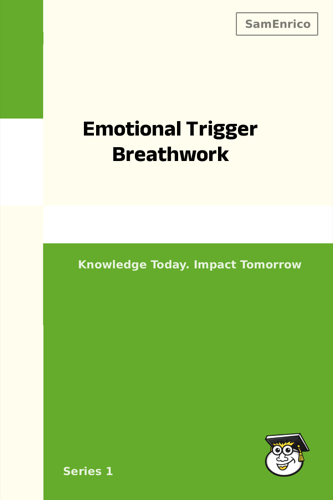
Emotional Trigger Breathwork eBook
Use specific breathing patterns to calm triggered
Use specific breathing patterns to calm triggered states.
Formats
Free sample
Chapter 1: The Invisible Explosion--–- It happens in less than a second. One moment you are fine—reading an email, sitting in traffic, listening to a partner’s casual comment—and the next moment your face is hot, your chest is tight, and words you will regret are already forming on your tongue. Or perhaps the opposite happens: your mind goes blank, your limbs feel heavy, and you disappear inside yourself while the world continues around you as if nothing has happened. You have been triggered.If you have ever wondered why you cannot “just calm down” no matter how hard you try, or why your rational brain seems to vanish exactly when you need it most, this chapter will give you the answer. More importantly, it will give you a new way to understand what is happening inside your body—not as a moral failure or a lack of willpower, but as a predictable biological cascade that you can learn to interrupt.The Three-Window Framework Before we dive into the neurobiology of triggers, let me introduce a framework that will structure this entire book.
Not all triggers are the same. They unfold over different time scales and require different breathwork responses. This book organizes every protocol around three distinct windows:The Acute Trigger Window lasts from the moment of impact to roughly five minutes afterward. This is the explosion itself—the surge of adrenaline, the racing heart, the flash of anger or spike of panic. During this window, your prefrontal cortex (the reasoning part of your brain) is largely offline.
You cannot reason your way out of an acute trigger. You need a biological brake. That is what Chapter 4’s A52 Method provides.The Sub-Acute Recovery Window begins after the initial surge has passed but your body has not yet returned to baseline. This can last hours or even days. You are no longer actively panicking, but you feel exhausted, heavy, irritable, or “off.” You may know the trigger is over, but your body has not gotten the message.
This window is addressed by cyclic sighing in Chapter 5 and the C.A.L.M. protocol in Chapter 6.The Chronic Freeze Window is different entirely. Here, the nervous system has collapsed into a state of numbness, dissociation, or helplessness. This is not a high-arousal state but a low-arousal one—feeling “not real,” disconnected from your body, or unable to move or speak. This requires a gentler, more specialized approach, which we will cover in Chapter 9.By the end of this chapter, you will be able to identify which window you are in at any given moment.
That awareness alone is a form of breathwork, because you cannot choose the right tool until you know what you are dealing with.The Speed of a Trigger Let us walk through what happens inside your body during an acute trigger. Imagine you are walking down the street and a large dog suddenly lunges toward you, barking. Your eyes send that visual information to the thalamus, which acts as a relay station in the brain. The thalamus then sends this signal along two different paths.The first path is fast. It goes directly to the amygdala, an almond-shaped cluster of neurons deep in the brain that acts as your threat detector.
The amygdala does not analyze. It does not ask questions like “Is that dog behind a fence?” or “Has this dog ever bitten me before?” It only asks one thing: “Is this a threat?” And if the answer is even maybe, it activates the sympathetic nervous system—your fight-or-flight response—in under a second.The second path is slower. It goes from the thalamus to the sensory cortex and then to the prefrontal cortex, where actual thinking happens. This path takes several seconds. By the time your prefrontal cortex has figured out that the dog is behind a sturdy fence and cannot reach you, your heart is already pounding, your palms are sweating, and your body is flooded with stress hormones.Here is the crucial insight for this book: triggers work exactly the same way, even when there is no physical threat.
An email from your boss, a text message from an ex-partner, a tone of voice from your parent, a smell that reminds you of a past event—all of these can activate the amygdala just as fast as a lunging dog. Your brain does not distinguish between a social threat and a physical one. A harsh word activates the same neural circuitry as a punch.This is not a design flaw. Evolution prioritized speed over accuracy because a false alarm (running from a stick that looked like a snake) is far less costly than a missed alarm (not running from an actual snake). Your brain is wired to err on the side of panic.
That is why you can know, intellectually, that you are safe, while your body acts as if you are not.The Breath-Disconnect Now we arrive at the central paradox of triggered states. During an acute trigger, your breathing changes automatically. It becomes faster, shallower, and higher in the chest. Most people also switch from nasal breathing to mouth breathing without realizing it. This is part of the sympathetic nervous system’s preparation for physical action—you are supposed to breathe rapidly if you are about to fight or flee.But here is the problem.
That rapid, shallow, mouth-based breathing pattern actually lowers the level of carbon dioxide in your blood. This is called relative hyperventilation. And the symptoms of relative hyperventilation include dizziness, tingling in the hands and face, a feeling of shortness of breath, chest tightness, and a racing heart.Those symptoms are nearly identical to the symptoms of a panic attack.In other words, your triggered breathing pattern creates physical sensations that your brain then interprets as more evidence of danger, which triggers more rapid breathing, which creates more symptoms, which triggers more panic. You become trapped in a feedback loop. This is why the common advice to “just take a deep breath” often fails.
If you take a single deep breath while still maintaining an overall pattern of rapid, shallow breathing, you are not breaking the loop. You are just taking one slightly deeper breath inside a hurricane of hyperventilation.The solution is not to take one deep breath. The solution is to change the entire breathing pattern. And that is what this book will teach you, starting with Chapter 4’s A52 Method.The Three Nervous System States To understand why different triggers require different breath patterns, you need a basic map of the autonomic nervous system. This is not complicated, but it is essential.The autonomic nervous system has three primary states, organized along what polyvagal theory calls the “hierarchy of response.” The first and most evolutionarily recent state is the ventral vagal state.
This is your social engagement system. In this state, you feel safe, connected, and present. Your heart rate is moderate, your breathing is calm, and your facial expressions are responsive. This is where you want to live most of the time.The second state is the sympathetic state, often called fight-or-flight. This is your mobilization system.
In this state, your heart rate increases, your breathing becomes faster and shallower, blood flows to your large muscles, and…
This is the end of the free sample. Get the eBook to keep going. Buy now
About this book
Details
- Author
- Barnette Marianela
- Publisher
- SamEnrico
- Language
- English
- Genre
- Non-Fiction, Self-Help, Breathwork
- Released
- 2026-06-07
- Pages (approx.)
- 144
- Available as
- eBook, Audiobook

Read better in the ZLOADR app
Your eBooks on your phone or tablet. Sign in with your SamEnrico account and start reading.
More by Barnette Marianela
 Road Rage for CouplesBarnette Marianela$11.99
 Divorce and Life InsuranceBarnette Marianela$11.99
 Hammock Swing VisualizationBarnette Marianela$11.99
 Corporate Layoff GuideBarnette Marianela$11.99
 Team Creativity for LawyersBarnette Marianela$11.99
 Breast Health For Intellectual DisabilitiesBarnette Marianela$11.99
 Persuasion for Software EngineersBarnette Marianela$11.99
 The Midnight Code: Harriet Tubman’s Secret Language of LiberationBarnette Marianela$11.99
 The Last Stand of the Spartan 300: Thermopylae’s Forgotten HeroBarnette Marianela$11.99
 How to Become a Rug-cleaner HelperBarnette Marianela$11.99
 How to Produce CoolersBarnette Marianela$11.99
 A Collector's Handbook to the Triumph Renown Mki TdbBarnette Marianela$11.99
You may also like
 Hong Kong Handover 1997Dunn Johnnie$11.99
 Zumba For Postnatal Recovery CourseNeal Christian$11.99
 Zumba for BeginnersLadner Nikia$11.99
 YouTube Comment Mining GuideHumes Pandora$12.99
 Worry Box MeditationCarlin Rudy$11.99
 Workplace Stress MeditationNguyen Lynn$11.99
 Workplace Stress and Sleep RepairHawley Ivory$11.99
 Workplace Perfectionism CureDelaney Jeffry$11.99
 Workplace Injustice Anger GuideWallen Isabelle$11.99
 Work Addiction and Burnout LinkGreenwood Ester$11.99
 Women in Yoga and WellnessBeattie Galina$11.99
 Women in Stand Up ComedyChun Evangeline$11.99