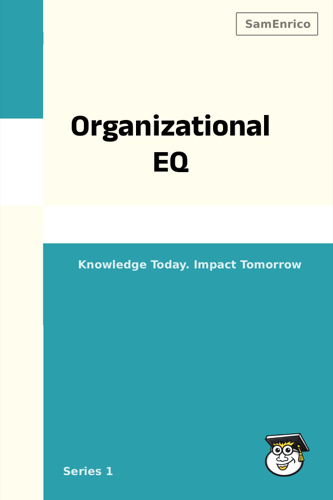
About this book
Free sample
Chapter 1: The Myth of Efficiency--–- On a Tuesday morning in March, a seasoned executive named Sarah walked into a boardroom and announced that 15 percent of her company’s workforce would be gone by Friday. She had spreadsheets to justify the decision. She had a presentation from a consulting firm that promised a 12 percent increase in operating margin. She had the full support of her board. What she did not have was data—real data—on what would happen next.One year later, that company’s operating margin had improved by only 2 percent.
Its voluntary turnover among high-performers had tripled. Its Glassdoor rating had dropped from 4.2 to 2.8. And Sarah, who had been promoted after the layoff for her “decisive action,” was quietly looking for another job, blaming the market for her team’s failure to execute.This story is not unusual. It is, in fact, the statistical norm.The Great Misunderstanding For decades, corporate leaders have operated under a seductive and dangerous assumption: that reducing headcount is a fast, reliable, and efficient way to increase profitability. This assumption is baked into MBA case studies.
It is reinforced by short-term stock market reactions, where layoff announcements often generate a temporary bump in share price. It is echoed in quarterly earnings calls, where CEOs describe workforce reductions as “rightsizing” or “aligning resources with strategic priorities.”There is just one problem. The assumption is wrong.Not occasionally wrong. Not wrong in certain circumstances. Overwhelmingly, consistently, and predictably wrong.This chapter is not an argument against ever reducing headcount.
There are legitimate circumstances—financial freefall, permanent market collapse, merger-driven redundancy—where workforce reduction is unavoidable. But before you can responsibly execute a layoff, you must first understand why most layoffs fail. And most layoffs fail because leaders misunderstand what they are actually doing.When you lay off employees, you are not simply removing a cost line from a spreadsheet. You are removing relationships, institutional knowledge, trust, and psychological safety. You are introducing trauma into a social system.
And you are doing so in a way that the survivors—the people you kept—will remember forever.What the Research Actually Says…
This is the end of the free sample. Get the eBook to keep going. Buy now
Contents
- Chapter 1
- Chapter 2
- Chapter 3
- Chapter 4
- Chapter 5
- Chapter 6
- Chapter 7
- Chapter 8
- Chapter 9
- Chapter 10
- Chapter 11
- Chapter 12
Details
- Author
- Barnette Marianela
- Publisher
- SamEnrico
- Language
- English
- Genre
- Non-Fiction, Self-Help / Corporate
- Released
- 2026-06-06
- Pages (approx.)
- 143
- Available as
- eBook, Audiobook

Read better in the ZLOADR app
Your eBooks on your phone or tablet. Sign in with your SamEnrico account and start reading.
More by Barnette Marianela
 Road Rage for CouplesBarnette Marianela$11.99
 Divorce and Life InsuranceBarnette Marianela$11.99
 Hammock Swing VisualizationBarnette Marianela$11.99
 Emotional Trigger BreathworkBarnette Marianela$11.99
 Team Creativity for LawyersBarnette Marianela$11.99
 Breast Health For Intellectual DisabilitiesBarnette Marianela$11.99
 Persuasion for Software EngineersBarnette Marianela$11.99
 The Midnight Code: Harriet Tubman’s Secret Language of LiberationBarnette Marianela$11.99
 The Last Stand of the Spartan 300: Thermopylae’s Forgotten HeroBarnette Marianela$11.99
 How to Become a Rug-cleaner HelperBarnette Marianela$11.99
 How to Produce CoolersBarnette Marianela$11.99
 A Collector's Handbook to the Triumph Renown Mki TdbBarnette Marianela$11.99