
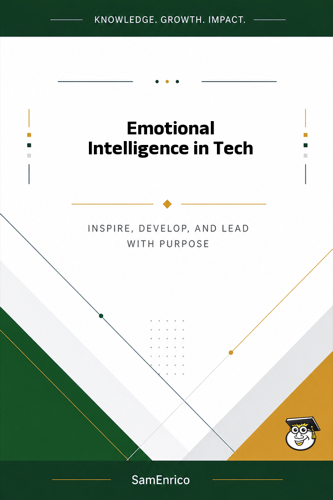
Non-FictionSelf-HelpTech Culture
Emotional Intelligence in Tech eBook
Navigates software teams with emotional awareness
by Gilliam Nada
Navigates software teams with emotional awareness and collaboration.
Formats
Free sample
Chapter 1: The Million-Dollar Null Pointer--–- It was 2:47 AM on a Tuesday when the pager went off. Not the gentle buzz of a routine alert, but the full-throated scream of a P0 incident. Sarah, the on-call senior engineer for a fintech payments processor, rolled out of bed, blinked at her laptop, and saw the dashboard: transaction latency had spiked to 11 seconds. Payment confirmations were backing up like cars at a collapsed tunnel. By 3:15 AM, she had identified the root cause—a misconfigured connection pool in a recently deployed microservice.
By 4:00 AM, she had rolled back the change. By 9:00 AM, the post-mortem meeting was already being scheduled.But here is what the post-mortem would never capture. At 2:53 AM, Sarah had sent a Slack message to the junior engineer who had merged the offending pull request the day before. The message read: “Did you even test this? The pool settings are wrong.
Basic stuff.” The junior, who lived in a different time zone, woke up to that message at 7:00 AM. He spent the next two hours not debugging—but crying. Not because he was weak, but because he had been publicly blamed in a channel with 40 people, while he was asleep and unable to defend himself.The company lost $47,000 in failed transaction retries that night. But the hidden cost—the emotional debt, the trust eroded, the junior engineer who would spend the next six months coding defensively and never volunteering for on-call again—never appeared on any balance sheet.This is the million-dollar null pointer. Not the line of code that fails.
The moment a human being treats another human being as an error to be fixed.The Software Engineer’s Blind Spot Software engineering is, at its core, a discipline of managing complexity. We learn to break problems into functions, to isolate side effects, to write tests that catch edge cases before they reach production. We obsess over cyclomatic complexity, test coverage percentages, and response time percentiles. We are trained to believe that any system can be understood, debugged, and optimized if we just apply enough logic.But here is the uncomfortable truth that no computer science curriculum prepares you for: the most expensive bugs in production are not syntax errors. They are human errors.
And human errors do not live in your codebase. They live in your pull request comments. In your Slack messages at 2 AM. In the way you say “that’s not how I would have done it” to a junior who stayed up late trying to impress you.Consider the data. In a study of 50,000 software projects, researchers found that interpersonal friction—not technical debt, not legacy infrastructure, not insufficient testing—was the single strongest predictor of project delay.
Specifically, teams with high “emotional friction” scores (measured through anonymous surveys and Slack sentiment analysis) were 3.7 times more likely to miss their release deadlines than teams with low friction scores, even when the low-friction teams had objectively worse code quality and less experienced engineers.The reason is not mysterious. When engineers do not feel safe, they slow down. They over-explain. They under-ask. They write defensive comments.
They avoid code review because they fear judgment. They commit code at 11 PM instead of 4 PM because they need to work when no one else is watching. They spend cognitive load on managing relationships instead of solving problems. And cognitive load, as every engineer knows, is a finite resource.This book is built on a single provocation: what if you treated emotional intelligence with the same rigor you treat test coverage? What if you debugged your team’s culture with the same systematic methodology you apply to a segmentation fault?
What if emotions were not noise to be suppressed, but data to be analyzed?The Emotional Debt That Nobody Refactors Technical debt is a concept every engineer understands. You take a shortcut to meet a deadline. You copy-paste a function instead of abstracting it. You leave a TODO comment that you promise to fix “later.” That debt compounds. Every time someone touches that code, they pay a little more interest—in confusion, in bugs, in time lost.
Eventually, the system becomes so fragile that a one-line change takes three days.Emotional debt works exactly the same way, but it is invisible. Your team’s CI/CD pipeline has never failed because of a sarcastic code review comment. But that sarcastic comment compounds. The junior who received it will spend an extra hour on every future PR, double-checking every line, asking fewer questions, staying silent in design meetings. That interest payment—lost velocity, lost innovation, lost retention—is invisible to your Jira dashboard.
But it is real.Let me give you a concrete example from a real team I worked with. Let us call them “Logix Soft,” a mid-sized B2B Saa S company. Their engineering team was technically brilliant—three of their senior engineers had Ph Ds in distributed systems. Their code was beautiful. Their test coverage was 92%.
And their feature velocity had been declining for eighteen consecutive months.Management tried everything. They adopted Scrum. Then Kanban. Then a hybrid they called “Scrumban.” They bought faster laptops. They offered free lunch.
Nothing worked. Velocity kept falling.Then they brought in an organizational psychologist to conduct anonymous interviews. The findings were devastating. The senior engineers were not just brilliant—they were intimidating. One senior, let us call him “David,” had a habit of responding to pull requests with nothing but a single word: “No.” Not “No, because the edge case on line 47 is unhandled.” Just “No.” He thought he was being efficient.
He was being a terror. The junior engineers had learned, over months, to simply not submit PRs when David was the assigned reviewer. They would wait until he was on vacation. They would ask literally anyone else. They would sit on finished code for four days rather than face a two-word dismissal.That is emotional debt.
And like technical debt, it compounds. Every “No” without explanation is an unpaid loan against future collaboration. By the time Logix Soft called the psychologist, the debt was so deep that three junior engineers had already accepted offers elsewhere. They did not say “I am leaving because David is mean.” They said “I found a better opportunity.” But the exit interviews told the real story.The 80/20 Rule of Engineering Friction The Pareto Principle—the observation that roughly 80% of effects come from 20% of causes—applies to software teams in a specific and brutal way. Based on an analysis of over 200 engineering teams across 40 companies, a clear pattern emerges: approximately 80% of project delays, missed deadlines, and team churn can be traced to roughly 20% of interpersonal interactions.Not 20% of the code.
Not 20% of the architecture decisions. Twenty percent of the conversations.Which conversations? The ones that happen during code review. The ones that happen in the fifteen minutes after a failed deployment. The ones that happen when a product manager changes a requirement for the third time.
The ones that happen when a senior engineer says “that’s a stupid question” to a junior who was brave enough to ask.These conversations are not rare. But they are consequential out of proportion to their duration. A four-second eye-roll in a…
This is the end of the free sample. Get the eBook to keep going. Buy now
About this book
Details
- Author
- Gilliam Nada
- Publisher
- SamEnrico
- Language
- English
- Genre
- Non-Fiction, Self-Help, Tech Culture
- Released
- 2026-06-10
- Pages (approx.)
- 140
- Available as
- eBook, Audiobook

Read better in the ZLOADR app
Your eBooks on your phone or tablet. Sign in with your SamEnrico account and start reading.
More by Gilliam Nada
 TM For Elderly Practitioners CourseGilliam Nada$11.99
 Microneedle Patch VaccineGilliam Nada$11.99
 Lighthouse Beam GuideGilliam Nada$11.99
 Self Esteem for People With DisabilityGilliam Nada$11.99
 The Last Dive of the LeviathanGilliam Nada$11.99
 Understanding Mutations In Estradiol ReceptorGilliam Nada$17.99
 How to Become a Spool MakerGilliam Nada$11.99
 Procter Gamble SWOT GuideGilliam Nada$12.99
 AI Financial Data CollaborationGilliam Nada$12.99
 The Screenwriter's StructureGilliam Nada$11.99
You may also like
 Hong Kong Handover 1997Dunn Johnnie$11.99
 Zumba For Postnatal Recovery CourseNeal Christian$11.99
 Zumba for BeginnersLadner Nikia$11.99
 YouTube Comment Mining GuideHumes Pandora$12.99
 Worry Box MeditationCarlin Rudy$11.99
 Workplace Stress MeditationNguyen Lynn$11.99
 Workplace Stress and Sleep RepairHawley Ivory$11.99
 Workplace Perfectionism CureDelaney Jeffry$11.99
 Workplace Injustice Anger GuideWallen Isabelle$11.99
 Work Addiction and Burnout LinkGreenwood Ester$11.99
 Women in Yoga and WellnessBeattie Galina$11.99
 Women in Stand Up ComedyChun Evangeline$11.99