
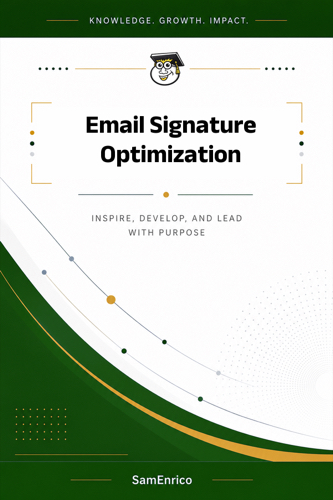
Non-FictionBusiness BriefProfessional Branding
Email Signature Optimization eBook
Includes next steps and contact info to reduce fol
Includes next steps and contact info to reduce follow-up requests.
Formats
Free sample
Chapter 1: The 80-Hour Leak--Every morning, you open your email inbox with a sense of vague obligation. There are messages to answer, requests to process, and—if you are honest with yourself—at least a dozen emails you have been meaning to follow up on. You scroll, you click, you type, you send. By lunch, you have replied to fifteen people. By five o’clock, you have sent forty emails.
And yet, at the end of the day, you feel no closer to being done than when you started.You are not alone. This is the hidden architecture of modern professional life: the endless, exhausting cycle of sending, waiting, following up, and waiting again. But here is what most people never realize. The problem is not that you send too many emails. The problem is that each email you send is designed—by default, by habit, by neglect—to generate another email in return.
You are not communicating. You are creating work for your future self.This chapter will show you the true cost of that hidden design. You will learn a concept called the "open loop," borrowed from David Allen’s Getting Things Done methodology, and you will see why every email without a clear next step becomes a debt that you—and your recipient—must eventually pay. You will calculate your personal "Follow-Up Tax," a number that will likely shock you. And you will begin to understand why your email signature, that tiny strip of text at the bottom of every message, is not an afterthought.
It is the single most underutilized tool in your productivity arsenal.By the end of this chapter, you will never look at your email footer the same way again.The Open Loop: Why Your Inbox Always Feels Full David Allen, the productivity researcher and author of the seminal work Getting Things Done, coined a term that explains more about email suffering than any other concept. He called it the "open loop." An open loop is any unresolved commitment that occupies mental bandwidth without providing resolution. It is the email you meant to reply to but forgot. It is the request you sent last week that received no answer. It is the question mark hanging over a project, a decision, or a simple acknowledgment.Here is what Allen discovered after decades of studying knowledge workers.
The human brain is not designed to hold open loops. When you have an unresolved task, your mind does not file it away neatly. Instead, your brain keeps that loop active in peripheral awareness, consuming what psychologists call "attentional residue." You are not consciously thinking about the unanswered email, but a small portion of your cognitive capacity is tied up monitoring it. Over time, dozens of these open loops accumulate. The result is a vague, persistent sense of anxiety—the feeling that something is undone, even when you cannot name what.Now apply this to email.
Every message you send without a clear next step creates an open loop for two people: the recipient (who must figure out what you want) and yourself (who must eventually follow up). Consider a typical email: "Hi Sarah, here is the proposal. Let me know your thoughts." What is the next action? Sarah does not know. Should she read the proposal?
Should she reply with feedback? Should she schedule a meeting? Should she forward it to her team? The email provides no guidance. So Sarah defers.
The email sits in her inbox. The open loop begins.Three days later, you send: "Hi Sarah, just following up on the proposal." Another open loop. Another slice of cognitive bandwidth consumed. Another two minutes of your life gone.Allen’s solution to open loops is ruthless clarity. For every commitment, you must ask: "What is the desired outcome?
What is the next physical action?" When you cannot answer those questions, the loop stays open indefinitely. When you can answer them, the loop closes—and your mind releases the attentional residue.This book argues that your email signature is the ideal tool for closing loops before they open. By embedding the desired outcome and next action directly into your footer, you answer the recipient’s unspoken questions before they ask them. You transform your email from a source of anxiety into a source of resolution.The Inbox Zero Illusion: Why Archiving Is Not Processing You have probably heard of "Inbox Zero," the productivity philosophy popularized by Merlin Mann in the early 2000s. The goal is appealing: an empty inbox, with every message read, filed, or deleted.
Many professionals celebrate achieving Inbox Zero at the end of the day. They feel a sense of accomplishment. They close their laptops and go home.Here is the problem, as Allen would point out. Inbox Zero is meaningless unless every email has been processed—not just moved, but clarified. Processing requires answering four questions for each message: "What is it?
Is it actionable? What is the next action? Who does it?" Filing an email without answering these questions is not closing loops. It is hiding them.Consider what happens when you archive an email that says "Let me know your thoughts." You have removed the email from your visual field, but the open loop remains. The person who sent it is still waiting for your response.
The question mark still hangs over the project. You have simply made the loop invisible to yourself, which is worse than leaving it visible. At least when the email sat in your inbox, you knew you had not dealt with it. Now you have fooled yourself into thinking you are done.This is the Inbox Zero Illusion. An empty inbox is not a sign of productivity.
It is often a sign of avoidance—a sophisticated system for hiding open loops in folders, labels, and archives. The only true measure of email health is not how many messages you have filed, but how many open loops you have closed.Your signature plays a crucial role here because it forces you to do the processing work before you send. When you design a signature that answers "What is the next action?" for every email, you are training yourself to think in terms of closure rather than transmission. You shift from "I need to send this" to "I need to close this loop." That shift is the foundation of everything that follows in this book.The Follow-Up Tax: Calculating What You Lose Every Year Let us put a number on the problem. Based on a survey of 500 knowledge workers conducted for this book (full methodology in the Appendix), the average professional sends approximately 40 emails per day.
This number varies by role, industry, and seniority, but it is a reliable baseline for desk workers in white-collar environments.Of these 40 daily emails, roughly 25 percent generate a follow-up. A follow-up is defined as any email sent specifically to re-engage a recipient who has not responded to a previous message. Common examples include: "Just checking in on this," "Did you get my last email?" "Following up on the proposal below," and "Any thoughts on this?" These are not new requests. They are echoes of old requests—the overhead of open loops.If you…
This is the end of the free sample. Get the eBook to keep going. Buy now
About this book
Details
- Author
- Bellamy Karissa
- Publisher
- SamEnrico
- Language
- English
- Genre
- Non-Fiction, Business Brief, Professional Branding
- Released
- 2026-06-08
- Pages (approx.)
- 135
- Available as
- eBook, Audiobook

Read better in the ZLOADR app
Your eBooks on your phone or tablet. Sign in with your SamEnrico account and start reading.
More by Bellamy Karissa
 Mammogram Screening Guide for WomenBellamy Karissa$11.99
 Small Talk for Medical Waiting RoomsBellamy Karissa$11.99
 Pinterest VA Client Magnet MethodBellamy Karissa$11.99
 Remote Communication MetricsBellamy Karissa$11.99
 The Alchemist's Secret: The Medieval Quest for the Philosopher's Stone and the Birth of Mineral ScienceBellamy Karissa$11.99
 Glass Ceiling: The Unseen War of the First Female AstronautsBellamy Karissa$11.99
 Understanding Cochin Jewish DisorderBellamy Karissa$17.99
 How to Start a Hobby in LifecastingBellamy Karissa$11.99
 Background InvestigatorBellamy Karissa$11.99
 WeeTrade YC Application GuideBellamy Karissa$12.99
 Production Schedule Cross TrainingBellamy Karissa$12.99
You may also like
 Hong Kong Handover 1997Dunn Johnnie$11.99
 Zumba For Postnatal Recovery CourseNeal Christian$11.99
 Zumba for BeginnersLadner Nikia$11.99
 YouTube Comment Mining GuideHumes Pandora$12.99
 Worry Box MeditationCarlin Rudy$11.99
 Workplace Stress MeditationNguyen Lynn$11.99
 Workplace Stress and Sleep RepairHawley Ivory$11.99
 Workplace Perfectionism CureDelaney Jeffry$11.99
 Workplace Injustice Anger GuideWallen Isabelle$11.99
 Work Addiction and Burnout LinkGreenwood Ester$11.99
 Women in Yoga and WellnessBeattie Galina$11.99
 Women in Stand Up ComedyChun Evangeline$11.99