
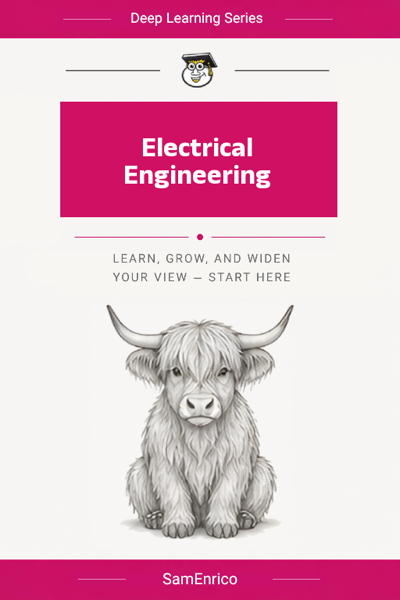
Electrical Engineering eBook
A Coursebook on Electrical Engineering
A Coursebook on Electrical Engineering
Formats
Free sample
Chapter 1: The Unspoken Secret--–- Before you calculate your first current or solder your first joint, you need to know something that most electrical engineering textbooks will never tell you: electricity is trying to kill you. Not maliciously, not with intent, but with the cold indifference of physics. The same voltage that powers your phone can, under the right conditions, stop your heart. The same current that lights your home can turn your muscles rigid and lock you to a live circuit. This is not meant to frighten you away from the profession.
Quite the opposite. This chapter exists because the engineers who respect electricity—who understand its dangers with clarity rather than fear—are the ones who build extraordinary things and live long enough to enjoy them.Welcome to electrical engineering. Not the version you might have imagined, filled only with elegant equations and tidy circuit diagrams. Those exist. But before you can master the math or design the systems that will change the world, you must first learn the unspoken secret that every practicing engineer carries: safety is not an add-on or a checklist.
Safety is the foundation upon which all good engineering is built.The First Lesson: Your Body Is a Resistor Let us begin with a truth that is simultaneously obvious and routinely ignored. The human body conducts electricity. You are, from an electrical perspective, a bag of saline solution wrapped in a somewhat resistive skin. Your internal tissues—blood, muscle, nerve—have a resistivity of roughly 0.5 to 1.0 ohm-meters, similar to that of salt water. Your dry skin, by contrast, provides resistance between 10,000 and 1,000,000 ohms, depending on thickness, moisture, and contact pressure.
When your skin is wet or cut, that resistance can drop to as low as 500 ohms. Do you see the problem now? The difference between a harmless tingle and a fatal shock is often just a thin layer of moisture.Consider Ohm's Law, which we will explore in systematic depth in Chapter 2. For now, the essential relationship is simple: current equals voltage divided by resistance. A typical household outlet in North America provides 120 volts.
Your dry hand might present 100,000 ohms of resistance. That yields a current of 1.2 milliamperes—noticeable but not dangerous. But if your hands are sweaty or wet, resistance might drop to 1,000 ohms. Now the same voltage delivers 120 milliamperes through your body. That is well into the lethal range.What levels of current actually cause harm?
The human body is exquisitely sensitive to electrical current, and the effects are remarkably well documented from decades of industrial accident data and controlled experiments. At 0.5 to 2 milliamperes, you perceive a tingling sensation but no real danger. At 2 to 10 milliamperes, muscles begin to contract involuntarily, and you may be unable to let go of a live conductor—a condition known as "let-go threshold." At 10 to 20 milliamperes, muscle contractions become severe, breathing becomes difficult, and the "can't let go" condition becomes nearly certain. At 30 to 100 milliamperes, ventricular fibrillation begins—the heart's normal rhythmic contractions degenerate into chaotic quivering, pumping no blood and leading to death within minutes if untreated. Above 100 milliamperes, severe burns and cardiac arrest occur.
Note the asymmetry: currents too low to be fatal can still paralyze you, locking your hand around the very source that is killing you. This is why electricians call it the "hold-on" effect.The path of the current through your body matters as much as the magnitude. A current entering one finger and exiting the same hand stays in the extremity—painful but rarely fatal. A current entering one hand and exiting the other hand passes directly through your heart. A current entering your hand and exiting your foot passes through your heart as well, though somewhat attenuated.
This is why the "one-hand rule" exists: when working on live circuits, keep one hand in your pocket. You force any accidental current to travel from your working hand down the same side of your body to your foot, missing your heart. It is a simple, ancient piece of wisdom that has saved countless lives.The Hidden Dangers You Cannot See Electricity has a cruel advantage over other workplace hazards. You can see a spinning blade. You can smell smoke.
You can hear a roaring engine. But electricity—until it arcs or smokes—is silent, invisible, and odorless. A wire can be carrying 480 volts with no outward sign. A capacitor can be charged to 300 volts hours after the power was disconnected. A seemingly dead circuit can become live the moment someone else flips a switch in another room.
These are not theoretical possibilities. These are the mundane realities of electrical work, and every experienced engineer has a story about the time they almost learned the hard way.Consider the capacitor. It is one of the most fundamental components in electronics—we will spend considerable time on capacitors throughout this book, particularly in Chapters 3, 5, and 10. A capacitor stores energy in an electric field. In a camera flash, a capacitor might charge to 300 volts and store enough energy to produce a brilliant flash of light.
In the power supply of a tube amplifier, a capacitor might hold 450 volts for days after the device was unplugged. Here is the danger: a capacitor discharges its stored energy almost instantly when shorted. If you are the shorting path, that energy discharges through you. There is a reason old television repair technicians always kept one hand behind their back and carried a discharge tool—a long insulated rod with a resistor and a clip lead. They had been bitten before, and they learned.The other invisible danger is the arc flash.
When high voltages or high currents arc through the air, they create a plasma channel with temperatures reaching 35,000 degrees Fahrenheit—three times hotter than the surface of the sun. The arc flash produces a pressure wave that can throw a grown adult across a room, molten metal droplets that embed in skin, and a blinding light that damages retinas. Arc flash incidents are rare in low-voltage electronics work but become a serious risk in industrial settings, switchgear, and any circuit above about 240 volts or with high available current. The engineering controls for arc flash include proper lockout-tagout procedures, flame-resistant clothing, face shields, and maintaining safe distances. But the most important control is the one between your ears: never assume a circuit is safe just because you cannot see the danger.The Three Barriers Between You and Death Electrical safety is not magic.
It is not about memorizing a list of rules that you then ignore in the interest of convenience. Electrical safety is a system of three overlapping barriers, each designed to catch the failures of the others. When all three barriers are in place and functioning, you are safe. When one barrier is missing, you are vulnerable. When two are missing, you are gambling with your life.The first barrier is insulation and separation.
Wires are covered with plastic or rubber insulation. Connectors are recessed so that your fingers cannot contact live metal. Transformers provide galvanic isolation between primary and secondary circuits. Circuit boards are coated with solder mask and conformal coating. These are the passive barriers that prevent you from ever touching a live conductor…
This is the end of the free sample. Get the eBook to keep going. Buy now
About this book
Details
- Author
- Ellington Lauretta
- Publisher
- SamEnrico
- Language
- English
- Genre
- Non-Fiction, Informative, Educational
- Released
- 2026-06-02
- Pages (approx.)
- 142
- Available as
- eBook, Audiobook

Read better in the ZLOADR app
Your eBooks on your phone or tablet. Sign in with your SamEnrico account and start reading.
More by Ellington Lauretta
 Teaching Nonverbal AwarenessEllington Lauretta$11.99
 Gacy Victim IdentificationEllington Lauretta$11.99
 Offline SMS Marketing GuideEllington Lauretta$11.99
 The Healing Herbs of the Great Queen: Amanirenas and the Medicine of KushEllington Lauretta$11.99
 Learn to Play the SaxotrombaEllington Lauretta$11.99
 How to Start a Clock Business (Beginners Guide)Ellington Lauretta$11.99