
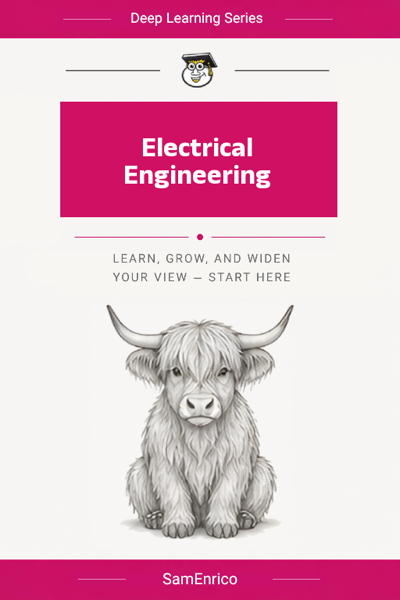
Electrical Engineering Audiobook
A Coursebook on Electrical Engineering
A Coursebook on Electrical Engineering
Formats
Free sample
Chapter 1: The Unspoken Secret--–- Before you calculate your first current or solder your first joint, you need to know something that most electrical engineering textbooks will never tell you: electricity is trying to kill you. Not maliciously, not with intent, but with the cold indifference of physics. The same voltage that powers your phone can, under the right conditions, stop your heart. The same current that lights your home can turn your muscles rigid and lock you to a live circuit. This is not meant to frighten you away from the profession.
Quite the opposite. This chapter exists because the engineers who respect electricity—who understand its dangers with clarity rather than fear—are the ones who build extraordinary things and live long enough to enjoy them.Welcome to electrical engineering. Not the version you might have imagined, filled only with elegant equations and tidy circuit diagrams. Those exist. But before you can master the math or design the systems that will change the world, you must first learn the unspoken secret that every practicing engineer carries: safety is not an add-on or a checklist.
Safety is the foundation upon which all good engineering is built.The First Lesson: Your Body Is a Resistor Let us begin with a truth that is simultaneously obvious and routinely ignored. The human body conducts electricity. You are, from an electrical perspective, a bag of saline solution wrapped in a somewhat resistive skin. Your internal tissues—blood, muscle, nerve—have a resistivity of roughly 0.5 to 1.0 ohm-meters, similar to that of salt water. Your dry skin, by contrast, provides resistance between 10,000 and 1,000,000 ohms, depending on thickness, moisture, and contact pressure.
When your skin is wet or cut, that resistance can drop to as low as 500 ohms. Do you see the problem now? The difference between a harmless tingle and a fatal shock is often just a thin layer of moisture.Consider Ohm's Law, which we will explore in systematic depth in Chapter 2. For now, the essential relationship is simple: current equals voltage divided by resistance. A typical household outlet in North America provides 120 volts.
Your dry hand might present 100,000 ohms of resistance. That yields a current of 1.2 milliamperes—noticeable but not dangerous. But if your hands are sweaty or wet, resistance might drop to 1,000 ohms. Now the same voltage delivers 120 milliamperes through your body. That is well into the lethal range.What…
This is the end of the free sample. Get the Audiobook to keep going. Buy now
About this book
Details
- Author
- Ellington Lauretta
- Publisher
- SamEnrico
- Language
- English
- Genre
- Non-Fiction, Informative, Educational
- Released
- 2026-06-02
- Pages (approx.)
- 142
- Available as
- eBook, Audiobook

Listen in the VoxFlicks app
Audiobooks and audio dramas wherever you go. Sign in with your SamEnrico account and press play.
More by Ellington Lauretta
 Teaching Nonverbal AwarenessEllington Lauretta$11.99
 Gacy Victim IdentificationEllington Lauretta$11.99
 Offline SMS Marketing GuideEllington Lauretta$11.99
 The Healing Herbs of the Great Queen: Amanirenas and the Medicine of KushEllington Lauretta$11.99
 Learn to Play the SaxotrombaEllington Lauretta$11.99
 How to Start a Clock Business (Beginners Guide)Ellington Lauretta$11.99