
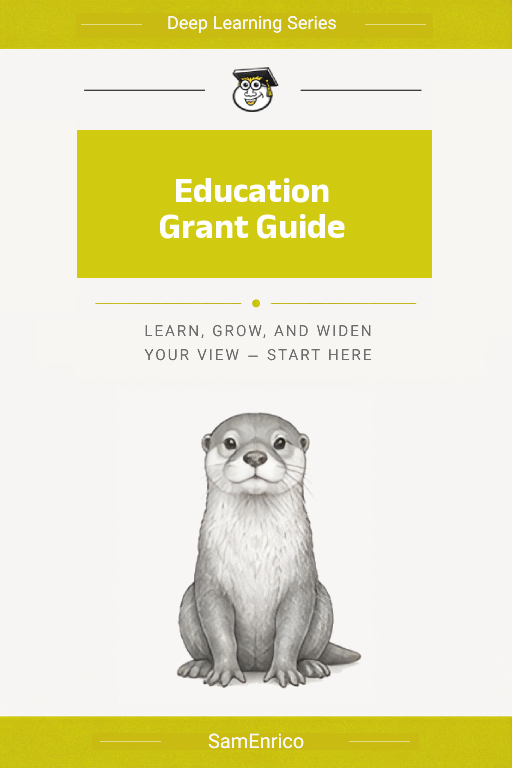
Non-FictionProfessional's Cheat SheetEducation Grants
Education Grant Guide eBook
Find education funding from government and private
Find education funding from government and private foundations for learning programs.
Formats
Free sample
Chapter 1: The Readiness Paradox--–- Before you write a single word of a grant proposal, before you research a single foundation, before you even open a browser tab to browse opportunities, you must look inward. This is the single most counterintuitive truth in the entire grant-seeking process, and it is the reason that most educators and nonprofit leaders fail before they begin. They chase money they cannot legally accept, they design programs they cannot actually deliver, and they submit proposals to funders whose priorities they have never truly understood—all because they skipped the unglamorous but essential work of internal preparation. This chapter is about that preparation. It is about the hard, boring, utterly necessary task of becoming "grant ready" before you ever ask for a dime.The Seduction of the Search Every educator knows the feeling.
A Friday afternoon email lands in your inbox: "Grant Opportunity: $250,000 for STEM Programs." Your heart rate increases. You imagine new laptops, robotics kits, a field trip to the science museum. Within minutes, you have clicked the link, skimmed the requirements, and begun mentally drafting the proposal. This is the seduction of the search, and it is a trap.The bestselling books on grant writing—from Brewer and Achilles' Finding Funding to Browning's Grant Writing For Dummies—all converge on a single, uncomfortable conclusion: the organizations that win the most grants are not necessarily the ones with the best writers. They are the ones that have done their homework before the opportunity even appears.
They have their legal paperwork in order. They have a clear, data-driven definition of the problem they are solving. They have a logic model that connects their activities to measurable outcomes. They have a team, even a team of one, with assigned roles and deadlines. In short, they are ready.This chapter is your pre-flight checklist.
It is the equivalent of a pilot walking around the aircraft, checking the flaps, the fuel, the hydraulics, before anyone ever boards. It is not exciting. It will not win you a prize for creativity. But skipping it means you are flying a plane with unknown mechanical issues, and the crash—in the form of a rejection letter or, worse, an audited and disallowed grant—is not a matter of if but when.The Grant Readiness Audit: A Self-Diagnostic Before we go any further, take out a piece of paper or open a new document. You are going to conduct a Grant Readiness Audit.
Answer the following questions honestly. There is no penalty for a "no" answer, only the gift of knowing what you need to fix.Legal and Fiscal Readiness:Does your organization have a valid 501(c)(3) determination letter from the IRS? If you are a public school, do you have a fiscal agent or district authorization to apply?Do you have a Unique Entity Identifier (UEI) and an active, current registration in the System for Award Management (SAM.gov)? (This is required for all federal grants and can take weeks to obtain.)Do you have audited financial statements or, at minimum, reviewed financials for the past two years?Do you have a federal Employer Identification Number (EIN) separate from any individual's Social Security number?Programmatic Readiness:Have you conducted a formal needs assessment in the past 12 months using local data (test scores, attendance, surveys, focus groups)?Can you state the specific problem you want to solve in one sentence without using the word "funding"?Do you have a draft logic model that connects your resources to activities to outcomes? (If not, we will build one in this chapter.)Do you have at least one potential partner (another school, a nonprofit, a library, a business) who has expressed interest in working with you?Operational Readiness:Do you have a dedicated person or team responsible for grant seeking, even if it is only five hours per week?Do you have a calendar or project management system (even a free one like Trello or Asana) to track deadlines?Do you have a system for storing and retrieving past proposals, budgets, and supporting documents?If you answered "no" to three or more of these questions, you are not ready to apply for grants.
That is not a failure; it is a diagnosis. The remainder of this chapter is your treatment plan.The Needs Assessment: Moving from Wants to Evidence The most common mistake in grant seeking is confusing a want with a need. "We want money for new computers" is a want. "Seventy-three percent of our eighth graders scored below proficient on the state science assessment, and the district has not replaced computers in seven years, resulting in software that cannot run required simulations" is a need. The difference is evidence.A proper needs assessment answers three questions, and it answers them with data, not anecdotes (though anecdotes have their place, as we will discuss in Chapter 4).
The three questions are:What is the current state? Gather baseline data. Test scores. Attendance rates. Discipline referrals.
Graduation rates. College enrollment. Food insecurity percentages. English language learner populations. Special education identification rates.
Do not guess. Go to your school or district data dashboard. Request reports from your county health department. Look at the American Community Survey for neighborhood-level demographics.What is the desired state? This is not "perfect." This is realistic, measurable, and time-bound.
For example: "Within two years of program implementation, 60 percent of participating eighth graders will score proficient or above on the state science assessment, an increase from the current 27 percent." Note the specificity: two years, 60 percent, eighth graders, state science assessment.What is the gap, and why does it exist? This is the root cause analysis. Do not stop at "because the school is underfunded." Why is the school underfunded? Property tax base? State funding formula?
Historical inequities? Do not stop at "because students lack motivation." Why do they lack motivation? No relevant curriculum? No exposure to STEM careers? Competing stressors like hunger or unstable housing?A powerful needs assessment uses a "triangulation" of data sources: quantitative (test scores, attendance), qualitative (teacher interviews, student focus groups), and comparative (state averages, neighboring districts).
One of the best-selling guides, Winning Grants Step by Step by Mim Carlson and the staff of TCC Group, emphasizes that funders are trained to spot the difference between a data-driven needs statement and a hand-wavy wish list. They will fund the data every time.Case Study: The After-School Program That Almost Failed Consider two after-school programs applying for the same $100,000 literacy grant. Program A writes: "Many of our students struggle with reading. We need money for books and tutors." Program B writes: "According to our district's 2023 universal screener, 68 percent of our 120 third graders scored below grade level on reading fluency. This is 22 percentage points higher than the state average of 46 percent.
In focus groups conducted with 15 classroom teachers, the most commonly cited barrier was lack of one-on-one support: the current student-to-teacher ratio during reading block is 28:1. We propose an after-school program serving 60 of the lowest-performing students with a 4:1 student-to-tutor ratio." Which program do you think received the funding? Program B did, and they won on their first attempt.The difference is not money. The difference is evidence. Program B…
This is the end of the free sample. Get the eBook to keep going. Buy now
About this book
Details
- Author
- Hobson Cindie
- Publisher
- SamEnrico
- Language
- English
- Genre
- Non-Fiction, Professional's Cheat Sheet, Education Grants
- Released
- 2026-06-01
- Pages (approx.)
- 152
- Available as
- eBook, Audiobook

Read better in the ZLOADR app
Your eBooks on your phone or tablet. Sign in with your SamEnrico account and start reading.
More by Hobson Cindie
 Mindful Dishwashing PracticeHobson Cindie$11.99
 Remote Worker Sleep BalanceHobson Cindie$11.99
 Introvert Conversation Starters WorkbookHobson Cindie$11.99
 Classical Conditioning Food CravingsHobson Cindie$11.99
 Parent Death and Eating DisorderHobson Cindie$11.99
 Anansi’s Lyrical Web: The Spider’s Trickster AnthemsHobson Cindie$11.99
 The Deep-Sea Gold Rush: Uncovering the Atlantic's Hidden TreasuresHobson Cindie$11.99
 Understanding Glycogenosis Type IiiHobson Cindie$17.99
 Outdoors(Edit)Hobson Cindie$11.99
 How to Start a Printing Devices (hand Operated) Business (Beginners Guide)Hobson Cindie$11.99
 One Page Competitor Analysis WorkbookHobson Cindie$12.99
You may also like
 Hong Kong Handover 1997Dunn Johnnie$11.99
 Zumba For Postnatal Recovery CourseNeal Christian$11.99
 Zumba for BeginnersLadner Nikia$11.99
 YouTube Comment Mining GuideHumes Pandora$12.99
 Worry Box MeditationCarlin Rudy$11.99
 Workplace Stress MeditationNguyen Lynn$11.99
 Workplace Stress and Sleep RepairHawley Ivory$11.99
 Workplace Perfectionism CureDelaney Jeffry$11.99
 Workplace Injustice Anger GuideWallen Isabelle$11.99
 Work Addiction and Burnout LinkGreenwood Ester$11.99
 Women in Yoga and WellnessBeattie Galina$11.99
 Women in Stand Up ComedyChun Evangeline$11.99