
Non-FictionBusiness BriefTiny Living
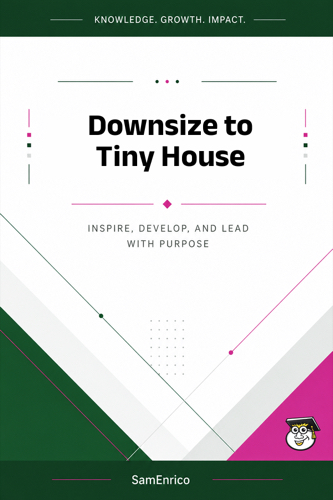
Downsize to Tiny House eBook
Radical downsizing feasibility for minimal cost re
Radical downsizing feasibility for minimal cost retirement living.
Formats
Free sample
Chapter 1: The Equity Trap--–- Your house is lying to you. Every month, it whispers a seductive promise: “I am your greatest asset. Protect me. Hold onto me. I am your retirement.” And every month, millions of Americans believe that whisper.
They make their mortgage payments with the quiet faith that their home will eventually rescue them—that the equity they’re building will transform into a comfortable retirement, a safety net, a legacy. But here’s the truth your house will never tell you: your home is eating your retirement alive, one payment at a time.The average American retiree between the ages of sixty-five and seventy-four spends $2,500 per month on housing-related expenses. That’s mortgage payments (for those still paying), property taxes, homeowners insurance, utilities, and maintenance. The average monthly Social Security benefit for retired workers in 2025 is $1,900. Do the math.
Even before you buy food, before you fill a prescription, before you put gas in the car, you are underwater by six hundred dollars every single month. Your house is not your retirement plan. Your house is the reason you cannot retire.This chapter will reframe everything you think you know about home equity. You will learn to see your house not as an asset to preserve for inheritance, but as fuel for a more liquid, more flexible, and more liberated retirement. You will calculate your personal “Net Zero” number—the exact sale price that unlocks your freedom.
You will discover why forty percent of tiny homeowners are over fifty, and why this is not a millennial trend but a retirement revolution. And you will meet empty nesters who walked away from their family homes with two hundred thousand dollars or more in liquid assets, not because they were wealthy, but because they understood one simple truth: you don’t need more money. You need less house.The Mathematics of Suffocation Let’s start with the numbers, because the numbers do not lie. They cannot. They sit there on the page, cold and indifferent to your emotional attachments, your childhood memories, your pride of ownership.
And those numbers tell a brutal story.Consider a typical American homeowner, age sixty-two, living in a 2,200-square-foot suburban house purchased twenty-five years ago. The home is now worth $400,000. They have a remaining mortgage balance of $80,000. Their monthly housing expenses break down like this:Mortgage payment (principal and interest): $650Property taxes: $350Homeowners insurance: $150Utilities (electric, water, gas, sewer, trash): $400Maintenance (annual average divided by twelve): $300**Total monthly housing cost: $1,850**On the surface, $1,850 per month sounds manageable—especially if they’ve paid down most of their mortgage. But watch what happens when we factor in everything else.
This same homeowner has $250,000 in home equity (the $400,000 value minus the $80,000 mortgage and $70,000 in estimated selling costs). That equity is not cash. It is trapped. It cannot buy groceries. It cannot pay medical bills.
It sits there, locked inside walls and roof tiles, providing psychological comfort but zero spending power.Now imagine this homeowner sells the house. After closing costs, real estate commissions, and paying off the mortgage, they walk away with $300,000 in cash. They take $60,000 of that to buy a well-built tiny house (on foundation, 400 square feet, main-floor bedroom—we’ll discuss design in Chapter 9). They invest the remaining $240,000 in a conservative portfolio of index funds and bonds. Using the standard 4% withdrawal rule, that portfolio generates $9,600 per year, or $800 per month, in passive income.Their new monthly housing expenses:Property taxes (on tiny house, assessed at $60,000): $80Homeowners insurance: $50Utilities (solar with propane backup): $80Maintenance (annual average): $40**Total monthly housing cost: $250**Do you see what happened?
Their monthly housing cost dropped from $1,850 to $250—a reduction of 86%. Their invested equity now generates $800 per month in passive income. Add that to their $1,900 Social Security benefit, and their monthly income rises to $2,700 while their housing expense falls to $250. They now have $2,450 per month for everything else: food, healthcare, travel, hobbies, gifts for grandchildren. They are not just surviving.
They are thriving.This is not a fantasy. This is arithmetic.The 80% Reduction Rule Throughout this book, you will encounter what I call the 80% Reduction Rule. It appears in three critical areas of tiny house living, and understanding it is essential to your financial reset.First, tiny houses cost 70–80% less than traditional homes. The median sale price of an existing single-family home in the United States is currently around $420,000. A professionally built tiny house on a foundation typically costs between $60,000 and $90,000.
A DIY kit can cost as little as $20,000 to $40,000. Even at the high end—a custom luxury tiny house with premium finishes and off-grid capabilities—you are rarely spending more than $150,000. That means you can own your home outright for less than the down payment on a traditional house.Second, tiny houses use 80% less energy. This is not an estimate; it is a consequence of physics. A 400-square-foot home requires dramatically less heating, cooling, and lighting than a 2,200-square-foot home.
Even without solar panels, tiny homeowners report average monthly utility bills between $50 and $100. With solar and propane backup, that number can drop to $30 or less during mild seasons. The energy savings alone often cover the entire cost of the tiny house mortgage (if you have one) within ten years.Third—and most importantly for retirees—tiny houses allow you to unlock 80% or more of your trapped home equity. In the example above, our homeowner unlocked 75% of their $400,000 home value ($300,000 cash after sale, or 75%). Some retirees unlock even more by selling in hot markets, moving to lower-cost areas, or choosing less expensive tiny homes.
The money you free is not imaginary. It is real, liquid, and spendable.Who Is Actually Doing This?There is a persistent myth that tiny houses are for young minimalists, Instagram influencers, and people who want to live in a “shed” to save the planet. The data tells a very different story.According to a 2023 survey of tiny homeowners conducted by the Tiny House Industry Association, forty percent of tiny homeowners are over the age of fifty. Twenty-two percent are over sixty. The fastest-growing segment of the tiny house market is retirees and near-retirees, and the reasons are obvious when you look at the math.Meet Susan and David, both age sixty-seven, from Portland, Oregon.
Their 2,800-square-foot suburban home was worth $650,000. They owed $120,000. Their monthly housing costs (mortgage, taxes, insurance, utilities, maintenance) averaged $2,800. Their combined Social Security income was $3,200. After housing, they had $400 per month for everything else—food, medical copays, car insurance, gas, entertainment, gifts.
They were not poor. They were house-poor.In 2022, they sold their home for $680,000 (a small bidding war helped). After closing costs and paying off the mortgage, they walked away with $520,000. They bought a 380-square-foot tiny house on a foundation in a tiny home community outside Bend, Oregon, for $85,000. They invested the remaining $435,000.
Using the 4% rule, that portfolio now generates $1,450 per month. Their new monthly housing costs (land lease in the community, utilities, insurance) total $550. Their Social Security plus investment income gives them $4,650 per month. After housing, they have $4,100 for everything else.Susan told me: “We thought we were going to work until we died. We had accepted that.
And then we realized our house was the problem. We sold it, and suddenly we had more money than we’d…
This is the end of the free sample. Get the eBook to keep going. Buy now
About this book
Details
- Author
- Brown Angelica
- Publisher
- SamEnrico
- Language
- English
- Genre
- Non-Fiction, Business Brief, Tiny Living
- Released
- 2026-06-07
- Pages (approx.)
- 120
- Available as
- eBook, Audiobook

Read better in the ZLOADR app
Your eBooks on your phone or tablet. Sign in with your SamEnrico account and start reading.
More by Brown Angelica
 Creative Routine For EngineersBrown Angelica$11.99
 Bomb Squad Technician GuideBrown Angelica$11.99
 The Pain Energy MetaphorBrown Angelica$11.99
 Social Entrepreneur Failure RecoveryBrown Angelica$11.99
 The Enigma of the Voynich Manuscript: Decoding the Unbreakable CodeBrown Angelica$11.99
 The Forgotten Codebreakers of the Indian Ocean: AI Before Its TimeBrown Angelica$11.99
 Understanding Familial DeafnessBrown Angelica$17.99
 Produce ManagerBrown Angelica$11.99
 Presenting Data for Internal Stakeholder ReviewsBrown Angelica$12.99
 CPF for Brazil DropshippingBrown Angelica$12.99
 How to Start a Dairy Cattle BusinessBrown Angelica$11.99
You may also like
 Hong Kong Handover 1997Dunn Johnnie$11.99
 Zumba For Postnatal Recovery CourseNeal Christian$11.99
 Zumba for BeginnersLadner Nikia$11.99
 YouTube Comment Mining GuideHumes Pandora$12.99
 Worry Box MeditationCarlin Rudy$11.99
 Workplace Stress MeditationNguyen Lynn$11.99
 Workplace Stress and Sleep RepairHawley Ivory$11.99
 Workplace Perfectionism CureDelaney Jeffry$11.99
 Workplace Injustice Anger GuideWallen Isabelle$11.99
 Work Addiction and Burnout LinkGreenwood Ester$11.99
 Women in Yoga and WellnessBeattie Galina$11.99
 Women in Stand Up ComedyChun Evangeline$11.99