
Non-FictionInternal CommunicationStakeholder Management
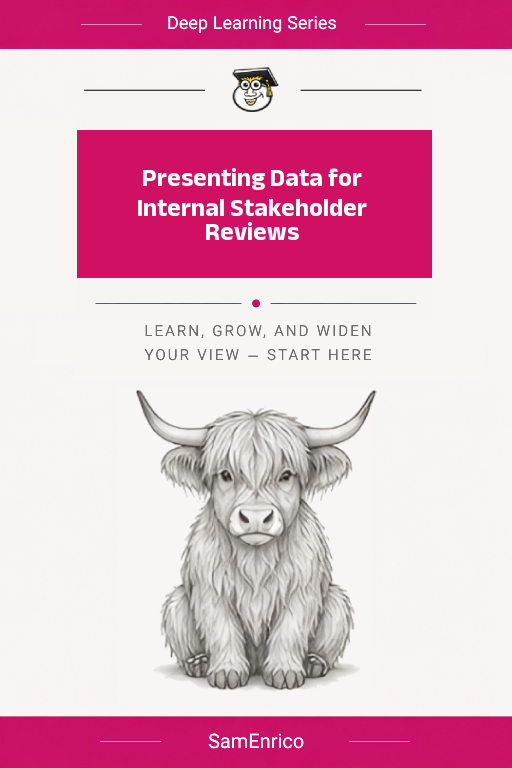
Presenting Data for Internal Stakeholder Reviews
Design data slides that align cross-functional tea
Design data slides that align cross-functional teams without debate. Show the same numbers with different annotations for each audience, and include a data dictionary appendix that ends metric definition arguments.
Formats
About this book
Free sample
Chapter 1: The Blink Test--–- The会议室 door clicks shut. Twelve executives, managers, and analysts stare at a projected slide. The chart is a dense line graph with five overlapping metrics, a legend that requires a decoder ring, and a headline that reads “Q3 Performance.” For the next ninety seconds, no one speaks. They are decoding. Then the questions begin: “What’s the blue line again?” “Is this net or gross?” “Why does it spike here?” By the time someone finally answers, the presenter has lost control.
The meeting derails into a debate about definitions, not a decision about action. This scene repeats itself in thousands of conference rooms every single day. It is the single greatest waste of time in internal data reviews, and it is entirely preventable.The Hidden Cost of Confusion Most presenters believe that the goal of a data slide is to show the data. This is wrong. The goal of a data slide is to enable a decision.
Yet the vast majority of internal data slides fail this test because they violate a simple cognitive principle: the human brain can only hold a limited amount of information in working memory at any given moment. When a slide forces stakeholders to spend their limited cognitive budget on decoding the chart itself – deciphering axes, matching legend colors to lines, parsing abbreviations – there is nothing left for analysis, pattern recognition, or decision-making. The meeting becomes a puzzle-solving exercise rather than a strategic conversation.This chapter introduces a single, transformative standard: The Blink Test. Every data slide you present internally must pass the Blink Test, meaning that within five seconds – roughly the duration of a single blink – any stakeholder in the room can answer three questions: (1) What metric am I looking at? (2) Is it good or bad relative to a target?
(3) What action does this imply? If a slide fails the Blink Test, it is not ready for review. Period.The stakes are higher than mere convenience. When stakeholders cannot quickly understand a slide, they fill the vacuum with defensiveness, skepticism, and political maneuvering. A finance leader who cannot immediately…
This is the end of the free sample. Get the eBook to keep going. Buy now
Contents
- Chapter 1
- Chapter 2
- Chapter 3
- Chapter 4
- Chapter 5
- Chapter 6
- Chapter 7
- Chapter 8
- Chapter 9
- Chapter 10
- Chapter 11
- Chapter 12
Details
- Author
- Brown Angelica
- Publisher
- SamEnrico
- Language
- English
- Genre
- Non-Fiction, Internal Communication, Stakeholder Management
- Released
- 2026-06-01
- Pages (approx.)
- 143
- Available as
- eBook, Audiobook

Read better in the ZLOADR app
Your eBooks on your phone or tablet. Sign in with your SamEnrico account and start reading.
More by Brown Angelica
 Creative Routine For EngineersBrown Angelica$11.99
 Bomb Squad Technician GuideBrown Angelica$11.99
 The Pain Energy MetaphorBrown Angelica$11.99
 Downsize to Tiny HouseBrown Angelica$11.99
 Social Entrepreneur Failure RecoveryBrown Angelica$11.99
 The Enigma of the Voynich Manuscript: Decoding the Unbreakable CodeBrown Angelica$11.99
 The Forgotten Codebreakers of the Indian Ocean: AI Before Its TimeBrown Angelica$11.99
 Understanding Familial DeafnessBrown Angelica$17.99
 Produce ManagerBrown Angelica$11.99
 CPF for Brazil DropshippingBrown Angelica$12.99
 How to Start a Dairy Cattle BusinessBrown Angelica$11.99
You may also like
 Hong Kong Handover 1997Dunn Johnnie$11.99
 Zumba For Postnatal Recovery CourseNeal Christian$11.99
 Zumba for BeginnersLadner Nikia$11.99
 YouTube Comment Mining GuideHumes Pandora$12.99
 Worry Box MeditationCarlin Rudy$11.99
 Workplace Stress MeditationNguyen Lynn$11.99
 Workplace Stress and Sleep RepairHawley Ivory$11.99
 Workplace Perfectionism CureDelaney Jeffry$11.99
 Workplace Injustice Anger GuideWallen Isabelle$11.99
 Work Addiction and Burnout LinkGreenwood Ester$11.99
 Women in Yoga and WellnessBeattie Galina$11.99
 Women in Stand Up ComedyChun Evangeline$11.99