
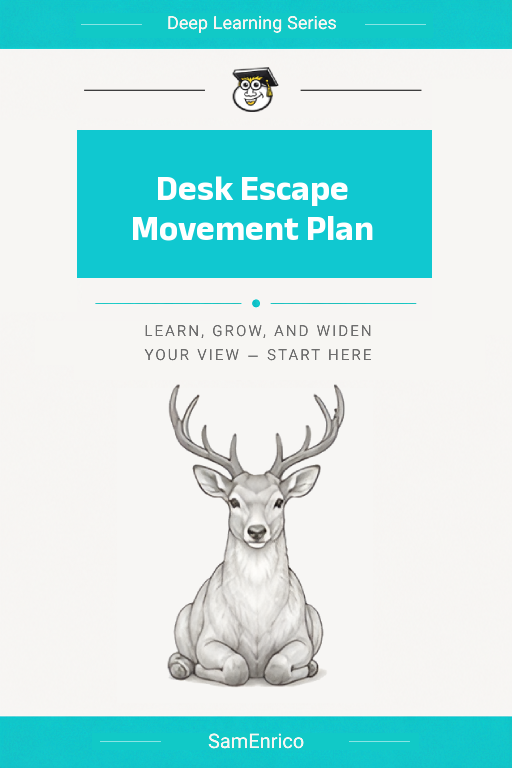
Non-FictionMental WealthWork-Life BalanceMovement Guide
Desk Escape Movement Plan eBook
Prevent physical burnout with workstation ergonomi
by Stearns Yang
Prevent physical burnout with workstation ergonomics, walking meetings, and midday movement triggers. Includes hourly reset cues, stretch-along guides, and outdoor break tracking.
Formats
Free sample
Chapter 1: The 23-Hour Problem--–- You are currently sitting. And every hour you remain seated, you are making a decision about how your 70-year-old body will feel.Let that land for a moment. Not a decision about your productivity. Not a decision about your to-do list. A decision about your future spine, your future hips, your future ability to pick up a grandchild, tie your shoes, or sleep through the night without lower back pain.Most people wake up with stiff joints and assume it is age.
They feel brain fog at 2:00 PM and assume it is lunch. They snap at their partner after a long day of Zoom calls and assume it is stress. They are wrong on all three counts. What they are experiencing is not the inevitable decay of the human body. It is the predictable consequence of a single, modifiable behavior: prolonged, uninterrupted sitting.This book is not about getting you to run marathons or join a Cross Fit box.
It is about solving what I call the 23-Hour Problem. Here is the math. The average office worker sits for nine to twelve hours per day. They sleep for seven to eight hours. That leaves roughly four to eight hours for everything else—commuting, cooking, eating, showering, errands, and, if they are lucky, thirty minutes on a Peloton or a jog around the block.
Do the math differently: twenty-three hours of relative stillness, one hour of intentional movement. The 23-Hour Problem.The fitness industry has sold you a lie. The lie is that you can out-exercise a sedentary life. It tells you that one hour of sweating in the morning buys you permission to sit for the remaining twenty-three. The science says otherwise.
A landmark study from the University of California, San Diego followed nearly 1,500 women over the age of sixty-five for twelve years. The researchers strapped accelerometers to their hips and tracked every minute of sitting, standing, and walking. The results were staggering. The women who sat for more than 11.5 hours per day had a 57 percent higher mortality rate than those who sat less. Not a 5 percent difference.
Not a 10 percent difference. Fifty-seven percent. And here is the kicker: that difference held true regardless of how much the women exercised. The women who ran marathons but sat for twelve hours a day died younger than the women who never exercised but moved frequently throughout the day.Frequency, not intensity. That is the secret the fitness industry does not want you to know.This chapter is the diagnosis.
It will tell you exactly what prolonged sitting does to your body—not in vague terms like "it is bad for you," but in precise, measurable, terrifying detail. You will learn about an enzyme called lipoprotein lipase that literally turns off when you sit. You will learn about the spinal degradation cascade that begins within twenty minutes of taking a seat. You will learn why your chair is a metabolic weapon aimed directly at your own biology. And you will learn the single most important distinction in this entire book: the difference between visible movement and invisible movement.By the end of this chapter, you will never look at your office chair the same way again.
You will perform a Sedentary Self-Audit. And you will learn the first and most fundamental skill of the Desk Escape Movement Plan: Active Inactivity, or the art of moving without stopping your work.Let us begin.The Enzyme That Dies in a Chair There is an enzyme inside your blood vessels called lipoprotein lipase. Its job is simple: it breaks down fat in the blood and converts it into energy. Think of it as a microscopic garbage disposal for dietary fat. When you eat a meal, lipoprotein lipase jumps into action, grabbing fat molecules and shuttling them into muscle tissue where they can be burned for fuel.
It is one of the most important metabolic enzymes in your body.Here is what happens when you sit. Within two to three hours of uninterrupted sitting, the activity of lipoprotein lipase drops by approximately 50 percent. Half of your fat-burning capacity simply turns off. Not because you are sick. Not because you are old.
Because you are sitting. The enzyme does not stop working because it is broken. It stops working because your muscles—specifically the large postural muscles of your legs, glutes, and back—have gone silent. Those muscles are the primary activators of lipoprotein lipase. When they are not contracting, the enzyme gets the signal to stand down.This is where the "one hour at the gym" myth collapses entirely.
Imagine you sit for ten hours straight, then go for a thirty-minute run. During that run, your lipoprotein lipase activity will spike. Wonderful. Then you sit down to dinner, watch two hours of television, and go to bed. By the time you wake up, your enzyme activity has crashed again.
The thirty-minute run did not "bank" any metabolic benefit for the following day. It was a temporary spike in a sea of suppression.The researchers who discovered this phenomenon, led by Dr. Marc Hamilton at the University of Missouri, put it bluntly: "Sitting is a textbook modifiable risk factor. We just do not treat it like one." We treat smoking as a risk factor. We treat high blood pressure as a risk factor.
We treat prolonged sitting as a lifestyle choice. It is not. It is a metabolic assault.Let me give you a concrete example. Two people eat the exact same 2,000-calorie diet. Person A sits for ten hours and exercises for one hour.
Person B sits for five hours, moves frequently throughout the day, and exercises for zero hours. Who has better metabolic health? The research is clear: Person B. Not because exercise is useless—it is not. But because the metabolic suppression of prolonged sitting is so powerful that it takes more than an hour of exercise to reverse it.
You cannot outrun your chair. You can only interrupt it.The Spinal Degradation Cascade Now let us move from your blood vessels to your spine. The human spine is a miracle of engineering. It consists of twenty-four vertebrae stacked like building blocks, separated by soft, gelatinous discs that act as shock absorbers. Those discs have no direct blood supply.
They do not get oxygen from your arteries. They get oxygen through a process called diffusion, which requires movement. Specifically, they require the spine to change shape—to flex, extend, twist, and bend—so that fluid can move in and out of the discs, bringing nutrients and carrying away waste.When you sit, especially in a slouched or hunched position, you compress the front of the discs and stretch the back of the discs unevenly. This is not inherently bad. The spine is designed to handle compression.
The problem is duration. When you hold a compressed position for hours at a time, the discs cannot rehydrate. They begin to lose height. They become brittle. Small tears form in the outer layers of the disc, called annular tears.
Those tears are painless at first. Then one day you reach for a pencil on the floor, or you sneeze, or you twist to…
This is the end of the free sample. Get the eBook to keep going. Buy now
About this book
Details
- Author
- Stearns Yang
- Publisher
- SamEnrico
- Language
- English
- Genre
- Non-Fiction, Mental Wealth, Work-Life Balance, Movement Guide
- Released
- 2026-05-30
- Pages (approx.)
- 145
- Available as
- eBook, Audiobook

Read better in the ZLOADR app
Your eBooks on your phone or tablet. Sign in with your SamEnrico account and start reading.
More by Stearns Yang
 Phobia Catastrophic ThinkingStearns Yang$11.99
 Habit Stacking Goal MethodStearns Yang$11.99
 Snapchat Spotlight ComparisonStearns Yang$11.99
 The Assertive ApologyStearns Yang$11.99
 The Alcohol Freedom Evening RoutineStearns Yang$11.99
 The Vanishing Act of the Blackbeard’s ShadowStearns Yang$11.99
 A Beginners Guide to Blokus (Volume 1)Stearns Yang$11.99
 Understanding Intercellular Cholesterol Esterification DiseaseStearns Yang$17.99
 Experiential Spending Trends GuideStearns Yang$12.99
 CoronerStearns Yang$11.99
You may also like
 Hong Kong Handover 1997Dunn Johnnie$11.99
 Zumba For Postnatal Recovery CourseNeal Christian$11.99
 Zumba for BeginnersLadner Nikia$11.99
 YouTube Comment Mining GuideHumes Pandora$12.99
 Worry Box MeditationCarlin Rudy$11.99
 Workplace Stress MeditationNguyen Lynn$11.99
 Workplace Stress and Sleep RepairHawley Ivory$11.99
 Workplace Perfectionism CureDelaney Jeffry$11.99
 Workplace Injustice Anger GuideWallen Isabelle$11.99
 Work Addiction and Burnout LinkGreenwood Ester$11.99
 Women in Yoga and WellnessBeattie Galina$11.99
 Women in Stand Up ComedyChun Evangeline$11.99