
Non-FictionMental WealthWorkplace Wellness
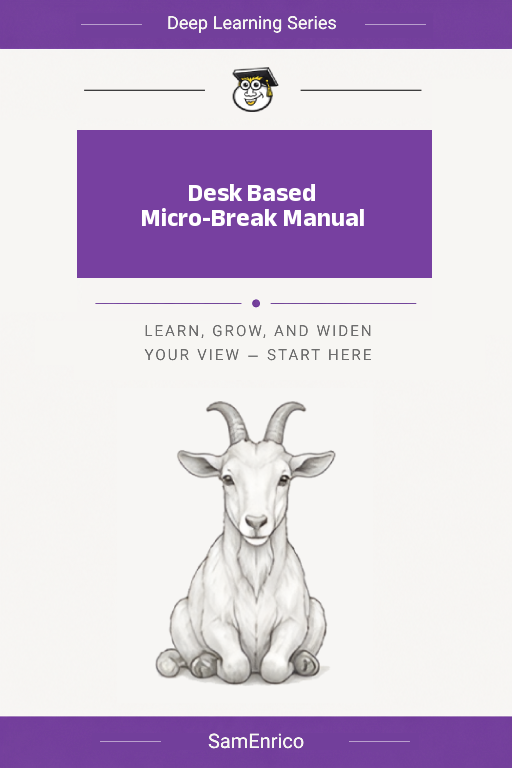
Desk Based Micro-Break Manual eBook
Perform 19 subtle exercises at your workstation th
Perform 19 subtle exercises at your workstation that reset your nervous system without leaving your chair.
Formats
Free sample
Chapter 1: The Desk Trap--–- You are reading this while sitting down. Notice how that feels for a moment. Not the content of the sentence, but the physical reality of your body. Are your shoulders rounded forward? Is your jaw lightly clenched?
Are you breathing into your upper chest rather than your belly? These are not signs of laziness or poor discipline. They are the predictable, mechanical consequences of a position the human body was never designed to hold for eight hours at a time. And they are silently fracturing your nervous system in ways that no amount of evening yoga or weekend hiking can fully repair.The chair you are sitting on right now is not neutral furniture. It is a piece of technology that shapes your physiology from the inside out, often without your conscious awareness.
When you sit, especially in the way most office chairs encourage you to sit—hips flexed to ninety degrees, spine slumped into the backrest, head jutting forward to meet a screen—you are asking your body to do something it interprets as a low-grade threat. The body does not know the difference between a deadline and a predator. It only knows posture, breath, and tension patterns. And when those patterns resemble freezing, hiding, or preparing for impact, the nervous system responds accordingly.This chapter is not about posture correction in the conventional sense. You will not be told to “sit up straight” as if that were a simple matter of willpower.
Instead, this chapter will teach you to read the language of your own autonomic nervous system—the ancient, unconscious network that decides whether you feel safe, threatened, or collapsed. By the end of these pages, you will be able to identify your current nervous system state in under thirty seconds, and you will understand why the twenty-four exercises in this book work not by strengthening muscles, but by sending specific safety signals to your brainstem. This is the foundation upon which every micro-break is built.The Autonomic Nervous System: Your Internal Security Guard Every moment of your life, your nervous system is asking one question: Am I safe? It does not ask this question in words, but in physiological tone. Think of your autonomic nervous system as a security guard who never sleeps, stationed at the base of your skull, constantly scanning your internal and external environment for signs of danger or safety.
This security guard has three primary responses, and you have experienced all of them in the last week, probably within the last few hours.The first response is mobilization, more commonly known as the fight-or-flight response. This is the sympathetic branch of your nervous system. When activated, your heart rate increases, your pupils dilate, your breathing becomes shallow and fast, and blood rushes to your large muscles. This is excellent for running from a predator or meeting an urgent deadline. The problem is that modern desk work keeps you in a low-grade sympathetic state for hours on end—not full panic, but a persistent hum of alertness that never quite turns off.
You know this state. It is the feeling of checking email at 10 PM, the jaw tension during a difficult Zoom call, the inability to fully relax even when you close your laptop.The second response is immobilization, specifically the dorsal vagal branch of the parasympathetic system. This is the freeze or shutdown response. It is the nervous system’s last resort when mobilization fails or when the threat is inescapable. In this state, your heart rate slows, your breathing becomes shallow but irregular, your limbs feel heavy, and you may experience dissociation or brain fog.
This is the feeling of staring at a blank screen for ten minutes, of nodding along in a meeting while feeling completely checked out, of the post-lunch stupor that no amount of coffee seems to lift. Desk work triggers this state through monotony, social defeat (difficult feedback, office politics), and prolonged immobility.The third response is social engagement, or the ventral vagal state. This is the only state in which you are truly resilient, creative, and connected. In ventral vagal, your heart rate is variable (high HRV), your breathing is slow and diaphragmatic, your facial muscles are relaxed, and you are capable of eye contact, listening, and flexible thinking. This is the state you want to inhabit for deep work, difficult conversations, and creative problem-solving.
It is also the state that desk work actively erodes.Here is the crucial insight: these three states are not fixed traits. They are fluid, moment-to-moment physiological realities that shift in response to internal and external cues. The good news is that you can influence them deliberately, from the bottom up, using your body to signal safety to your brain. That is exactly what every exercise in this book is designed to do.Polyvagal Theory for Desk Workers The framework described above comes from polyvagal theory, developed by Dr. Stephen Porges and popularized in books like The Body Keeps the Score.
At its heart is a deceptively simple idea: the vagus nerve, the tenth cranial nerve, acts as a two-way communication superhighway between your brain and your organs. But not all vagal activity is the same. The “poly” in polyvagal refers to the fact that the vagus nerve has multiple branches with different functions.The dorsal vagal branch (the older, more primitive one) is responsible for immobilization. The ventral vagal branch (newer, unique to mammals) is responsible for social engagement. When your ventral vagal circuit is active, it literally inhibits the sympathetic fight-or-flight response and dampens the dorsal shutdown response.
It acts as a brake on the stress response.For desk workers, this is revolutionary. It means that you are not at the mercy of your stress. You can intentionally activate the ventral vagal brake using small, specific movements. These movements act as ventral vagal anchors—sensory cues that tell your brainstem “you are safe” faster than conscious thought can intervene. A sternum tap, a soft palate yawn, a slow exhalation that is longer than your inhalation—these are not just relaxation techniques.
They are direct physiological interventions that shift your nervous system state from the bottom up.Throughout this book, you will encounter twenty-four such anchors. Each one is designed to be performed at your desk, in your chair, in fifteen to sixty seconds. Some are mechanical (tapping, stretching), some are breath-driven, some target visceral afferents from your gut, and some work through proprioceptive or vascular pathways. Chapter 4 contains a detailed map of these four pathways. For now, the only thing you need to understand is that your body already knows how to do this.
You have yawned to calm yourself before. You have taken a deep breath before speaking. You have shaken out your hands after typing too long. This book simply systematizes those instincts into a reliable toolkit.The Three Signals: Breath, Eyes, Jaw Before you can reset your nervous system, you need to know which state you are currently in. The following self-assessment takes thirty seconds and requires no equipment.
It is based on three signals that are always available to you: your breath, your eyes, and your jaw.Signal One: Breath Place…
This is the end of the free sample. Get the eBook to keep going. Buy now
About this book
Details
- Author
- Galvan Catheryn
- Publisher
- SamEnrico
- Language
- English
- Genre
- Non-Fiction, Mental Wealth, Workplace Wellness
- Released
- 2026-05-29
- Pages (approx.)
- 142
- Available as
- eBook, Audiobook

Read better in the ZLOADR app
Your eBooks on your phone or tablet. Sign in with your SamEnrico account and start reading.
More by Galvan Catheryn
 Recurring Nightmares in ChildrenGalvan Catheryn$11.99
 Hinton Compensation After ReleaseGalvan Catheryn$11.99
 Full Retirement Age CalculationGalvan Catheryn$11.99
 Reconstruction of Patricide CasesGalvan Catheryn$11.99
 Pomodoro for ParamedicsGalvan Catheryn$11.99
 Method Of Loci For Coding SyntaxGalvan Catheryn$11.99
 Irish Famine British NeglectGalvan Catheryn$11.99
 Dream Journaling for PTSDGalvan Catheryn$11.99
 The Beirut Bank Heist: The Counterfeit Crisis That Shook the Middle EastGalvan Catheryn$11.99
 The Luthiers of the Andes: Crafting Soul into Strings (1500s)Galvan Catheryn$11.99
 How to Produce PotatoesGalvan Catheryn$11.99
 How to Produce Drinking Straws and StirrersGalvan Catheryn$11.99
You may also like
 Hong Kong Handover 1997Dunn Johnnie$11.99
 Zumba For Postnatal Recovery CourseNeal Christian$11.99
 Zumba for BeginnersLadner Nikia$11.99
 YouTube Comment Mining GuideHumes Pandora$12.99
 Worry Box MeditationCarlin Rudy$11.99
 Workplace Stress MeditationNguyen Lynn$11.99
 Workplace Stress and Sleep RepairHawley Ivory$11.99
 Workplace Perfectionism CureDelaney Jeffry$11.99
 Workplace Injustice Anger GuideWallen Isabelle$11.99
 Work Addiction and Burnout LinkGreenwood Ester$11.99
 Women in Yoga and WellnessBeattie Galina$11.99
 Women in Stand Up ComedyChun Evangeline$11.99