
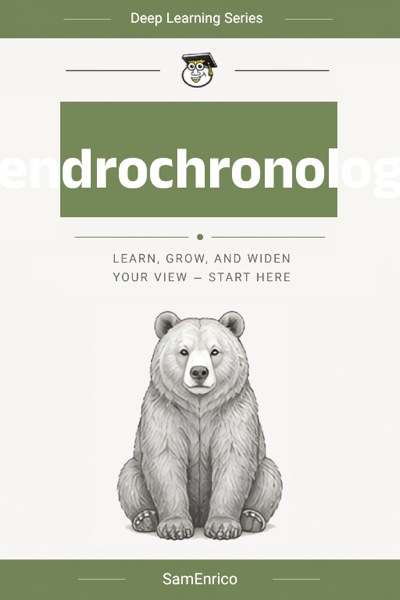
Non-FictionInformativeEducational
Dendrochronology eBook
A Coursebook on Dendrochronology
A Coursebook on Dendrochronology
Formats
Free sample
Chapter 1: The Silent Archivists...--–- Every tree tells a story, but only those who learn to read the rings can hear it. On a cool autumn morning in the White Mountains of California, a gnarled bristlecone pine stands exposed to the wind, its twisted form shaped by nearly five millennia of snow, drought, and sunlight. A few hundred meters away, a graduate student kneels beside a fallen log—dead for a thousand years—and extracts a core the width of a drinking straw. She will take this core back to a laboratory, mount it on a stage, and begin to count. Not just rings.
Years. She will match the pattern of wide and narrow rings from the dead log to the pattern from the living tree, sliding the two sequences back and forth until they lock into place like puzzle pieces. When they do, she will have done something extraordinary: she will have assigned a precise calendar year to every single growing season in that log’s life, some of them from an era when the Roman Empire was collapsing and the Maya were building their great cities. She will have reached across time and touched a specific summer—perhaps a wet one, perhaps a dry one—over a millennium ago. This is dendrochronology.
It is not merely the counting of tree rings. It is the science of absolute time, the art of reading environmental history year by year, and arguably the most precise dating method available to the natural and human sciences.–- Dendrochronology derives from three Greek roots: dendron (tree), chronos (time), and logos (study). At its simplest, it is the science of dating and studying tree rings. But to describe it so simply is like describing a symphony as a collection of notes. Tree rings are annual time capsules.
Each ring contains information about the growing conditions of a single year—how much rain fell, how warm the summer was, whether a fire swept through the forest, whether an insect outbreak defoliated the canopy. When we extract a core from a living tree, we retrieve a chronological record that may span centuries. When we match that record to older deadwood, and that to even older subfossil logs, we can extend the timeline backward for thousands, even tens of thousands of years. No other paleoenvironmental proxy—not ice cores, not lake sediments, not cave stalagmites—offers the combination of annual resolution and absolute dating certainty that tree rings provide. Ice cores can be dated, but with uncertainty; radiocarbon is powerful but requires calibration; sediment layers may be annual but are often disturbed.
Tree rings, when properly crossdated, give you the year, sometimes even the season.Why Trees? The Unrivaled Bioindicator–- Not every organism makes a good archive. To preserve environmental history, an organism must be sessile (unable to relocate away from stress), sensitive to its environment, long-lived, and geographically widespread. Trees satisfy all these conditions with remarkable fidelity. A tree cannot flee a drought; it must endure it, and its rings record that endurance.
A tree integrates environmental conditions across an entire growing season, not just a single day’s snapshot. And trees are everywhere: from the boreal forests of Siberia to the tropical rainforests of the Amazon, from sea-level mangroves to alpine treelines at 4,000 meters. Wherever wood forms, dendrochronology can potentially follow.–- Consider the difference between a bioindicator and a passive archive. A lake sediment accumulates particles that settle from the water column; those particles may be re-suspended, mixed by burrowing organisms, or disturbed by currents. An ice core preserves atmospheric gases and particulates, but annual layers thin with depth, and melting can obscure boundaries.
A tree ring, in contrast, is formed by the vascular cambium—a thin layer of dividing cells just beneath the bark—and once formed, that ring is permanent. It does not get mixed, re-suspended, or overwritten. It remains locked in the wood, a faithful record of the year it was created. This is why dendrochronology has become the gold standard for calibrating other dating methods, most notably radiocarbon dating. Without tree rings, every radiocarbon date would be an approximation; with tree rings, we can correct for atmospheric fluctuations and assign calendar ages with confidence.Relative Versus Absolute Dating: A Critical Distinction–- To understand why dendrochronology is revolutionary, one must understand the difference between relative and absolute dating.
Relative dating places events or objects in sequence without assigning specific calendar years. If an archaeologist says, “This pottery style is older than that one,” or “This stratum lies below that one, so it must be earlier,” they are using relative dating. It tells you what came first, but not when. Absolute dating, by contrast, assigns a specific calendar year (or range of years) to an event. “This beam was cut in the winter of 1472 AD” is an absolute date.
“This tree germinated in the spring of 832 BCE” is an absolute date.–- Most scientific dating methods provide absolute dates only within margins of error, and those margins are often large. Radiocarbon dating, for example, returns a result like “1,200 ± 30 radiocarbon years before present,” which, after calibration, might become “1,350–1,420 calendar years before present.” That is a seventy-year window. Dendrochronology can often narrow that window to a single year. When a tree ring contains the bark edge—the final ring formed just beneath the bark before the tree was cut—the date of that outermost ring is the exact year the tree died. If the last ring is incomplete (earlywood present but no latewood), we can even say the tree was felled in the spring.
This is forensic precision.The Temporal Span: How Far Back Can We Go?–- One of the first questions a student asks is, “How old do trees get?” The answer varies dramatically by species and environment. The oldest living individual trees are the Great Basin bristlecone pines (Pinus longaeva) of California and Nevada, with one specimen—named Methuselah—germinated approximately 4,850 years ago, around 2832 BCE. That is older than the oldest Egyptian pyramid (the Pyramid of Djoser, built ~2670 BCE). Methuselah was already a century old when the first stone of the Great Pyramid of Giza was laid. To put that in perspective: the entire recorded history of human civilization fits within the lifespan of a single bristlecone pine.–- But living trees are only the beginning.
By matching living trees to deadwood lying on the forest floor, then to older logs preserved in bogs, lakes, and archaeological sites, researchers extend chronologies backward in time. The longest continuous tree-ring chronology currently stands at approximately 14,000 years, built from a combination of bristlecone pine, European oak, and subfossil kauri (Agathis australis) from New Zealand. However, it is important to note that maximum length varies by region and species: bristlecone pine reaches about 9,000 years in continuous chronology; European oak reaches about 7,400 years (the Belfast Long Chronology, built by Mike Baillie and colleagues); and subfossil kauri logs have been radiocarbon-dated to 50,000 years, though not continuously annually resolved for the full length. When we say “tree-ring chronologies extend back 14,000 years,” we mean that there is an unbroken annual sequence of rings—each ring assigned to a specific calendar year—covering that entire…
This is the end of the free sample. Get the eBook to keep going. Buy now
About this book
Details
- Author
- Burdette Marketta
- Publisher
- SamEnrico
- Language
- English
- Genre
- Non-Fiction, Informative, Educational
- Released
- 2026-06-02
- Pages (approx.)
- 124
- Available as
- eBook, Audiobook

Read better in the ZLOADR app
Your eBooks on your phone or tablet. Sign in with your SamEnrico account and start reading.
More by Burdette Marketta
 The Shopping Cart HandleBurdette Marketta$11.99
 Hearst King FeaturesBurdette Marketta$11.99
 Food Addiction And Trauma ConnectionBurdette Marketta$11.99
 Gambling Cue Detection CourseBurdette Marketta$11.99
 The Library Overcrowding StressBurdette Marketta$11.99
 Remote Introvert Communication GuideBurdette Marketta$11.99
 Anticipatory Grief and MeaningBurdette Marketta$11.99
 Maternal Gatekeeping ChildhoodBurdette Marketta$11.99
 Swimmer Shoulder Flexibility CourseBurdette Marketta$11.99
 The Curse of the Cardinal: How a 31-Year Title Drought Shaped a DynastyBurdette Marketta$11.99
 The Golden Voice of Axum: The Hymns of King Ezana and the Birth of African Christian MusicBurdette Marketta$11.99
 Frozen Rivalry: The Race to the North Pole and the Men Who Defined ItBurdette Marketta$11.99
You may also like
 Hong Kong Handover 1997Dunn Johnnie$11.99
 Zumba For Postnatal Recovery CourseNeal Christian$11.99
 Zumba for BeginnersLadner Nikia$11.99
 YouTube Comment Mining GuideHumes Pandora$12.99
 Worry Box MeditationCarlin Rudy$11.99
 Workplace Stress MeditationNguyen Lynn$11.99
 Workplace Stress and Sleep RepairHawley Ivory$11.99
 Workplace Perfectionism CureDelaney Jeffry$11.99
 Workplace Injustice Anger GuideWallen Isabelle$11.99
 Work Addiction and Burnout LinkGreenwood Ester$11.99
 Women in Yoga and WellnessBeattie Galina$11.99
 Women in Stand Up ComedyChun Evangeline$11.99