
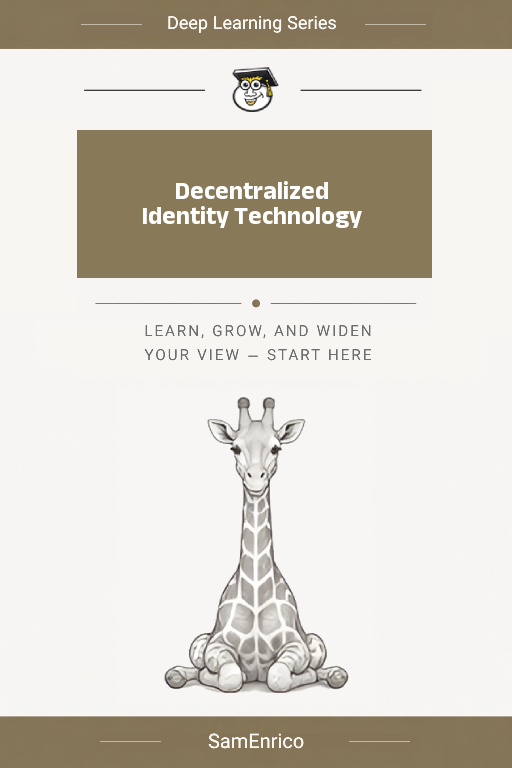
Non-FictionForecast & OutlookSSI
Decentralized Identity Technology eBook
Explore blockchain-based digital IDs giving users
Explore blockchain-based digital IDs giving users control over their personal data while enabling frictionless KYC across institutions.
Formats
Free sample
Chapter 1: The Orphaned Self...--–- You do not own your digital identity. You rent it from institutions that see you as a liability, and the lease can be revoked at any time.This is not a philosophical statement. It is a technical fact. Every time you log into a website, every time you swipe a loyalty card, every time you submit a driver's license scan to a car rental counter, you are surrendering fragments of yourself to databases you cannot see, controlled by people you have never met, secured by measures you are not allowed to audit. And when those databases are breached—not if, but when—you are the one who suffers the consequences.
The institution will issue a press release, offer two years of credit monitoring, and move on. You will spend the next decade untangling identity theft, explaining to collections agencies that you did not take out that loan, and wondering why the digital world treats you like a stranger in your own life.This chapter traces the history of how we arrived at this broken model, explains why the username and password is mathematically doomed, and lays the foundation for everything that follows. Because before we can build something better, we must understand exactly how the current system failed—and why it was designed to fail from the very beginning.The Mainframe Era: When You Were Just a Record in Someone Else's File The story of digital identity begins in the 1970s, not with the internet but with mainframe computers. In that era, a computer was a room-sized machine kept behind locked doors, accessible only to trained operators. If you were a bank customer, your identity existed as a record in that mainframe's database.
If you were a hospital patient, your medical history was a file on a tape reel. If you were a university student, your grades lived on a disk pack that no student could ever touch.This model worked because the scale was small. A single mainframe served a single organization. The users of that system were employees, not customers. Access Control Lists (ACLs)—simple tables that said "User X can read File Y"—were sufficient because the number of users was measured in hundreds, not billions.
The database was a silo, and that was fine because the silo did not need to talk to any other silo.Then came the personal computer revolution of the 1980s, followed by the commercial internet of the 1990s, and suddenly those silos needed to communicate. Banks needed to talk to credit bureaus. Hospitals needed to share records with insurers. Retailers needed to verify payment information with card networks. And at every point of connection, the same problem emerged: how does System A know that the person claiming to be User X in System B is actually User X?The answer, for three decades, has been the password.The Password's False Promise The password is a shared secret.
You type it into a website; the website compares it to a stored hash; if they match, you are granted access. This is simple, it is familiar, and it is catastrophically insecure for reasons that were understood as early as 1979 when Ken Thompson, co-creator of Unix, warned that password systems were fundamentally untrustworthy.The first problem is that passwords rely on human memory. Humans are terrible at remembering random strings of sufficient length and complexity. When left to their own devices, people choose "password," "123456," and their own names. When forced to create complex passwords, they write them on sticky notes attached to monitors or reuse the same password across dozens of sites.This last behavior—password reuse—is the single greatest vulnerability in the modern digital identity system.
According to a 2022 study by the Virginia Tech Department of Computer Science, the average internet user has 240 digital accounts but only remembers 12 unique passwords. The rest are variations or outright repetitions. This means that when a low-security site like a forum or a recipe website gets breached—and they get breached constantly—the attacker now has a working email and password combination that will likely unlock that user's bank account, email account, and social media profiles.This is called credential stuffing, and it is not theoretical. In 2019, security researchers at Akamai observed over 88 billion credential stuffing attacks, representing nearly 90% of all login traffic on major platforms. Attackers do not need to guess passwords; they simply take the millions of email-password pairs leaked from previous breaches and try them everywhere else.
It is a numbers game, and the numbers overwhelmingly favor the attacker.The second problem is that passwords require a centralized database of hashes. Even if a company does everything right—salted hashes, bcrypt or Argon2 algorithms, regular security audits—that database remains a single point of failure. Every password hash stored is a potential key to the kingdom, and attackers have become extraordinarily sophisticated at cracking them.The Great Breaches: A Catalog of Systemic Failure Consider the 2017 Equifax breach. Equifax, one of the three major credit bureaus in the United States, stored the personal data of nearly every adult American with a credit history. This included names, Social Security numbers, birth dates, addresses, and in some cases, driver's license numbers and credit card information.
The breach occurred because a single unpatched server—one server among thousands—went unnoticed for 76 days. Attackers exploited a vulnerability in the Apache Struts framework, a piece of open-source software that Equifax had failed to update. The result: 147 million records exposed.Not 147,000. Not 1.47 million. One hundred forty-seven million.
That is roughly half the adult population of the United States.The response was telling. Equifax's chief executive stepped down. The company offered free credit monitoring. A class-action lawsuit eventually settled for up to $700 million. But the data cannot be un-exposed.
Those Social Security numbers, birth dates, and addresses are permanently in the hands of criminals. They will be used for identity theft for decades to come. And every single one of those 147 million victims is now permanently more vulnerable than they were before—not because of anything they did, but because a company they never chose to do business with collected their data without their consent and failed to protect it.The Marriott breach of 2018 followed a similar pattern but with an even longer timeline. Attackers gained access to Marriott's Starwood reservation system in 2014 and remained undetected for four years. During that time, they exfiltrated 500 million guest records, including passport numbers, payment card information, and travel histories.
Four years. The attackers had more time inside Marriott's network than many employees spend at the company.The Facebook breach of 2019 was different in mechanism but identical in outcome. Two separate datasets, totaling 540 million records, were found exposed on public cloud servers. Not hacked, not breached through sophisticated intrusion—simply left on an unsecured server where anyone with an internet connection could download them. The data included phone numbers, account names, and Facebook IDs, all cross-referenced and ready for use in targeted phishing campaigns.These are not isolated incidents.
They are symptoms of a structural flaw. As long as personal data is aggregated in centralized databases, those databases will be breached. The only variables are time and scale.The Economics…
This is the end of the free sample. Get the eBook to keep going. Buy now
About this book
Details
- Author
- Wooden Catrina
- Publisher
- SamEnrico
- Language
- English
- Genre
- Non-Fiction, Forecast & Outlook, SSI
- Released
- 2026-05-29
- Pages (approx.)
- 129
- Available as
- eBook, Audiobook

Read better in the ZLOADR app
Your eBooks on your phone or tablet. Sign in with your SamEnrico account and start reading.
More by Wooden Catrina
 Pain Neuroscience Podcast GuideWooden Catrina$11.99
 Brand Value Assortment OptimizationWooden Catrina$11.99
 The Fourth Step Inventory WorkbookWooden Catrina$11.99
 Exercise Time Blocking GuideWooden Catrina$11.99
 Nefertiti's Lost Hymn: The Sun Queen's Forgotten MelodyWooden Catrina$11.99Nefertiti's Lost Hymn: The Sun Queen's Forgotten MelodyWooden Catrina$11.99
 Ashes of the Sky: The Day Mount Pinatubo Blew Up the WorldWooden Catrina$11.99
 Slash Career Builder HandbookWooden Catrina$12.99
 Understanding Hyperostosis Cortical InfantileWooden Catrina$17.99
 Territory RepresentativeWooden Catrina$11.99
You may also like
 Hong Kong Handover 1997Dunn Johnnie$11.99
 Zumba For Postnatal Recovery CourseNeal Christian$11.99
 Zumba for BeginnersLadner Nikia$11.99
 YouTube Comment Mining GuideHumes Pandora$12.99
 Worry Box MeditationCarlin Rudy$11.99
 Workplace Stress MeditationNguyen Lynn$11.99
 Workplace Stress and Sleep RepairHawley Ivory$11.99
 Workplace Perfectionism CureDelaney Jeffry$11.99
 Workplace Injustice Anger GuideWallen Isabelle$11.99
 Work Addiction and Burnout LinkGreenwood Ester$11.99
 Women in Yoga and WellnessBeattie Galina$11.99
 Women in Stand Up ComedyChun Evangeline$11.99