
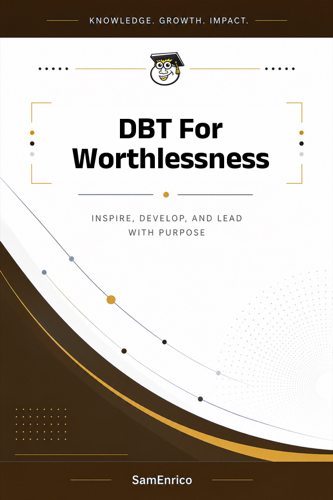
Non-FictionSelf-HelpSelf Worth
DBT For Worthlessness eBook
Use checking facts and building mastery to challen
Use checking facts and building mastery to challenge low self-worth beliefs.
Formats
Free sample
Chapter 1: The Worthlessness Lie--–- You wake up and the first voice you hear is your own, telling you that you are not enough. Not smart enough, not productive enough, not lovable enough, not worth the space you occupy. This voice does not shout. It whispers with the calm authority of absolute truth. It has been with you for so long that you no longer recognize it as a voice at all.
You recognize it as reality.If you opened this book, chances are that voice has won more arguments than you care to count. You have tried to fight it with logic: "I have a job, friends, a roof over my head – clearly I have some value." But the voice barely pauses. It says, "Yes, but you could be doing better. You don't really deserve those things. They just haven't figured you out yet." You have tried to fight it with achievement: you worked harder, earned more, helped everyone who asked.
And for a moment, the voice went quiet. Then it returned with a new demand. You have tried to fight it with self-care, with meditation, with positive affirmations that felt like lies. Nothing stuck.This chapter is not going to tell you to "just love yourself." It is not going to give you ten easy steps to self-esteem. It is going to do something more useful: it is going to show you that the voice of worthlessness is not a truth-teller.
It is a feeling dressed up as a fact. And once you learn to see the costume, you can never unsee it.The Difference Between Feeling Worthless and Being Worthless Let us begin with a distinction that will save you years of confusion. There is a vast difference between feeling worthless and being worthless. One is an emotion. The other is an objective state.
Emotions change. They arrive, they peak, they fade, they return. Objective states – like being 6 feet tall or having brown eyes – do not change with a good night's sleep or a kind word from a friend.When you say "I am worthless," you are making a claim about objective reality. You are saying that your existence has no value, that you contribute nothing, that you are beneath consideration. That is a very heavy claim.
To prove it, you would need evidence that holds up in a courtroom. You would need to show that across every domain of your life – as a friend, a worker, a human being – you consistently produce nothing of value. You would need to show that no one has ever been glad to see you, that you have never helped anyone, that you have never learned or grown or tried. That evidence does not exist. Not for you.
Not for anyone.What does exist is a feeling. A hot, heavy, suffocating feeling that tells you you are not enough. That feeling is real. It hurts. It deserves compassion.
But it is not evidence. A nightmare feels real while you are in it, but that does not make the monsters factual. The feeling of worthlessness is the nightmare. This book is the alarm clock.Why Your Brain Lies to You About Your Value The human brain evolved to survive, not to be happy. It evolved to detect threats, remember dangers, and keep you small enough to avoid predators.
In the ancestral environment, the worst thing you could do was stand out. Standing out got you eaten. So your brain developed a negativity bias: it pays more attention to bad things than to good things, because bad things could kill you.This bias is still running in the background of every thought you have. When you make one mistake at work and receive ten compliments, your brain will replay the mistake on loop. When you have a hundred good interactions and one awkward silence, your brain will dissect the silence for hours.
That is not because you are broken. That is because your brain is doing exactly what evolution designed it to do: scan for danger.The danger, in your case, is social rejection. Worthlessness is the brain's way of saying, "If you believe you have no value, you won't take risks, and if you don't take risks, you won't be rejected, and if you aren't rejected, you won't die alone on the savanna." It is a strategy. A very old, very crude, very painful strategy. But it is not truth.Shame Versus Worthlessness: A Critical Distinction One of the most common confusions in self-help literature is the interchangeable use of the words "shame" and "worthlessness." They are not the same.
Understanding the difference is the first real skill this book will teach you.Shame is about a specific action or state. Shame says, "I did something bad," or "I have a trait that is socially undesirable." Shame has a target. It is uncomfortable, sometimes excruciating, but it is also useful. Shame tells you when you have violated your own values or the norms of a community you care about. Healthy shame motivates repair: you apologize, you change your behavior, you make amends, and the shame fades.Worthlessness is about your entire identity.
Worthlessness says, "I am bad." Not what you did. Not a trait you possess. Your very existence. Worthlessness has no target because it is the target. You are the problem.
And if you are the problem, there is nothing to repair except your entire self – which feels impossible. So worthlessness leads not to repair but to paralysis. Why try if the problem is you?This book is about worthlessness. But shame is often the doorway. Many people feel shame about a specific event (I yelled at my child, I failed a test, I lied to a friend) and then their brain generalizes that shame into worthlessness (I yelled, therefore I am a bad parent; I failed, therefore I am a failure).
The chapters that follow will teach you how to stop that generalization. But for now, simply practice noticing the difference.A Quick Self-Check for Right Now: Think of the last time you felt bad about yourself. Was the thought "I did something wrong" (shame) or "I am wrong" (worthlessness)? If it was worthlessness, does that thought include any specific, observable behavior? Or is it just a fog?The Three Minds of DBT: Emotion, Reason, and Wise DBT (Dialectical Behavior Therapy) was developed by psychologist Marsha Linehan to help people with overwhelming emotions.
One of its most useful tools is the model of three "minds." Understanding these minds will help you see why fighting worthlessness with logic alone has failed you.Emotion Mind is when your feelings are driving the bus. In Emotion Mind, your thoughts are flooded with heat, urgency, and conviction. You believe whatever the emotion tells you. When you are angry, you believe you have been wronged. When you are afraid, you believe danger is imminent.
When you are in the grip of worthlessness, you believe you have no value. Emotion Mind feels 100% true. That is its job. It is not designed for accuracy; it is designed for action.Reasonable Mind is when logic and facts are driving the bus. In Reasonable Mind, you are cool, analytical…
This is the end of the free sample. Get the eBook to keep going. Buy now
About this book
Details
- Author
- Skinner Mayola
- Publisher
- SamEnrico
- Language
- English
- Genre
- Non-Fiction, Self-Help, Self Worth
- Released
- 2026-06-06
- Pages (approx.)
- 150
- Available as
- eBook, Audiobook

Read better in the ZLOADR app
Your eBooks on your phone or tablet. Sign in with your SamEnrico account and start reading.
More by Skinner Mayola
 Childhood Trauma Dream DecoderSkinner Mayola$11.99
 Denmark Norway Napoleonic Wars GuideSkinner Mayola$11.99
 The Assertive Neurodivergent GuideSkinner Mayola$11.99
 The Roman Room Technique GuideSkinner Mayola$11.99
 The Blood and Gold of Cajamarca: Pizarro’s Gambit (1532)Skinner Mayola$11.99
 Gameroom AttendantSkinner Mayola$11.99
 Grant Writing as EvidenceSkinner Mayola$12.99
 Chinese Negotiation TacticsSkinner Mayola$12.99
 Understanding Syndrome of Inappropraite Antidiuretic HormoneSkinner Mayola$17.99
 How to Start a Muslin Dressing Business (Beginners Guide)Skinner Mayola$11.99
You may also like
 Hong Kong Handover 1997Dunn Johnnie$11.99
 Zumba For Postnatal Recovery CourseNeal Christian$11.99
 Zumba for BeginnersLadner Nikia$11.99
 YouTube Comment Mining GuideHumes Pandora$12.99
 Worry Box MeditationCarlin Rudy$11.99
 Workplace Stress MeditationNguyen Lynn$11.99
 Workplace Stress and Sleep RepairHawley Ivory$11.99
 Workplace Perfectionism CureDelaney Jeffry$11.99
 Workplace Injustice Anger GuideWallen Isabelle$11.99
 Work Addiction and Burnout LinkGreenwood Ester$11.99
 Women in Yoga and WellnessBeattie Galina$11.99
 Women in Stand Up ComedyChun Evangeline$11.99