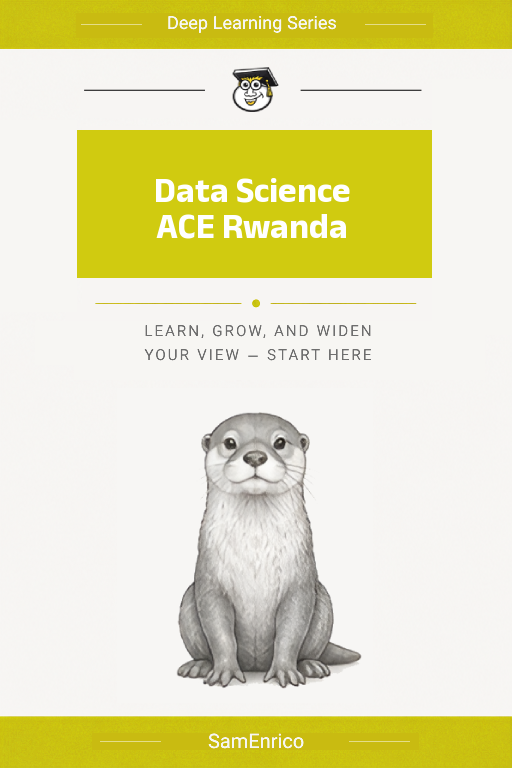
Data Science ACE Rwanda eBook
Pursues master's in Data Science at African Center
by Fite Elke
Pursues master's in Data Science at African Center of Excellence in Data Science at UR, with industry partnerships and research opportunities.
Formats
Free sample
Chapter 1: The Wrong Model--–- In 2019, a Master’s student named Javan Juma built a model that predicted insurance default risk in rural Rwanda. His model was wrong. Not a little wrong—catastrophically wrong. It told insurers to deny coverage to the very farmers who needed it most.Javan didn’t fail because he couldn’t code. He had mastered Python, could wrangle messy data in his sleep, and had even taught himself a bit of Tensor Flow on the side.
By any technical measure, he was a competent data scientist. The problem wasn’t his skill. The problem was the textbooks he studied.Every book on his shelf was written in Boston, San Francisco, or London. Every dataset in his online courses came pre-cleaned, pre-labeled, and pre-packaged. Every assumption about data completeness, internet connectivity, and even the meaning of the word “address” was built for a world that did not exist in rural Rwanda.Javan learned this the hard way.
His model used mobile phone transaction data to predict which smallholder farmers would default on microinsurance loans. The logic was sound: farmers who consistently saved money via mobile money were lower risk. The methodology was standard: a gradient-boosted tree trained on historical data. The problem was the data itself. Half the farmers in his training set had no mobile money history—not because they didn’t save, but because they saved in cash under their mattresses.
The model interpreted missing data as “high risk.” It penalized the poorest farmers for being poor.When Javan presented his results to the insurance partner, a woman named Claudine, who had spent twenty years underwriting risk in the Rwandan countryside, looked at his confusion matrix and said something he never forgot: “Your model is mathematically beautiful. It is also morally wrong.”That moment—the collision of technical competence and contextual failure—is the reason this book exists.The Problem with Silicon Valley Textbooks Data science, as taught by the global bestsellers, assumes a world of abundance. Abundant data. Abundant computing power. Abundant clean records.
Abundant stable internet. These assumptions are reasonable if you work at Google, Shopify, or J.P. Morgan. They are actively dangerous if you work in a Ministry of Health trying to predict malaria outbreaks, an agricultural cooperative trying to optimize fertilizer distribution, or an insurance company trying to serve rural farmers.Consider what the typical textbook teaches you to do with missing data. Drop the rows.
Impute the mean. Use a simple model that handles missingness natively. These are fine strategies when missingness is random and affects less than 5% of your data. But in many African contexts, missingness is not random. It is structural.
A farmer with no mobile money history is not “missing” data—she is revealing something about her economic behavior. Dropping her row means dropping the poorest, most vulnerable, and often most interesting cases from your analysis.Consider what textbooks teach you about model evaluation. Accuracy. Precision. Recall.
F1. ROC curves. These metrics assume that false positives and false negatives have symmetric costs. In Javan’s insurance model, a false positive (predicting default for a farmer who would have paid) meant denying coverage to someone who needed it. A false negative (predicting payment for a farmer who would have defaulted) meant the insurance company lost money.
These costs are not symmetric. One harms a human being. The other harms a balance sheet. No textbook metric captures that distinction.Consider what textbooks teach you about deployment. A REST API.
A cloud server. Continuous integration. These are wonderful if your users have smartphones and stable 4G. In rural Rwanda, your user might have a $20 feature phone, intermittent network coverage, and no email address. Deploying a model means SMS.
It means USSD codes. It means offline-first architectures. It means explaining predictions in Kinyarwanda using voice notes.This book is not a rejection of those textbooks. Many of them are excellent. This book is a correction.
It takes what works—the mathematics, the algorithms, the coding practices—and re-grounds them in the reality of data science in emerging markets.The Genesis of the African Centre of Excellence The story of this correction begins on October 17, 2016. On that day, the World Bank approved the establishment of the African Centre of Excellence in Data Science (ACE-DS) at the University of Rwanda. The center was part of a larger initiative: the Eastern and Southern Africa Centers of Excellence project, funded by a $150 million credit from the International Development Association.The mandate was unusual. Most university data science programs are designed by academics for academics. They prioritize theoretical rigor, publishable research, and preparation for Ph D programs.
ACE-DS was designed differently. Its founding documents explicitly stated that the center would focus on “development challenges in agriculture, health, insurance, and governance.” It would not simply train data scientists. It would train data scientists who could solve problems.This distinction matters more than it might seem. A traditional statistics department might ask: “Can we develop a more accurate model for crop yield prediction?” ACE-DS asks: “Can we build a model that a farmer cooperative can actually use to decide when to distribute fertilizer?” The first question is interesting. The second question is urgent.The center was placed within the University of Rwanda’s College of Business and Economics (CBE), not within a computer science or statistics department.
This was a deliberate choice. The founders understood that data science in a development context is not primarily a technical discipline. It is a decision-making discipline. It requires understanding economics to frame causal questions, public health to interpret survival curves, and agriculture to know which features matter. The CBE provided access to faculty in econometrics, actuarial science, and demography—fields that are often siloed away from computer science in traditional universities.From the beginning, ACE-DS was structured around five specializations, each corresponding to a domain where data science could have immediate impact: Data Mining (machine learning for prediction and pattern discovery), Biostatistics (health data analysis and clinical trial design), Econometrics (causal inference for policy evaluation), Actuarial Science (risk modeling for insurance and finance), and Demography (population dynamics and migration modeling).
This structure—five pillars, each with its own methodology and domain—is the backbone of the program.Why Rwanda? The National Context ACE-DS did not emerge in a vacuum. It emerged in a country that had made data-driven governance a national priority.Rwanda’s digital transformation began in earnest in the early 2000s, but the decisive moment came with the launch of the Economy Digitalisation Programme in 2017. This was not a typical government IT project. It was a comprehensive strategy to move the entire economy—government services, financial transactions, agricultural supply chains, health records—onto digital platforms.
The logic was simple: digital data enables evidence-based policy, reduces corruption, improves service delivery, and creates new economic opportunities.By 2019, the results were visible. The National Institute of Statistics of Rwanda (NISR) had conducted the world’s first fully digital census. The Rwanda Information Society Authority (RISA) had built a national data exchange platform connecting government databases. Mobile money penetration had reached 60% of adults. The Rwanda Agriculture Board (RAB) was using satellite imagery to monitor crop health.
The Ministry of Health had rolled out an electronic medical records system in major hospitals.But there was a problem. All…
This is the end of the free sample. Get the eBook to keep going. Buy now
About this book
Details
- Author
- Fite Elke
- Publisher
- SamEnrico
- Language
- English
- Genre
- Non-Fiction, Student's Shortcut, Data Science
- Released
- 2026-05-29
- Pages (approx.)
- 144
- Available as
- eBook, Audiobook

Read better in the ZLOADR app
Your eBooks on your phone or tablet. Sign in with your SamEnrico account and start reading.
More by Fite Elke
 Work Life Balance LongevityFite Elke$11.99
 Walking Meditation For Veterans With AmputationFite Elke$11.99
 ABCDE For Decluttering HomeFite Elke$11.99
 Eisenhower Matrix for Digital DetoxFite Elke$11.99
 The Arthritis Weight Management GuideFite Elke$11.99
 The Compass and the Cosmos: How the West Charted the UnknownFite Elke$11.99
 Understanding Right Ventricle HypoplasiaFite Elke$17.99
 VAT Software Solutions GuideFite Elke$12.99
 Metaversal Experience DesignerFite Elke$11.99
 How to Become a PluggerFite Elke$11.99