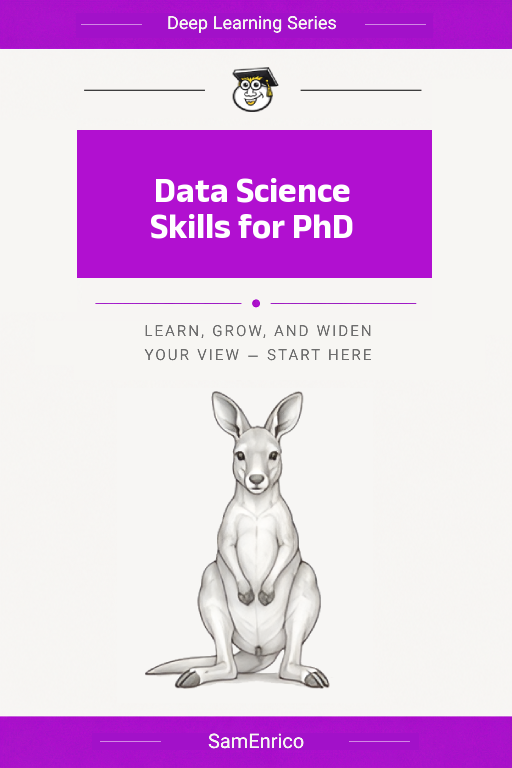
Data Science Skills for PhD
Highlights computational and data science skills t
Highlights computational and data science skills that attract advisors even when traditional publication record is absent.
Formats
About this book
Free sample
Chapter 1: The Publication Trap--The rejection letter arrived on a Tuesday.Maria read it three times, hoping the words would rearrange themselves into something less final. "While your academic record is strong, the admissions committee determined that your research output is insufficient for admission to our doctoral program." She closed her laptop and sat in the dark of her one-bedroom apartment, the glow of the screen still burned into her retinas. She had a 3.9 GPA. She had three glowing letters of recommendation from faculty who genuinely liked her. She had spent two years on a Master's thesis that her advisor called "promising." But she had no publications.
And according to this rejection — her fourth in six weeks — that made her invisible.Maria was not alone. Across the country, thousands of prospective Ph D applicants were receiving identical messages. Their GPAs were excellent. Their test scores were competitive. Their letters were warm.
But in the hypercompetitive landscape of doctoral admissions, "promising" was no longer enough. The question haunting every applicant in her position was simple and devastating: How do you prove you can do research if no one will give you the chance to publish?This book is the answer to that question. But before we get to the answer, we need to understand how the game changed — and why the old rules no longer apply.The Changing Currency of Academia For decades, the currency of Ph D admissions was straightforward: grades, test scores, letters of recommendation, and — for the most competitive applicants — one or two publications in respectable journals. This currency system made sense in a world where research was slow, publication timelines were predictable, and advisors had the luxury of training students from scratch.That world no longer exists.The modern research university operates at a different tempo. Grant cycles have shortened.
Funding agencies demand rapid results. Interdisciplinary collaboration has blurred the boundaries between fields, creating new problems that no single department knows how to solve. And at the center of this transformation is data — more data than any previous generation of researchers could have imagined.Consider the following: In…
This is the end of the free sample. Get the eBook to keep going. Buy now
Contents
- Chapter 1
- Chapter 2
- Chapter 3
- Chapter 4
- Chapter 5
- Chapter 6
- Chapter 7
- Chapter 8
- Chapter 9
- Chapter 10
- Chapter 11
- Chapter 12
Details
- Author
- Grubbs Therese
- Publisher
- SamEnrico
- Language
- English
- Genre
- Non-Fiction, Student's Shortcut, Data Science
- Released
- 2026-06-01
- Pages (approx.)
- 145
- Available as
- eBook, Audiobook

Read better in the ZLOADR app
Your eBooks on your phone or tablet. Sign in with your SamEnrico account and start reading.
More by Grubbs Therese
 The Perfectionist Student GuideGrubbs Therese$11.99
 Radical Acceptance EmotionsGrubbs Therese$11.99
 Dreamwork After AbortionGrubbs Therese$11.99
 Denny Hamlin Nearly ManGrubbs Therese$11.99
 The Climate Tech HR GuideGrubbs Therese$11.99The Climate Tech HR GuideGrubbs Therese$11.99
 The Gold of Granada: How Money Won the ReconquistaGrubbs Therese$11.99
 Understanding Syringomelia HyperkeratosisGrubbs Therese$17.99
 Pop Up Costs London GuideGrubbs Therese$12.99
 Intake CounselorGrubbs Therese$11.99
 How to Start a Palletizer Business (Beginners Guide)Grubbs Therese$11.99