
Non-FictionStartup GuideExecutive Search
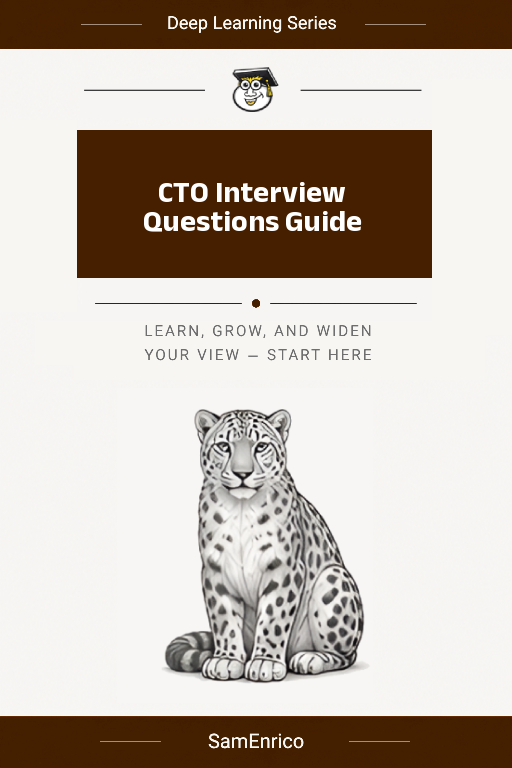
CTO Interview Questions Guide eBook
Ask the right technical interview questions as a n
Ask the right technical interview questions as a non-technical founder. Evaluate candidates without coding knowledge.
Formats
Free sample
Chapter 1: The Million-Dollar Mistake--The first time I watched a non-technical founder destroy their startup, it wasn’t because they ran out of money. It wasn’t because the product was bad. It wasn’t even because the market was wrong.It was because they asked the wrong question in a ninety-minute interview.The founder’s name was Sarah. She had raised two million dollars for a logistics platform. She was smart, driven, and completely dependent on her newly hired CTO to build the product.
She had done everything “right”—she used a recruiter, she ran technical screens, she checked references. The CTO she hired had a perfect resume: ten years at Google, three patents, a master’s degree from Stanford.Six months later, the CTO had rewritten the entire codebase three times. The product had not shipped. The engineering budget was gone. And Sarah discovered, too late, that her CTO had never actually led a team before—he had been an individual contributor who looked good on paper but could not make a single trade-off decision without six weeks of analysis.The worst part?
Every red flag had been visible in the interview. She just didn’t know what to listen for.This book exists so that does not happen to you.The Hidden Epidemic of Bad Technical Hires Here is a statistic that should terrify you: according to data from multiple venture capital firms tracking their portfolios, nearly seventy percent of startup CTO hires fail within eighteen months. The failures are not because the candidates lacked technical skill. In case after case, the CTO had a strong engineering background. They failed because they could not communicate with non-technical leaders.
They failed because they prioritized technical elegance over business needs. They failed because they could not diagnose problems before prescribing solutions.And here is the kicker: as a non-technical founder, you are uniquely vulnerable to these failures. Not because you are less intelligent—but because the traditional technical interview is designed by engineers for engineers. It assumes you can read code, evaluate algorithmic complexity, and spot architectural flaws. You cannot do any of those things.
And you should not have to.Your job is not to be a proxy engineer. Your job is to hire a business partner who happens to speak in code.The Three Lies You Have Been Told About Technical Interviews Before we build a better system, we need to dismantle the broken one. Most non-technical founders enter the hiring process believing three dangerous lies.Lie #1: “You need to understand code to evaluate a CTO.”This is the most seductive lie because it contains a grain of truth. A CTO makes technical decisions. To evaluate those decisions, you need some context.
But the gap between “some context” and “writing code” is enormous. You do not need to understand recursion to know whether someone explains trade-offs clearly. You do not need to debug an API to know whether someone asks diagnostic questions before jumping to solutions. You need a strategic vocabulary—about fifteen terms—and nothing more. We will give you those terms in Chapter 2.Lie #2: “Leet Code and whiteboarding are objective measures.”Silicon Valley has spent twenty years convincing itself that algorithmic puzzles predict job performance.
The research says otherwise. A comprehensive study of technical hiring found that performance on whiteboarding challenges correlates with exactly two things: how many whiteboarding challenges the candidate has practiced, and how much anxiety they experience under observation. It does not correlate with leadership, product sense, communication, or even on-the-job coding quality. Leet Code tests memorization, not judgment. And judgment is what you are hiring for.Lie #3: “The best CTOs are the best coders.”This is the most destructive lie of all.
The skills that make someone a brilliant individual contributor—hyperfocus, perfectionism, deep immersion in a single problem—are often the opposite of what makes a great CTO. A CTO needs breadth, not depth. They need to stop coding and start leading. The best CTO you will ever hire is probably not the best coder in the room. They are the person who knows when to stop optimizing and start shipping.
They are the person who can explain a complex database decision to your head of sales. They are the person who asks “what problem are we solving?” before opening a code editor.What You Are Actually Hiring For If you are not hiring for algorithmic skill, what are you hiring for?After analyzing hundreds of CTO hires across startups of all sizes, a clear pattern emerges. The CTOs who succeed—the ones who stay for years, who build teams that ship, who become true partners to their founders—share exactly four characteristics. These four characteristics form the backbone of this entire book.First: Diagnostic Problem-Solving A great CTO does not jump to solutions. When you describe a problem—slow website, missed deadline, rising cloud costs—they ask questions.
Lots of them. They want to understand the system before changing a single part. This is the single biggest predictor of success. We will spend an entire chapter on it (Chapter 4) because it is that important.Second: Communication Clarity A great CTO can explain a complex technical concept to a five-year-old. No, really.
If they cannot explain why they chose a particular database in plain language, they will not be able to explain it to your board, your investors, or your customers. Technical jargon is not a sign of expertise; it is a sign of either laziness or insecurity. We will teach you the two-minute test that separates communicators from jargon-dumpers (Chapter 6).Third: Business Judgment A great CTO knows that code exists to serve the business, not the other way around. They build when they must and buy when they can. They understand runway, customer acquisition cost, and retention—because those numbers determine how much time they have to refactor.
They do not fall in love with their own architecture. We will give you the build-versus-buy litmus test that exposes the hobbyists (Chapter 9).Fourth: Cultural Alignment A great CTO fits your team. Not because they share your taste in music or coffee—but because they share your values about speed, quality, communication, and accountability. A CTO who is a cultural mismatch will destroy your engineering culture faster than any technical debt. And here is your secret advantage: as a non-technical founder, you are better at evaluating culture fit than any technical interviewer.
You have been doing it your whole career. We will show you how to apply that instinct systematically (Chapter 3).Why Your “Gut” Is Not Enough (And Why Data Alone Is Also Not Enough)At this point, some readers will fall into one of two traps. The first trap is over-reliance on intuition: “I have good instincts about people. I will just trust my gut.” The problem with gut instinct is that it is wildly inconsistent. Your gut loves confident people, even when they are wrong.
Your gut hates humble people, even when they are right. Your gut is biased by a good handshake, a fancy resume, and the fact that the candidate reminds you of your favorite professor. Do not trust your gut.The second trap is the opposite extreme: “Give…
This is the end of the free sample. Get the eBook to keep going. Buy now
About this book
Details
- Author
- Seward Laronda
- Publisher
- SamEnrico
- Language
- English
- Genre
- Non-Fiction, Startup Guide, Executive Search
- Released
- 2026-05-29
- Pages (approx.)
- 143
- Available as
- eBook, Audiobook

Read better in the ZLOADR app
Your eBooks on your phone or tablet. Sign in with your SamEnrico account and start reading.
More by Seward Laronda
 The Expectation Reset GuideSeward Laronda$11.99
 Smoking and ED GuideSeward Laronda$11.99
 MDD Subtypes ExplainedSeward Laronda$11.99
 The Working Memory for Chess GuideSeward Laronda$11.99
 Emergency Placement NightsSeward Laronda$11.99
 The Lost Tapes of the Apollo 11 Mission: Unearthed Secrets from the MoonSeward Laronda$11.99
 The Breeder's Guide to Randall Lineback CattleSeward Laronda$11.99
 .eu vs .com ComparisonSeward Laronda$12.99
 Opseu CourierSeward Laronda$11.99
 How to Become a Log PeelerSeward Laronda$11.99
You may also like
 Hong Kong Handover 1997Dunn Johnnie$11.99
 Zumba For Postnatal Recovery CourseNeal Christian$11.99
 Zumba for BeginnersLadner Nikia$11.99
 YouTube Comment Mining GuideHumes Pandora$12.99
 Worry Box MeditationCarlin Rudy$11.99
 Workplace Stress MeditationNguyen Lynn$11.99
 Workplace Stress and Sleep RepairHawley Ivory$11.99
 Workplace Perfectionism CureDelaney Jeffry$11.99
 Workplace Injustice Anger GuideWallen Isabelle$11.99
 Work Addiction and Burnout LinkGreenwood Ester$11.99
 Women in Yoga and WellnessBeattie Galina$11.99
 Women in Stand Up ComedyChun Evangeline$11.99