
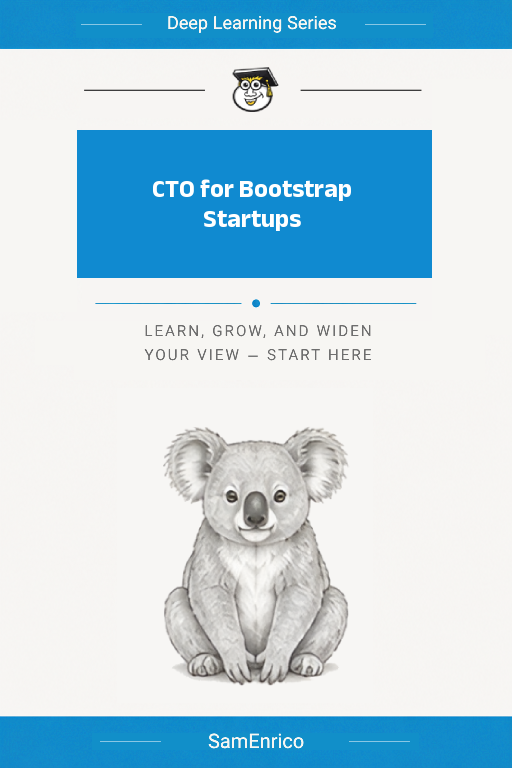
Non-FictionStartup GuideBootstrap
CTO for Bootstrap Startups eBook
Attract a CTO with low salary but meaningful equit
by Ruth Jodee
Attract a CTO with low salary but meaningful equity when you're bootstrapping.
Formats
Free sample
Chapter 1: The Asymmetric Bet--–- The first time I watched a bootstrapped founder lose a CTO candidate, it wasn’t because of money. It was because of math. The founder, let’s call her Sarah, had built a waiting list of three thousand customers for her B2B Saa S product. She had no code, no MVP, but she had validation. She found a brilliant engineer named James who had led teams at Amazon and was bored out of his mind maintaining legacy payment systems.
James loved her problem. He loved the greenfield opportunity. Then Sarah said, “I can’t pay you a salary, but I’ll give you five percent equity.” James smiled, shook her hand, and walked away. Sarah never understood why.The answer is simple. James did the math in his head.
Five percent of nothing is nothing. He had been at Amazon long enough to know that most startups fail. He had also been at Amazon long enough to know that a twenty percent chance of a ten million dollar exit is worth more than a one hundred percent chance of a hundred thousand dollar salary. But five percent? That was a joke.
Sarah had undervalued not just James, but herself. She had misread the entire market.This book exists because that scene plays out thousands of times every year. Bootstrapped founders, armed with passion and zero cash, believe they can attract top-tier technical talent with tiny equity grants and big promises. They cannot. Or rather, they can, but only if they understand one core concept: the asymmetric bet.What is an Asymmetric Bet?An asymmetric bet is an opportunity where the downside is limited but the upside is massive.
Buying a lottery ticket is an asymmetric bet: you lose two dollars or you win ten million. But the odds are terrible. A true asymmetric bet in the startup world is different. It is an opportunity where the downside is the same as any other job (long hours, stress, uncertainty) but the upside is orders of magnitude larger if the company succeeds. For a CTO joining a bootstrapped startup, the downside is low salary or no salary.
The upside is life-changing wealth. But here is the catch: the equity must be large enough that the math works. If the equity is too small, the bet is not asymmetric. It is just a bad job.Let me give you a concrete example. Imagine a CTO who could earn two hundred fifty thousand dollars per year at a public tech company.
That is the baseline, the opportunity cost. Now imagine that same CTO joins your bootstrapped startup at zero salary for two years. Their foregone salary is five hundred thousand dollars. For this to be a rational asymmetric bet, their expected value from equity needs to exceed that five hundred thousand dollars by a significant margin. That means if you give them five percent equity, you need to convince them that the company has a realistic path to a ten million dollar exit (five percent of ten million is five hundred thousand dollars, which merely breaks even with zero risk premium).
A rational CTO would demand a risk premium of at least three to five times. That means a five percent equity grant implies a thirty to fifty million dollar exit just to make the bet worthwhile. For an idea-stage startup, that is a hard sell. For a post-MVP startup with some revenue, it becomes plausible. But if you are at the idea stage, the equity needs to be forty to fifty percent because the risk is so much higher.This is not charity.
This is math. And most founders never do the math. They give ten percent and wonder why candidates laugh. Or they give fifty percent and panic that they are giving away the company. The trick is to match the equity to the stage, which we will cover in detail in Chapter 3.
For now, understand this: you are not looking for an employee. You are looking for a partner who will take the same asymmetric bet that you are taking. That means they need enough upside to justify the downside.The Three Lies Founders Tell Themselves About Hiring a CTOBefore we go further, we need to clear the rubble. There are three lies that bootstrapped founders repeat to themselves. These lies keep you stuck, offering tiny equity to great engineers and then blaming the market when no one accepts.Lie Number One: “My idea is worth more than their code.”This is the most dangerous lie.
It sounds like this: “I came up with the idea. I did the customer discovery. I raised a little money from friends. The CTO is just building what I tell them to build.” This lie is seductive because it feeds the ego. But it is factually wrong.
In a bootstrapped startup, the idea without execution is worth exactly zero. The CTO’s code is the execution. Without it, you have a Power Point deck. With it, you have a product. The idea is a multiplier, not the base.
If the idea is great and the execution is terrible, you have nothing. If the idea is mediocre and the execution is excellent, you have a company. The founder who believes their idea is worth more than the code will offer ten percent equity to a CTO and then act confused when the CTO feels disrespected. The CTO is not being greedy. The CTO is doing the math.
If the idea is so valuable, why are you only offering ten percent? If the idea is worth ninety percent of the company, prove it by building it yourself. When you cannot, you will understand that the code is not a commodity. It is the product.Lie Number Two: “I can just hire a developer on Upwork for ten thousand dollars to build the MVP.”Yes, you can. And you will get exactly what you pay for.
A ten thousand dollar MVP from a freelance developer will be spaghetti code, unmaintainable, and non-scalable. It will work just well enough to get your first few customers, and then it will collapse under its own weight. When you finally hire a real CTO, they will look at the codebase and say, “We need to rewrite everything.” That rewrite will cost you six months and another fifty thousand dollars. The ten thousand dollars you saved was the most expensive money you ever spent. Worse, the freelance developer has no equity, no loyalty, and no incentive to stay.
They will build exactly what you ask for, not what you need. A CTO with meaningful equity will argue with you. They will say, “That feature is a trap. That database schema will break at scale. That API will cost us five thousand dollars a month in overage fees.” The freelancer will not say any of that.
They will take your money and build your mistake. The ten thousand dollar MVP is a trap. It feels like a shortcut, but it is actually a detour that adds months or years to your timeline.Lie Number Three: “I’ll give them a small equity now and more later if they perform.”This is…
This is the end of the free sample. Get the eBook to keep going. Buy now
About this book
Details
- Author
- Ruth Jodee
- Publisher
- SamEnrico
- Language
- English
- Genre
- Non-Fiction, Startup Guide, Bootstrap
- Released
- 2026-05-29
- Pages (approx.)
- 137
- Available as
- eBook, Audiobook

Read better in the ZLOADR app
Your eBooks on your phone or tablet. Sign in with your SamEnrico account and start reading.
More by Ruth Jodee
 Parent Loss Journal PromptsRuth Jodee$11.99
 Peer Support Group MethodRuth Jodee$11.99
 The Blood Draw BreathRuth Jodee$11.99
 CrossFit Injury PreventionRuth Jodee$11.99
 The Midday Reset ProtocolRuth Jodee$11.99
 Sciatica MeditationRuth Jodee$11.99
 Amazon Reselling RestrictionsRuth Jodee$11.99
 Therapy After Child DeathRuth Jodee$11.99
 Boundary Setting For DoctorsRuth Jodee$11.99
 The Golden Notes of Joseph Bologne: Chevalier de Saint-Georges and the Birth of Classical BrillianceRuth Jodee$11.99
 The Ale of Alexandria: Euclid's Theorem and the Birth of Mathematical PrecisionRuth Jodee$11.99
 Operation Midnight Sun: The Untold Story of How a Single Leak Exposed a Decade of EspionageRuth Jodee$11.99
You may also like
 Hong Kong Handover 1997Dunn Johnnie$11.99
 Zumba For Postnatal Recovery CourseNeal Christian$11.99
 Zumba for BeginnersLadner Nikia$11.99
 YouTube Comment Mining GuideHumes Pandora$12.99
 Worry Box MeditationCarlin Rudy$11.99
 Workplace Stress MeditationNguyen Lynn$11.99
 Workplace Stress and Sleep RepairHawley Ivory$11.99
 Workplace Perfectionism CureDelaney Jeffry$11.99
 Workplace Injustice Anger GuideWallen Isabelle$11.99
 Work Addiction and Burnout LinkGreenwood Ester$11.99
 Women in Yoga and WellnessBeattie Galina$11.99
 Women in Stand Up ComedyChun Evangeline$11.99