
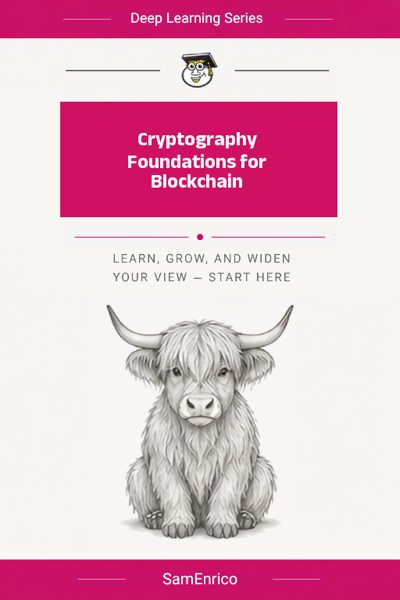
Cryptography Foundations for Blockchain eBook
A Coursebook on Cryptography Foundations for Block
A Coursebook on Cryptography Foundations for Blockchain
Formats
Free sample
Chapter 1: The Trust Protocol--–- Before the blockchain, before Bitcoin, before the first digital signature ever signed, there was a problem older than computers, older than electricity, older even than the written word. It is the problem of trust between strangers.Imagine, for a moment, that you are a merchant in ancient Mesopotamia. A traveler arrives with a donkey loaded with copper ingots. He wants to trade for twenty jars of your finest olive oil. You have never seen this man before.
You do not speak his language fluently. You have no shared bank, no contract lawyer on retainer, no credit card network, no escrow service, and certainly no blockchain. What do you do?You rely on intermediaries. Perhaps a temple priest vouches for the traveler because the traveler made an offering last month. Perhaps a local elder stands between you, taking a small commission for the guarantee.
Perhaps you simply trust the traveler because the cost of getting caught cheating—a beating, exile, or worse—outweighs the value of twenty jars of oil.For ten thousand years, human commerce has been built on a fragile scaffolding of reputation, intermediaries, and brute-force enforcement. The priest, the elder, the king, the bank, the credit card company, the escrow agent, the clearing house, the notary—these are all trusted third parties. They stand between two strangers and say, in effect, "I know both of you, or I have enough power to punish one of you if you cheat, so go ahead and trade."These intermediaries work reasonably well. Western Union moves money across continents. Visa processes thousands of transactions per second.
Banks hold our savings and issue loans. But they are not free. They take time. They take fees. They take control of your money—a bank can freeze your account, a credit card company can reverse a charge, a government can seize assets.
And they are not universally available. Two billion adults on this planet have no bank account. They cannot access the global financial system because no intermediary will vouch for them.What if there were another way?What if two strangers could transact directly, without any intermediary, with the same confidence as if they had signed a contract in front of a judge with armed guards waiting to enforce the verdict? What if the contract was the enforcement? What if trust could be engineered into mathematics rather than delegated to institutions?That is the promise of blockchain.
And that promise is built entirely on cryptography.This book is about those cryptographic foundations. Not the hype, not the speculation, not the get-rich-quick schemes that dominate the headlines—but the actual mathematics, algorithms, and protocols that make blockchains work. By the end of this chapter, you will understand why cryptography is not merely a feature of blockchain but the essence of it. You will learn how a thirty-year-old problem called the Byzantine Generals Problem defines the entire project of decentralized consensus. And you will begin to see how hash functions, digital signatures, and proof-of-work fit together into a system that replaces human trust with mathematical verification.But first, we must start where all cryptography starts: with secrets, with adversaries, and with the immutable laws of mathematics.The Prehistory of Cryptography Long before the word "cryptography" existed, humans were encrypting messages.
The ancient Spartans wrapped a strip of parchment around a rod of a specific diameter (a skytale) and wrote along the length; unwrapped, the letters appeared scrambled. Julius Caesar shifted each letter in his military communications by three positions—what we now call the Caesar cipher. These were not academic exercises. They were matters of life, death, and empire.For most of human history, cryptography was about secrecy. Two parties who shared a secret (a rod diameter, a shift value) could communicate without eavesdroppers understanding.
But these systems had a fatal weakness: if the secret was discovered, all past and future messages were compromised. Worse, distributing the secret required a secure channel—a classic chicken-and-egg problem. How do you share a secret with someone if the only way to share it securely is to already have a secret?This problem persisted until the 1970s, when two revolutionary developments changed everything. The first was the formalization of modern cryptography as a rigorous mathematical discipline, moving beyond ad hoc ciphers to provable security based on computational hardness. The second was the invention of public-key cryptography, which solved the key-distribution problem and opened the door to digital signatures, secure online commerce, and—ultimately—blockchain.But modern cryptography did not abandon the old tools.
It refined them. The symmetric ciphers used by the ancient Greeks evolved into algorithms like AES-256, which can encrypt data at billions of bytes per second with mathematical guarantees of security. The hash functions used to detect file corruption evolved into cryptographic hash functions like SHA-256, which are one-way, collision-resistant, and deterministic—properties we will explore in depth in Chapter 3.Blockchain inherits all of this history. Every cryptographic primitive developed over the past four thousand years finds a place in the blockchain stack. Symmetric encryption protects wallet files.
Hash functions link blocks into an immutable chain. Public-key cryptography establishes ownership. Digital signatures authorize transactions. Randomness secures keys. Consensus protocols bind everything together.This chapter lays the foundation for understanding how these pieces fit together.
We will begin with the mathematical language that all cryptography speaks—modular arithmetic, prime numbers, and the probability theory that underlies security claims. Then we will introduce the concept of attacker models, which formalizes what we mean when we say a system is "secure." Finally, we will frame blockchain as a solution to the Byzantine Generals Problem, showing how cryptography replaces trust with verification. The remaining eleven chapters will fill in every detail of this framework.Mathematical Foundations: The Language of Cryptography Cryptography is applied mathematics. If you cannot speak the language, you cannot understand the guarantees—or the limitations. This section introduces the essential mathematical concepts that will appear repeatedly throughout this book.
Do not skim this section. The exercises at the end are not optional. Every subsequent chapter assumes you have internalized these ideas.Modular Arithmetic You already know modular arithmetic. You just call it "clock arithmetic." On a standard clock, 10 o'clock plus 4 hours is 2 o'clock, not 14 o'clock. In mathematical notation, we write this as:10 + 4 ≡ 2 (mod 12)The "mod 12" means we consider numbers equivalent if they differ by a multiple of 12.
More formally, we say that a ≡ b (mod n) if *n* divides (a - b). This is an equivalence relation, partitioning the integers into *n* equivalence classes called residue classes modulo *n*.Why does cryptography use modular arithmetic? Because computers work with fixed-size numbers. A 256-bit integer can represent values from 0 to 2²⁵⁶ − 1. When you add two such numbers and the sum exceeds 2²⁵⁶ − 1, the hardware silently wraps around—precisely modular arithmetic with modulus 2²⁵⁶.But cryptographic algorithms often use prime moduli that are not powers of two.
The secp256k1 elliptic curve used in Bitcoin, for example, operates over a finite field with a 256-bit prime modulus *p*. Arithmetic in this field works exactly like modular arithmetic with modulus *p*.Here are the rules you must master:Addition: (a + b) mod n = remainder when (a + b) is…
This is the end of the free sample. Get the eBook to keep going. Buy now
About this book
Details
- Author
- Woodson Hulda
- Publisher
- SamEnrico
- Language
- English
- Genre
- Non-Fiction, Informative, Educational
- Released
- 2026-06-02
- Pages (approx.)
- 153
- Available as
- eBook, Audiobook

Read better in the ZLOADR app
Your eBooks on your phone or tablet. Sign in with your SamEnrico account and start reading.
More by Woodson Hulda
 Resilience Training CourseWoodson Hulda$11.99
 Financial Stress Sleep Solutions GuideWoodson Hulda$11.99
 Thunberg Mental HealthWoodson Hulda$11.99
 Fitness Instagram Body ComparisonWoodson Hulda$11.99
 The Herd Immunity PrimerWoodson Hulda$11.99
 Low Self Worth From Divorce OriginsWoodson Hulda$11.99
 Self Talk for Career SuccessWoodson Hulda$11.99
 FLDS Polygamy EscapeWoodson Hulda$11.99
 Imposter Syndrome AffirmationsWoodson Hulda$11.99
 Bloodlines of Power: The Bhuttos and Pakistan's Unfinished RevolutionWoodson Hulda$11.99
 The Silent Scream: The Lost Boy Who Defied the SystemWoodson Hulda$11.99
 Frostbound Hearts: The Forbidden Love of Skadi and NjordWoodson Hulda$11.99