
Cross Functional Collaboration eBook
Brings designers, engineers, and PMs together.
by Curtin Keiko
Brings designers, engineers, and PMs together.
Formats
Free sample
Chapter 1: The Relay Race Lie--It begins quietly, almost invisibly. No one announces it. No one puts it on a whiteboard or adds it to a job description. But in thousands of product teams around the world, a silent agreement takes hold on the very first day a designer, a product manager, and an engineer sit down together. The agreement sounds reasonable.
It sounds efficient. It sounds like adulthood. The agreement is this: we will take turns.The PM will go first. They will talk to customers, synthesize feedback, talk to executives, and write a document. It might be called a PRD or a requirements document or a "spec." It will contain user stories, acceptance criteria, success metrics, and maybe a few diagrams.
When the document is finished—really finished, with all the comments resolved and all the boxes checked—the PM will hand it to the designer. Not metaphorically. Literally. They will attach a file to an email or ping a Slack channel and say, "Design is ready for you."The designer will go second. They will take the PM's document and translate it into wireframes, then mockups, then a clickable prototype.
They will agonize over hierarchy and affordance and cognitive load. They will run usability tests and tweak button colors and adjust spacing by two pixels. When the design is finished—really finished, signed off by the PM and maybe a director—the designer will hand it to the engineer. Another attachment. Another Slack ping.
"Ready for development."The engineer will go third. They will take the designer's mockups and the PM's requirements and attempt to turn them into working software. They will discover that the database doesn't store data in the way the design assumes. They will realize that the animation the designer spent three days perfecting will cause the app to drop frames on last year's i Phones. They will build something that works, mostly, and then they will be asked why it doesn't look exactly like the mockups.
The engineer will say, "That's what I built." The designer will say, "That's not what I designed." The PM will say, "We're launching in two weeks."This is the Relay Race Lie. It is the most common, most destructive, and most invisible failure mode in product development. It kills more features, more timelines, and more team morale than bad code, unclear requirements, or unreasonable executives ever could. And almost no one talks about it because almost everyone assumes this is just how work gets done.It is not. And this chapter will prove it.The Lie That Feels Like Common Sense The Relay Race Lie has three core assumptions, each of which sounds reasonable and each of which is quietly devastating.The first assumption is that work can be neatly sequential.
The PM defines the problem, then the designer solves it visually, then the engineer builds it. This mirrors how factories work: raw materials go in one end, finished products come out the other. But product development is not a factory. A factory transforms homogeneous inputs into predictable outputs. Product development transforms ambiguity into clarity.
You cannot sequence ambiguity. Ambiguity does not wait its turn. It infects every stage, every role, every conversation. The PM who thinks they have defined the problem fully will discover, three weeks into engineering, that customers meant something different than they said. The designer who thinks they have solved the problem visually will discover, during implementation, that the elegant animation breaks on mobile.
The engineer who thinks they have built what was requested will discover, at launch, that users are doing things no one anticipated. Sequencing work does not eliminate surprises. It just ensures that surprises arrive as late as possible.The second assumption is that each role's expertise is best applied in isolation. The PM is good at strategy, so they should strategize alone. The designer is good at aesthetics, so they should design alone.
The engineer is good at systems, so they should build alone. This sounds like respecting expertise. It is actually starving expertise of the one thing it needs to be useful: constraints. A PM's strategy without technical constraints is a fantasy. A designer's mockup without engineering input is a wish.
An engineer's architecture without user feedback is a guess. Expertise does not flourish in isolation. It flourishes at the intersection of constraints. The best product decisions happen when a PM says, "We need to increase retention by twenty percent," and an engineer says, "That database query will take six seconds," and a designer says, "Six seconds feels like forever to a user." That conversation cannot happen in sequence. It has to happen at the same time.The third assumption is that handoffs are efficient.
One person works, then stops. Another person starts, then stops. No one waits. No one is blocked. This is the logic of the assembly line, and it works beautifully for physical goods.
But product development is not physical goods. The cost of a handoff is not just the time between work. The cost is the loss of context. When a PM hands off a document to a designer, the designer does not receive the PM's understanding of the customer. They receive a document.
Documents are shadows of understanding. They capture conclusions, not reasoning. They capture decisions, not the debates that produced them. Every handoff loses information. Every handoff introduces interpretation.
By the time a requirement travels from PM to designer to engineer, it has been translated twice—and translation is lossy. The engineer does not build what the PM imagined. They build what the designer interpreted that the PM meant. And those are rarely the same thing.The Three Agendas That Cannot Be Sequenced To understand why the Relay Race Lie fails so consistently, we have to look at what each role actually optimizes for. These are not personality traits or individual preferences.
They are structural realities of the job.Engineers optimize for feasibility. This is not because engineers are pessimists, though many are. It is because engineers are held accountable for things working. When a system crashes, when a database corrupts, when an API returns the wrong data, the engineer gets the call at 2 AM. The engineer's reputation is built on reliability, scalability, and the absence of catastrophic failure.
So when an engineer looks at a design, they see questions the designer never considered. What happens when ten thousand users do this at the same time? What happens when the network is slow? What happens when the data is malformed? What happens when the third-party API changes without warning?
These are not objections to the design. They are the engineer's job. A design that ignores these questions is not a design. It is a drawing.Designers optimize for usability. This is not because designers are perfectionists, though many are.
It is because designers are held accountable for users understanding and enjoying the product. When users cannot figure out how to complete a task, when they click the wrong button, when they abandon the flow in frustration, the designer gets the feedback. The designer's reputation is built on clarity, delight, and the absence of confusion. So when a designer looks at a technical constraint…
This is the end of the free sample. Get the eBook to keep going. Buy now
About this book
Details
- Author
- Curtin Keiko
- Publisher
- SamEnrico
- Language
- English
- Genre
- Non-Fiction, Professional's Cheat Sheet, Collaboration, Self-Help, Cross-Functional
- Released
- 2026-06-05
- Pages (approx.)
- 150
- Available as
- eBook, Audiobook

Read better in the ZLOADR app
Your eBooks on your phone or tablet. Sign in with your SamEnrico account and start reading.
More by Curtin Keiko
 Perfectionism Failure Fear GuideCurtin Keiko$11.99
 Menopause Mental Health GuideCurtin Keiko$11.99
 The Caregiver Sundowning GuideCurtin Keiko$11.99
 Carson Wildlife Refuge Protection ManualCurtin Keiko$11.99
 Hearing Loss Dementia Risk GuideCurtin Keiko$11.99
 Mungo Lady and the Dawn of Humanity: Australia's Ancient StorytellersCurtin Keiko$11.99
 Gluskap’s Great Hunt: The Wabanaki Trickster’s TrialCurtin Keiko$11.99
 AI Compliance Monitoring WorkflowCurtin Keiko$12.99
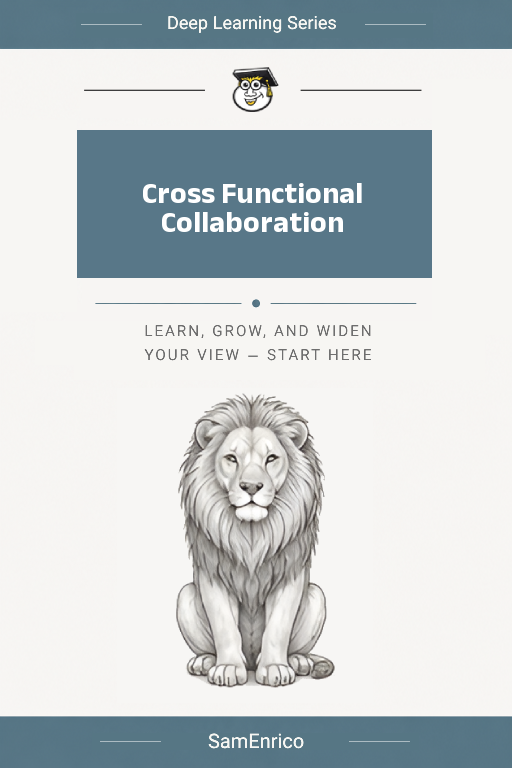 Cross Functional CollaborationCurtin Keiko$12.99
 Traffic MarshallCurtin Keiko$11.99
 Understanding Focal Alopecia Congenital MegalencephalyCurtin Keiko$17.99
 How to Become a Seam HammererCurtin Keiko$11.99