
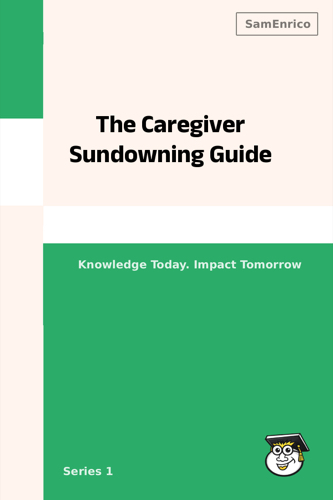
The Caregiver Sundowning Guide
Manage late afternoon agitation and confusion in d
by Curtin Keiko
Manage late afternoon agitation and confusion in dementia patients.
Formats
About this book
Free sample
Chapter 1: The Broken Clock...--The first time Margaret called the helpline, she was crying so hard she could barely say her name. It was 4:47 PM on a Tuesday in November. Her husband of forty-three years, a retired high school principal who once memorized the name of every student in his graduating class, had just spent thirty minutes trying to climb out their living room window because he believed strangers had taken over their house. He did not recognize her. He called her a stranger who was trying to keep him prisoner.
When she tried to calm him, he shoved her into the bookshelf. She fell. The corner of a hardcover copy of War and Peace—a book he had read three times—left a bruise on her forearm the shape of a crescent moon."I don't know who he is anymore," she whispered into the phone. "And I don't know who I am either."The helpline operator, trained in dementia care, asked a simple question: "What time did this start?"Margaret paused. "I don't know.
Four? Four-thirty?""Does it happen every day around this time?"A long silence. Then: "Yes. Every day. Like clockwork.
But the clock is broken."That is the first thing you need to understand about sundowning. It is not random chaos. It is a predictable pattern, but the pattern follows a broken clock—the broken clock inside the brain. Margaret's husband was not becoming a different person. He was not angry at her.
He was not "acting out" or "being difficult" or "losing his mind" in the way people mean when they use that phrase casually. His brain, damaged by Alzheimer's disease, had lost the ability to tell time. And when the afternoon sun began to shift, when the shadows lengthened, when the cortisol in his body failed to drop the way it should, his brain interpreted these signals as danger. Not intellectual danger. Not "I am worried about the state of the world" danger.
Primal, preverbal, fight-or-flight danger. The kind of danger that makes a person throw a chair through a window or scream at…
This is the end of the free sample. Get the eBook to keep going. Buy now
Contents
- Chapter 1
- Chapter 2
- Chapter 3
- Chapter 4
- Chapter 5
- Chapter 6
- Chapter 7
- Chapter 8
- Chapter 9
- Chapter 10
- Chapter 11
- Chapter 12
Details
- Author
- Curtin Keiko
- Publisher
- SamEnrico
- Language
- English
- Genre
- Non-Fiction, Self-Help, Dementia
- Released
- 2026-06-07
- Pages (approx.)
- 139
- Available as
- eBook, Audiobook

Read better in the ZLOADR app
Your eBooks on your phone or tablet. Sign in with your SamEnrico account and start reading.
More by Curtin Keiko
 Perfectionism Failure Fear GuideCurtin Keiko$11.99
 Menopause Mental Health GuideCurtin Keiko$11.99
 Carson Wildlife Refuge Protection ManualCurtin Keiko$11.99
 Hearing Loss Dementia Risk GuideCurtin Keiko$11.99
 Cross Functional CollaborationCurtin Keiko$12.99
 Mungo Lady and the Dawn of Humanity: Australia's Ancient StorytellersCurtin Keiko$11.99
 Gluskap’s Great Hunt: The Wabanaki Trickster’s TrialCurtin Keiko$11.99
 AI Compliance Monitoring WorkflowCurtin Keiko$12.99Cross Functional CollaborationCurtin Keiko$12.99
 Traffic MarshallCurtin Keiko$11.99
 Understanding Focal Alopecia Congenital MegalencephalyCurtin Keiko$17.99
 How to Become a Seam HammererCurtin Keiko$11.99
You may also like
 Hong Kong Handover 1997Dunn Johnnie$11.99
 Zumba For Postnatal Recovery CourseNeal Christian$11.99
 Zumba for BeginnersLadner Nikia$11.99
 YouTube Comment Mining GuideHumes Pandora$12.99
 Worry Box MeditationCarlin Rudy$11.99
 Workplace Stress MeditationNguyen Lynn$11.99
 Workplace Stress and Sleep RepairHawley Ivory$11.99
 Workplace Perfectionism CureDelaney Jeffry$11.99
 Workplace Injustice Anger GuideWallen Isabelle$11.99
 Work Addiction and Burnout LinkGreenwood Ester$11.99
 Women in Yoga and WellnessBeattie Galina$11.99
 Women in Stand Up ComedyChun Evangeline$11.99