
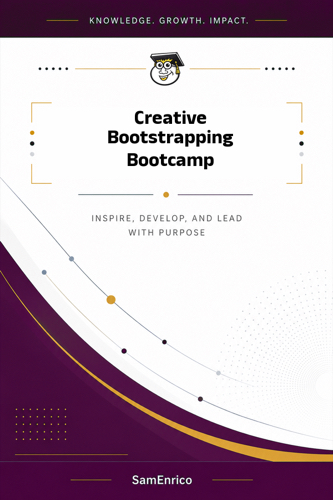
Creative Bootstrapping Bootcamp eBook
Thirty day program to master making art with almos
by Marin Lesha
Thirty day program to master making art with almost nothing.
Formats
Free sample
Chapter 1: The Jugaad Proposition...--–- Most artists believe a lie. It is a seductive lie, whispered in art schools, repeated in grant applications, and reinforced every time you walk past a gallery with gleaming white walls and price tags that exceed your annual rent. The lie is this: If only I had more money, I could make better art.You have felt its pull. I certainly have. I remember standing in an art supply store at twenty-two, holding a single tube of cadmium red that cost more than my weekly grocery budget.
My hand trembled. Not from the weight of the tube—it weighs nothing—but from the weight of the belief that this forty-dollar pigment was the only thing standing between me and the work I was supposed to make. I bought it. I took it home. And then I was too afraid to use it, because what if I wasted it?
What if my painting was ugly? What if I couldn't get it back?That tube sat on my shelf for three years. Three years of not painting, because I had convinced myself that I couldn't start until I had enough—enough paint, enough canvas, enough space, enough training, enough money. The lie had worked exactly as intended. It had stopped me cold.This book exists because I finally learned the truth, and the truth set me free.
Here it is, stated plainly so you cannot miss it: Scarcity is not your enemy. Scarcity is your superpower.Let me say that again, because your entire artistic conditioning has taught you the opposite. Scarcity—the state of having almost nothing—forces the kind of creative problem-solving that abundance kills. When you have unlimited paint, you never learn to mix. When you have unlimited canvas, you never learn to see the painting surface hiding inside a discarded pizza box.
When you have unlimited time, you never learn to work with the fierce economy of a person who knows that this moment, this material, this single chance is all they get.This chapter will rewire your relationship with "not enough." By the time you finish reading, you will no longer see your empty wallet as a barrier. You will see it as a creative constraint—and constraints, as every artist who has ever made something memorable knows, are where real art is born.The Myth of the Starving Artist Before we go any further, we need to kill something. Not literally, but conceptually. We need to kill the "starving artist" myth—not because it is untrue that artists struggle financially, but because it confuses two completely different states of being: involuntary poverty and voluntary constraint.Involuntary poverty is what happens when systemic forces—lack of access, discrimination, economic collapse, family breakdown, disability, or a thousand other circumstances beyond your control—deprive you of basic necessities. It is destructive.
It is exhausting. It is not romantic, and I would never ask you to celebrate it. If you are currently in a state of involuntary poverty, this book is not asking you to pretend that your situation is a gift. It is acknowledging your reality and offering you tools to make art within it, without pretending that struggle is somehow noble.Voluntary constraint is something else entirely. It is the choice to limit your materials, your budget, or your options in order to unlock creativity.
It is temporary. It is a game you play with yourself. It is the difference between being forced to fast and choosing intermittent fasting for your health. The external behavior looks similar. The internal experience is worlds apart.This book is about voluntary constraint.
You are choosing to spend thirty days making art with almost nothing. You are not being forced. You are not being punished. You are signing up for a creative bootcamp because you suspect—correctly—that having fewer options will force you to see more possibilities.The "starving artist" myth collapses these two states into one, telling you that suffering is necessary for art. It is not.
Suffering is just suffering. But chosen limitation—the kind you are about to undertake—is a door, not a wall.Jugaad: The Art of the Frugal Fix There is a word in Hindi that captures everything this book stands for: Jugaad (जुगाड़). It has no perfect English equivalent, but it describes a frugal, flexible, creative workaround—a way of solving a problem with whatever materials are at hand, often in ways that are counterintuitive, temporary, or delightfully strange.Imagine a farmer in rural India whose water pump breaks. He has no money for a replacement part, and the nearest store is a day's walk away. So he finds a discarded bicycle tube, cuts it, wraps it around the broken seal, and the pump works again—not perfectly, not permanently, but well enough to water his crops until he can afford a real fix.
That is Jugaad.Imagine a street vendor whose cart wheel falls off. He has no wrench, no replacement axle. So he finds a piece of scrap metal, hammers it into shape with a rock, and lashes it to the cart with rope salvaged from a broken chair. That is Jugaad.Now imagine an artist with no canvas, no stretcher bars, no gesso, and no budget. She finds a flattened cardboard box behind a grocery store, tears it open, mixes flour and water into paste, and paints a portrait that stops viewers in their tracks.
That is also Jugaad.Jugaad is not about making do. It is about seeing what others overlook. It is about recognizing that the gap between "what I need" and "what I have" is not a void—it is a space for invention.The opposite of Jugaad is what I call the "Lavish Film Set" mentality. This is the belief that every problem has a commercial solution, and that solution is always superior to a homemade one. Need a special effect?
Buy software. Need a particular texture? Buy a specialty brush. Need a certain color? Buy a tube of paint mixed in a factory hundreds of miles away.
The Lavish Film Set mentality says that money is the answer to every creative question.It is wrong. Money is often the enemy of creativity, because money lets you stop thinking. When you can simply buy your way out of a problem, you never learn the deeper structure of the problem itself. You never discover the unexpected beauty that emerges from a constraint you could not afford to bypass.This book is a thirty-day immersion in Jugaad. By the end, you will not just tolerate scarcity—you will crave it.
You will look at a problem and think, not "What can I buy to solve this?" but "What do I already have that could become a solution?"Why Abundance Kills Creativity Let me tell you about a study that changed how I think about creativity. Psychologists gave two groups of children the same art supplies and the same prompt: "Build something interesting." One group had access to an unlimited number of materials—boxes of every size, rolls of tape, tubes of glue, piles of colorful paper. The other group had a strict limit: they could use…
This is the end of the free sample. Get the eBook to keep going. Buy now
About this book
Details
- Author
- Marin Lesha
- Publisher
- SamEnrico
- Language
- English
- Genre
- Non-Fiction, Self-Help, Bootstrapping
- Released
- 2026-06-09
- Pages (approx.)
- 124
- Available as
- eBook, Audiobook

Read better in the ZLOADR app
Your eBooks on your phone or tablet. Sign in with your SamEnrico account and start reading.
More by Marin Lesha
 TM Expectations ManagementMarin Lesha$11.99
 Parking Tech Capital GuideMarin Lesha$11.99
 The Mattress Selection Back GuideMarin Lesha$11.99
 Sendy Logistics Exit GuideMarin Lesha$11.99
 The Papyrus Thieves: Stealing Stories from Ancient EgyptMarin Lesha$11.99
 Understanding Pfeiffer–palm–teller SyndromeMarin Lesha$17.99
 How to Start a Cabinets for Sewing Machines Business (Beginners Guide)Marin Lesha$11.99
 Lean Canvas Walkthrough GuideMarin Lesha$12.99
 Streaming Services PositioningMarin Lesha$12.99
 Bob Marley: Reggae RevolutionMarin Lesha$11.99