

Non-FictionSelf-HelpCoping Skills
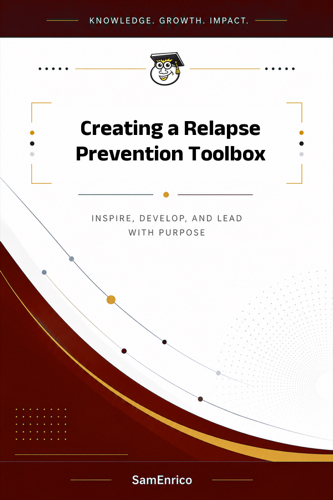
Creating a Relapse Prevention Toolbox eBook
Build a personalized set of coping strategies and
by Platt Rudolf
Build a personalized set of coping strategies and emergency actions for high-risk moments.
Formats
Free sample
Chapter 1: The Ambush Hour--The craving did not arrive with a warning label. It arrived at 9:47 on a Tuesday night, while he was standing in his own kitchen, holding a glass of water, not thinking about anything at all. One second, he was fine. The next, his mouth watered, his chest tightened, and a voice inside his head said, You could just go. No one would know. He had been sober for eleven months. He had a sponsor. He went to meetings. He owned three different meditation apps. And none of it mattered in that moment because he had never learned one simple truth: high-risk moments are not random. They follow a pattern. And if you cannot see the pattern, you will always be ambushed.This chapter is about making the invisible visible. It is about learning to spot a high-risk moment before it spots you. Most people believe that relapse happens because of a single catastrophic event—a fight, a funeral, a celebration gone wrong. But research spanning four decades tells a different story. Relapse is not an explosion. It is a chain. And chains can be broken at any link, but only if you know where the links are.The Anatomy of an Ambush Let us begin with a definition. A high-risk moment is any situation—internal or external—where your probability of returning to old behavior rises significantly above baseline. Not every stressful moment is high-risk. Not every negative emotion leads to craving. But certain situations, researched extensively by G. Alan Marlatt and his colleagues at the University of Washington, predict relapse with startling accuracy. Across dozens of studies involving alcohol, opioids, stimulants, nicotine, gambling, and even eating disorders, five situations consistently emerge as the most dangerous. They are not exotic. They are ordinary. That is what makes them so lethal.The first is negative emotions. Anger, anxiety, depression, boredom, frustration, loneliness. These are not just uncomfortable; they are physiologically similar to withdrawal. The brain craves relief. And the old behavior provided relief—temporarily, destructively, but reliably. The second is social pressure. This can be direct, with someone offering you a drink or a pill, or indirect, watching others use while you sit on your hands. The third is interpersonal conflict. Arguments with partners, fights with family, tension at work. The fourth is what researchers call "testing personal control"—the belief that you can have just one, that you are cured, that the rules no longer apply to you. And the fifth is positive emotional highs. Celebrations, reunions, financial windfalls, holidays. These are actually more dangerous than negative emotions for some people because they come with no guilt, no warning, and a collective expectation that everyone should be celebrating together.Think about the last time you relapsed or nearly relapsed. Not the event itself, but the hours or days before. Were you fighting with someone? Were you exhausted and lonely? Were you at a party where everyone was drinking? Were you secretly thinking, I have this under control now? The answer is almost certainly yes to at least one of these. High-risk moments are not mysterious. They are predictable. And predictability is power.The Relapse Chain: Five Links, One Weakness Here is where most recovery advice gets it wrong. People are told to "resist cravings" or "stay strong" as if a craving were a single event that either defeats you or does not. But a craving is not a single event. It is the fourth link in a five-link chain. And by the time you feel a craving, you have already missed three opportunities to stop the process.Link one is the trigger. A trigger is any stimulus—internal or external—that your brain has learned to associate with the old behavior. Triggers can be external, like a bar, a specific time of day, a song, a person, a neighborhood. They can be internal, like an emotion, a physical sensation, or even a thought. The critical thing to understand about triggers is that they operate below conscious awareness. You do not decide to be triggered. It happens automatically, in milliseconds, through pathways in your limbic system that evolved for survival and were hijacked by addiction.Link two is the automatic thought. This happens so fast that most people never notice it. The trigger activates a learned association: This place means drink. This feeling means drug. This argument means escape. The automatic thought is usually short, habitual, and distorted. Examples include "I need this," "Just once won't hurt," "I deserve a break," or "I cannot stand this feeling." These thoughts are not reasoned arguments. They are conditioned reflexes. And like all reflexes, they can be interrupted.Link three is the craving. This is the physical and emotional experience of wanting. Cravings have a body component—tightness in the chest, watering mouth, muscle tension, rapid heartbeat—and an emotional component—urgency, irritability, obsession. On a scale of one to ten, a craving can range from a mild whisper to a full-body scream. Most people believe that cravings are the problem. But cravings are actually the symptom. The problem is the trigger and the automatic thought that preceded it. If you only fight the craving, you are fighting the fire instead of cutting the fuel line.Link four is the lapse. This is the first return to the old behavior. One drink. One bet. One pill. One visit to the website. A lapse is not a relapse, and this distinction will save your life. A lapse is a single event. A relapse is a return to a pattern over days or weeks. The difference between the two is what you do in the first five minutes after the lapse. But that is Chapter Nine. For now, just know that a lapse is survivable, learnable, and not the end of recovery.Link five is the relapse. Days or weeks of returning to the old behavior pattern. Shame, isolation, escalating use. This is what everyone fears. But here is the truth that the top ten bestsellers all agree on: relapse almost never happens because of a single failure at link four. It happens because someone did not recognize the trigger at link one, did not challenge the automatic thought at link two, and did not have a tool for the craving at link three. By the time you reach link four, your options are limited. By the time you reach link five, your options are almost gone. The entire point of a relapse prevention toolbox is to intervene at links one, two, or three. Every single time.The Five High-Risk Situations in Depth Let us return to those five situations and make them concrete. Because reading a list is not the same as recognizing them in your own life.Negative emotions are the most common trigger across every substance and behavior. Anger is particularly dangerous because it comes with a sense of righteousness. When you are angry, you feel justified in seeking relief. The automatic thought is often, I deserve this. Anxiety and depression are dangerous for the opposite reason—they create a sense of hopelessness. The automatic thought is, Nothing matters anyway. Boredom is the silent killer of recovery because it is not dramatic enough to warn you. You are just sitting there, vaguely restless, and suddenly the idea of using seems reasonable.…
This is the end of the free sample. Get the eBook to keep going. Buy now
About this book
Details
- Author
- Platt Rudolf
- Publisher
- SamEnrico
- Language
- English
- Genre
- Non-Fiction, Self-Help, Coping Skills
- Released
- 2026-06-07
- Pages (approx.)
- 141
- Available as
- eBook, Audiobook

Read better in the ZLOADR app
Your eBooks on your phone or tablet. Sign in with your SamEnrico account and start reading.
More by Platt Rudolf
 Mechanical Engineering CreativityPlatt Rudolf$11.99
 The France Follow Up EtiquettePlatt Rudolf$11.99
 Administrative Burden Anger GuidePlatt Rudolf$11.99
 Even A Penny Helps TechniquePlatt Rudolf$11.99
 The Lioness of Sheba: The Queen Who Shaped a KingdomPlatt Rudolf$11.99
 Understanding Trisomy 6Platt Rudolf$17.99
 How to Become a Pipe-smoker-machine OperatorPlatt Rudolf$11.99
 African Hardware YC GuidePlatt Rudolf$12.99
 Cross-Border VAT Recovery GuidePlatt Rudolf$12.99
 Commission AnalystPlatt Rudolf$11.99
You may also like
 Hong Kong Handover 1997Dunn Johnnie$11.99
 Zumba For Postnatal Recovery CourseNeal Christian$11.99
 Zumba for BeginnersLadner Nikia$11.99
 YouTube Comment Mining GuideHumes Pandora$12.99
 Worry Box MeditationCarlin Rudy$11.99
 Workplace Stress MeditationNguyen Lynn$11.99
 Workplace Stress and Sleep RepairHawley Ivory$11.99
 Workplace Perfectionism CureDelaney Jeffry$11.99
 Workplace Injustice Anger GuideWallen Isabelle$11.99
 Work Addiction and Burnout LinkGreenwood Ester$11.99
 Women in Yoga and WellnessBeattie Galina$11.99
 Women in Stand Up ComedyChun Evangeline$11.99