
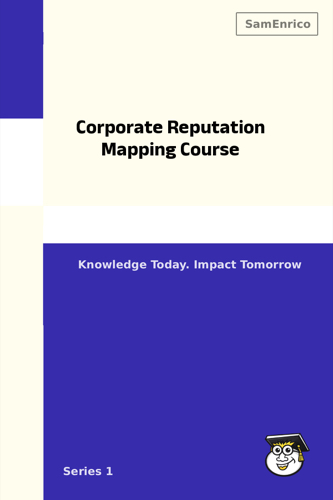
Non-FictionStrategic AtlasReputation Management
Corporate Reputation Mapping Course eBook
Map competitors by reputation scores from ESG rati
Map competitors by reputation scores from ESG ratings and corporate social responsibility.
Formats
Free sample
Chapter 1: The Hidden Asset--Most executives believe they understand their company's reputation. They track brand surveys, monitor social media sentiment, and commission annual perception studies. Yet when a competitor suddenly wins a billion-dollar contract, or an activist investor forces board turnover, or a supply chain scandal erases years of goodwill, these same executives are blindsided. The reason is simple but profound: they have been measuring reputation as a lagging indicator of past performance when, in fact, it has become a leading indicator of future financial outcomes.This book is built on a single, transformative premise. Corporate reputation is no longer a soft public relations asset that can be managed with press releases and charitable donations.
It has evolved into a hard, quantifiable, and tradeable asset class that sits directly alongside financial capital, intellectual property, and physical assets on the corporate balance sheet. The mechanism driving this transformation is the explosive growth of ESG—Environmental, Social, and Governance—ratings and the stakeholder capitalism movement that has made those ratings accessible, comparable, and consequential.To understand why this shift matters, consider the following reality. Over the past decade, institutional investors representing more than one hundred trillion dollars in assets under management have committed to integrating ESG criteria into their investment decisions. Procurement departments at Fortune 500 companies now routinely require suppliers to disclose their ESG scores before contracts are signed. Top-tier MBA graduates are choosing employers based on corporate sustainability rankings.
And regulators on three continents are mandating ESG disclosure as a matter of law. Reputation, in other words, has escaped the communications department and entered the core financial machinery of capitalism.This chapter establishes the foundational architecture for everything that follows. It will demonstrate, with empirical grounding and practical frameworks, why reputation must be measured in monetary terms, how ESG ratings have become the universal currency of corporate trust, and what this convergence means for competitive strategy. By the end of this chapter, you will have a clear methodology for calculating the financial impact of reputation gains and losses. More importantly, you will begin to see your competitors not merely as rivals in product markets but as data-rich subjects of intelligence that can be mapped, predicted, and strategically outmaneuvered.The Reputation Revolution For most of corporate history, reputation was a vague, qualitative concept.
A company had a good name or it did not. Trust was built over decades and could be destroyed overnight, but measuring its precise value seemed impossible. Public relations firms created brand equity models. Marketing departments tracked net promoter scores. Annual reports featured glossy photographs of happy employees and satisfied customers.
Yet none of these measures connected directly to the income statement or balance sheet in a way that satisfied a chief financial officer.That era has ended. Three forces have converged to transform reputation from an art into a science. The first force is data availability. Twenty years ago, information about a company's environmental spills, labor practices, or board composition was scattered across regulatory filings, newspaper archives, and internal documents. Today, that same information is aggregated, standardized, and published by multiple ESG rating agencies, available to any investor, customer, or competitor with an internet connection.
The second force is computational power. Algorithms now scrape news sources in real time, analyze satellite imagery of factory emissions, and track sentiment across millions of social media posts. What once required a team of analysts now happens automatically.The third and most important force is financial materiality. Researchers have conclusively demonstrated that ESG performance correlates with cost of capital, stock price volatility, operational efficiency, and customer loyalty. A meta-analysis of more than two thousand studies found that approximately ninety percent showed a non-negative relationship between ESG and corporate financial performance, with the majority showing a positive relationship.
In plain English, companies with strong reputations as measured by ESG ratings tend to outperform those with weak reputations. This is not correlation without causation. The mechanisms are identifiable, measurable, and actionable.Consider a manufacturing company with poor environmental scores. It faces higher energy costs, greater regulatory scrutiny, and increased risk of fines. Its cost of capital rises because lenders perceive environmental liability.
Its best engineers leave for competitors with stronger sustainability commitments. Its largest customers begin diversifying their supply chains to reduce concentration risk. Each of these effects appears on the financial statements. Each can be traced back to ESG ratings that flagged the problem months or years before the financial damage became visible.Conversely, consider a company with strong social and governance scores. It attracts talent more easily, reducing recruiting and training costs.
It faces fewer labor disputes, avoiding production stoppages. Its board oversight reduces the likelihood of fraud or compliance failures. Its transparent reporting builds trust with regulators, speeding approvals and reducing inspection frequency. These advantages compound over time, creating a gap between ESG leaders and laggards that grows wider each quarter.The critical insight for readers of this book is that reputation is not merely something to protect. It is something to weaponize.
When you understand how ESG scores translate into financial outcomes, you can identify the precise points of vulnerability in your competitors' positions. You can anticipate which rivals are about to suffer downgrades, scandals, or investor rebellions. And you can position your own organization to capture the value they leave behind.Introducing the Competitor Taxonomy Before proceeding further, this book establishes a clear framework for who exactly we mean when we say "competitor." In traditional strategy, a competitor is any firm that offers a similar product or service to the same customer base. For reputation mapping, this definition is insufficient. Reputational contagion flows through supply chains, across industry boundaries, and up and down ownership structures.
A scandal at a supplier can damage a company that has no direct relationship with that supplier if the company's customers perceive guilt by association. A governance failure at an industry peer can trigger regulatory scrutiny that captures innocent firms in its net.To address this complexity, this book introduces a three-tier competitor taxonomy that will be used throughout all subsequent chapters. Each chapter will specify which tiers its frameworks apply to, and readers are encouraged to maintain separate intelligence files for each tier.Tier One competitors are direct rivals. These are firms that offer substantially similar products or services to substantially similar customers in substantially similar geographic markets. If a customer chooses between your company and another company for the same purchase, that other company belongs in Tier One.
For most readers, Tier One will consist of between five and fifteen firms. These are the competitors you already track, but likely without the ESG intelligence framework this book provides.Tier Two entities are not competitors in the traditional sense but rather suppliers, logistics providers, and strategic partners that serve your Tier One competitors. The reputational risk here is indirect but potentially devastating. If a Tier One competitor relies on a Tier Two supplier with terrible labor practices, and that supplier is exposed in a media investigation, the Tier One competitor will suffer reputational damage regardless of its own operations. Moreover, because most companies conduct due diligence only on their direct suppliers, Tier Two vulnerabilities are often hidden from public view.
This book will teach you how to uncover them.Tier Three entities are industry peers and adjacent players. These are firms…
This is the end of the free sample. Get the eBook to keep going. Buy now
About this book
Details
- Author
- Hefner Lauralee
- Publisher
- SamEnrico
- Language
- English
- Genre
- Non-Fiction, Strategic Atlas, Reputation Management
- Released
- 2026-06-08
- Pages (approx.)
- 149
- Available as
- eBook, Audiobook

Read better in the ZLOADR app
Your eBooks on your phone or tablet. Sign in with your SamEnrico account and start reading.
More by Hefner Lauralee
 Remote Retreats for Burnout RecoveryHefner Lauralee$11.99
 Bank Loan Business Plan GuideHefner Lauralee$11.99
 Men's Cardiovascular Exercise ProtocolHefner Lauralee$11.99
 Deep Work for ChefsHefner Lauralee$11.99
 Echoes from the Abyss: The Australian Scientist Who Almost Predicted Black HolesHefner Lauralee$11.99
 Crowns & Crosses: The Secret War Behind the Windsor SplitHefner Lauralee$11.99
 Site Security ManagerHefner Lauralee$11.99
 Understanding Chromosome 10, Monosomy 10pHefner Lauralee$17.99
 B2B Customer Retention GuideHefner Lauralee$12.99
 Emerging Market Logistics GuideHefner Lauralee$12.99
You may also like
 Hong Kong Handover 1997Dunn Johnnie$11.99
 Zumba For Postnatal Recovery CourseNeal Christian$11.99
 Zumba for BeginnersLadner Nikia$11.99
 YouTube Comment Mining GuideHumes Pandora$12.99
 Worry Box MeditationCarlin Rudy$11.99
 Workplace Stress MeditationNguyen Lynn$11.99
 Workplace Stress and Sleep RepairHawley Ivory$11.99
 Workplace Perfectionism CureDelaney Jeffry$11.99
 Workplace Injustice Anger GuideWallen Isabelle$11.99
 Work Addiction and Burnout LinkGreenwood Ester$11.99
 Women in Yoga and WellnessBeattie Galina$11.99
 Women in Stand Up ComedyChun Evangeline$11.99