
Non-FictionProfessional's Cheat SheetLogisticsLast Mile
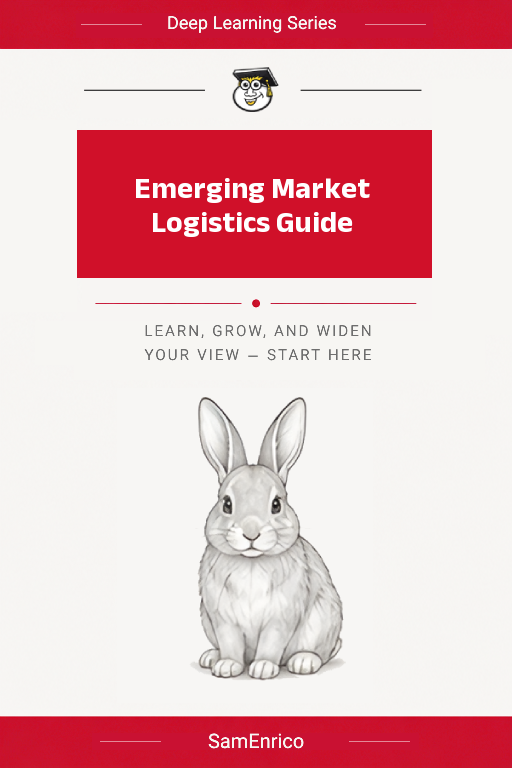
Emerging Market Logistics Guide
Manage vendor logistics in challenging environment
Manage vendor logistics in challenging environments including customs clearance and last mile delivery.
Formats
About this book
Free sample
Chapter 1: The Volatility Mandate--–- The first lesson every logistics manager learns in emerging markets is that the manual lies. Not accidentally, not due to a printing error, but systemically, predictably, and with complete indifference to your carefully constructed Excel models. The port authority’s website will show your container as “cleared – ready for pickup” when it is still sitting on a vessel two hundred nautical miles offshore. The tracking system will report “in transit” for forty-seven consecutive days while your goods are actually moldering in a bonded warehouse behind a locked gate whose key was lost during the previous administration. The local vendor’s cheerful confirmation that “everything is under control” means, with stunning regularity, that nothing whatsoever has happened since your last call.This is not incompetence.
This is not malice. This is the fundamental operating condition of logistics in environments where the friction of moving goods exceeds the friction of not moving them. And until you accept that volatility is not a bug in the system but the system itself, you will continue to experience the same delays, the same cost overruns, and the same frantic midnight phone calls that define the emerging market logistics profession.Welcome to the Volatility Mandate.The Map Is Not the Territory For twenty-five years, supply chain textbooks have taught a comforting gospel of predictability. Lead times are normally distributed. Inventory optimization follows the newsvendor model.
Safety stock calculations assume a stable demand signal and a reliable supply base. These teachings are not wrong in the abstract. They are simply irrelevant to the reality of moving goods through Lagos, Jakarta, Karachi, or any of the dozens of markets where infrastructure, governance, and information systems operate according to logic that would make a Western logistics auditor weep.Consider the Mombasa–Kigali corridor, a thousand-mile artery that serves as the primary trade route for Kenya, Uganda, Rwanda, and parts of eastern Democratic Republic of Congo. In a developed market, a container moving from port to inland destination would generate approximately forty-seven discrete data points: gate-out scans, weighbridge records, customs release notifications, GPS breadcrumbs, and delivery confirmations.…
This is the end of the free sample. Get the eBook to keep going. Buy now
Contents
- Chapter 1
- Chapter 2
- Chapter 3
- Chapter 4
- Chapter 5
- Chapter 6
- Chapter 7
- Chapter 8
- Chapter 9
- Chapter 10
- Chapter 11
- Chapter 12
Details
- Author
- Hefner Lauralee
- Publisher
- SamEnrico
- Language
- English
- Genre
- Non-Fiction, Professional's Cheat Sheet, Logistics, Last Mile
- Released
- 2026-05-29
- Pages (approx.)
- 140
- Available as
- eBook, Audiobook

Read better in the ZLOADR app
Your eBooks on your phone or tablet. Sign in with your SamEnrico account and start reading.
More by Hefner Lauralee
 Remote Retreats for Burnout RecoveryHefner Lauralee$11.99
 Bank Loan Business Plan GuideHefner Lauralee$11.99
 Corporate Reputation Mapping CourseHefner Lauralee$11.99
 Men's Cardiovascular Exercise ProtocolHefner Lauralee$11.99
 Deep Work for ChefsHefner Lauralee$11.99
 Echoes from the Abyss: The Australian Scientist Who Almost Predicted Black HolesHefner Lauralee$11.99
 Crowns & Crosses: The Secret War Behind the Windsor SplitHefner Lauralee$11.99
 Site Security ManagerHefner Lauralee$11.99
 Understanding Chromosome 10, Monosomy 10pHefner Lauralee$17.99
 B2B Customer Retention GuideHefner Lauralee$12.99
You may also like
 Hong Kong Handover 1997Dunn Johnnie$11.99
 Zumba For Postnatal Recovery CourseNeal Christian$11.99
 Zumba for BeginnersLadner Nikia$11.99
 YouTube Comment Mining GuideHumes Pandora$12.99
 Worry Box MeditationCarlin Rudy$11.99
 Workplace Stress MeditationNguyen Lynn$11.99
 Workplace Stress and Sleep RepairHawley Ivory$11.99
 Workplace Perfectionism CureDelaney Jeffry$11.99
 Workplace Injustice Anger GuideWallen Isabelle$11.99
 Work Addiction and Burnout LinkGreenwood Ester$11.99
 Women in Yoga and WellnessBeattie Galina$11.99
 Women in Stand Up ComedyChun Evangeline$11.99