
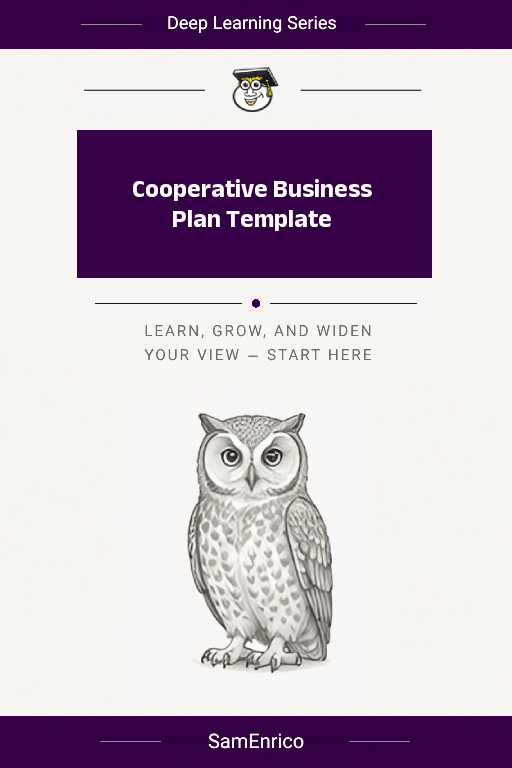
Cooperative Business Plan Template
Draft feasibility study with member contributions
Draft feasibility study with member contributions and projected surplus.
Formats
About this book
Free sample
Chapter 1: The Membership Trap--–- In 2016, the Maple Ridge Food Co-op opened its doors to tremendous fanfare. Three hundred members had pledged $1,000 each. A local credit union had lent $400,000. The shelves were stocked with organic produce, bulk grains, and pasture-raised eggs. The founding board had followed a standard business plan template—the same one used by every small grocery startup in the state.
By all conventional metrics, Maple Ridge was a success story.–- Eighteen months later, the co-op was bankrupt.–- Not because the market was weak. Not because the location was poor. Not because the products were overpriced. Maple Ridge failed because its business plan was written for the wrong kind of business. The founders had projected revenue based on "market share" rather than "member usage." They had budgeted for customer acquisition rather than member education.
They had assumed that a co-op could be managed like any other grocery store—just with a different legal structure tacked on at the end.–- The bank that lent the $400,000 got its money back first, thanks to a personal guarantee from a well-intentioned board member. The suppliers got pennies on the dollar. The three hundred members lost their $1,000 shares entirely. And the building—a beautiful, renovated warehouse in the heart of downtown—was sold to a national pharmacy chain.–- The co-op died because no one had explained a simple, brutal truth: A cooperative is not a business with members. A cooperative is a membership organization that operates a business.–- That distinction is everything.
And it is the subject of this chapter.The Invisible Hand Is a Fist–- Most entrepreneurs are taught to worship at the altar of Adam Smith's "invisible hand"—the idea that individuals pursuing their own self-interest inadvertently create collective prosperity. The for-profit business plan is the scripture of this religion. Its central commandment: maximize shareholder value.–- A standard business plan asks one question above all others: How much money can this business make for its owners? Everything else—product quality, customer service, employee welfare, environmental impact—is subordinated to that singular metric. If a decision increases shareholder returns, it is…
This is the end of the free sample. Get the eBook to keep going. Buy now
Contents
- Chapter 1
- Chapter 2
- Chapter 3
- Chapter 4
- Chapter 5
- Chapter 6
- Chapter 7
- Chapter 8
- Chapter 9
- Chapter 10
- Chapter 11
- Chapter 12
Details
- Author
- Council Shaunte
- Publisher
- SamEnrico
- Language
- English
- Genre
- Non-Fiction, Business Brief, Business Brief, Planning
- Released
- 2026-06-06
- Pages (approx.)
- 156
- Available as
- eBook, Audiobook

Read better in the ZLOADR app
Your eBooks on your phone or tablet. Sign in with your SamEnrico account and start reading.
More by Council Shaunte
 Progressive Muscle RelaxationCouncil Shaunte$11.99
 Bipolar And Light TherapyCouncil Shaunte$11.99
 Stress and Gratitude Practice CouplesCouncil Shaunte$11.99
 The Long Way HomeCouncil Shaunte$11.99
 Pregnancy Breath PreparationCouncil Shaunte$11.99
 Listening In Oil Gas GuideCouncil Shaunte$11.99Progressive Muscle RelaxationCouncil Shaunte$11.99
 Joyful Commute TransformationCouncil Shaunte$11.99
 Dave Thomas Square BurgersCouncil Shaunte$11.99
 Coffee Nap Timing HandbookCouncil Shaunte$11.99
 The Deep Thinkers of the Nile: How Ancient Egyptian Scholars Charted the CosmosCouncil Shaunte$11.99
 Lucid: The Forgotten Dreams of Nikola TeslaCouncil Shaunte$11.99