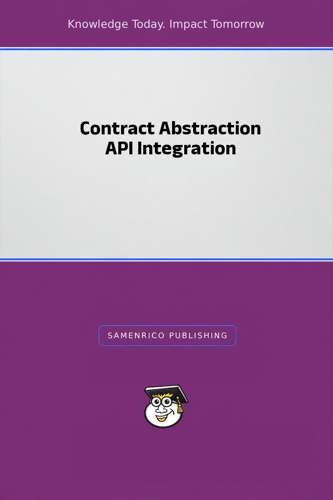
Contract Abstraction API Integration eBook
Connect AI extraction tools directly to your contr
Connect AI extraction tools directly to your contract management system for automated data ingestion.
Formats
Free sample
Chapter 1: The Paper Prison--The spreadsheet error cost them $4.7 million.It was a Tuesday morning when the legal operations manager at a mid-sized Saa S company opened the quarterly contract review report. The numbers felt wrong. She ran the query again. Same result. Seventy-three contracts with renewal dates in the past 90 days.
Seventy-three. The system showed that all of them had been marked "auto-renew" during the abstraction process six months earlier. But when she pulled the original PDFs and searched for "automatic renewal," she found something different.Forty-one of those contracts contained explicit clauses requiring written notice of non-renewal at least 60 days in advance. The paralegal who had manually abstracted those contracts had missed the clause entirely, scanning only the first page of each document instead of reading the entire 47-page agreement. By the time the legal team discovered the error, the notice windows had closed.
The company was locked into $4.7 million in software licenses it no longer needed, for products it had already replaced.The CFO's question, delivered in a conference room at 4:47 PM on a Friday, was simple: "How did this happen, and why am I just hearing about it now?"The legal operations manager had no good answer. The truth was uncomfortable. Their contract abstraction process was manual, inconsistent, and invisible. A team of five paralegals and junior attorneys spent an average of twenty-two minutes per contract, typing renewal dates, counterparty names, governing law provisions, and liability caps into a spreadsheet that lived on a shared network drive. No version control.
No audit trail. No confidence scoring. Just people, PDFs, and the quiet certainty that something would eventually slip through the cracks.Something had.This book exists because that story is not an outlier. It is the norm.Every year, organizations of all sizes lose hundreds of millions of dollars to manual contract abstraction errors. Missed renewals.
Overlooked termination rights. Unnoticed liability caps. Unidentified compliance obligations. The problem is not that contract data is inaccessible. The problem is that it is trapped in a form that business systems cannot read, stored in a process that humans cannot scale, and managed with tools that were never designed for the complexity of modern legal operations.The spreadsheet is not the solution.
It is the symptom.The Agreement Trap: Why Your Contracts Are Holding You Hostage Consider what happens to a contract after it is signed. The document, often a PDF or a scanned image, is saved to a shared drive, a document management system, or a basic CLM platform. Then the real work begins. Someone must open the file, read it, find the key terms, and type those terms into a structured format that the rest of the business can use.This is the Agreement Trap. Your contracts exist in two parallel universes simultaneously.
In one universe, they are legal documents—binding agreements that define rights, obligations, and risks. In the other universe, they are sources of data—renewal dates that trigger procurement decisions, liability caps that inform risk assessments, governing law clauses that determine litigation strategy, and compliance obligations that shape operational processes.The tragedy is that these two universes never truly connect. The legal document sits in one system. The structured data sits in another. And the bridge between them is human effort.The scale of this problem is staggering.
A typical mid-sized enterprise executes between two thousand and ten thousand contracts per year. Each contract contains between ten and fifty data points that matter for downstream business processes. That is between twenty thousand and five hundred thousand discrete pieces of contract data that must be extracted, validated, and entered into business systems annually.Performed manually, at twenty minutes per contract, that is between six hundred sixty and three thousand three hundred hours of work per year. At an average loaded cost of fifty dollars per hour for legal operations staff, that is between thirty-three thousand and one hundred sixty-five thousand dollars in direct labor costs. The hidden costs—missed renewals, compliance failures, litigation exposure—easily multiply that number by a factor of ten or more.The Keyword Search Illusion Many organizations believe they have already solved this problem.
They point to their document management system's search functionality. "We can find any contract by keyword," they say. "We don't need structured data."This is a dangerous illusion.Keyword search is fundamentally limited because it operates on the presence or absence of exact character sequences. It does not understand meaning, context, or legal nuance. Consider a simple example.
You need to find all contracts that are governed by New York law. You type "jurisdiction" into the search bar. Zero results. The contracts, however, contain a clause titled "Governing Law" that says "This Agreement shall be governed by and construed in accordance with the laws of the State of New York."Keyword search failed because it looked for "jurisdiction" and found "Governing Law." The information was present. The system could not find it.Now consider a more complex example.
You need to identify all contracts that contain unlimited liability for data breaches. Search for "unlimited liability." Zero results. The actual clause reads: "Provider shall be fully liable for any and all damages arising from any security incident, without limitation as to amount or type." The meaning is unlimited liability. The text does not contain the words "unlimited liability."Keyword search fails. OCR fails when documents are scanned images.
Regular expressions fail when clause language varies. The only reliable way to find what is actually in your contracts is to understand what the words mean, not just what they literally say.This is where artificial intelligence enters the picture. But AI alone is not enough.The Abstraction Layer: Connecting Legal Language to Business Systems The core insight of this book is that automated contract abstraction requires an abstraction layer. This is not a philosophical concept. It is a technical architecture.An abstraction layer is a defined schema that sits between the messy, unpredictable, human-written language of legal contracts and the clean, structured, machine-readable format that business systems require.
It tells the AI what to look for. It tells the validator what format to expect. It tells the API where to send the result. And it does all of this in a way that separates the what from the how.Consider a simple example. A legal contract contains an effective date.
In human language, that date might appear as "March 15, 2024," or "15 March 2024," or "the date of last signature," or "the date set forth in Section 1.1." Your CRM, however, expects dates in ISO 8601 format: "2024-03-15T00:00:00Z."The abstraction layer bridges this gap. It tells the AI: "Extract the effective date, whatever form it takes, and return it as a string." It tells the validator: "This string must be convertible to an ISO date. If not, flag it for human review." It tells the transformation engine: "Convert the extracted string to ISO 8601 before loading." And it tells the API: "Send the converted value to the field named Contract.Start_Date__c in Salesforce."Without this abstraction layer, every piece of logic is hardcoded. The AI prompt hardcodes the field names. The validation script hardcodes the date format.
The transformation function hardcodes the target mapping. The API call hardcodes the Salesforce field. When anything changes, everything breaks.With the…
This is the end of the free sample. Get the eBook to keep going. Buy now
About this book
Details
- Author
- Mclaughlin Audrey
- Publisher
- SamEnrico
- Language
- English
- Genre
- Non-Fiction, AI Operator, API Integration
- Released
- 2026-06-09
- Pages (approx.)
- 143
- Available as
- eBook, Audiobook

Read better in the ZLOADR app
Your eBooks on your phone or tablet. Sign in with your SamEnrico account and start reading.
More by Mclaughlin Audrey
 Diarrhea Research ReviewMclaughlin Audrey$11.99
 Success Attribution ImposterMclaughlin Audrey$11.99
 School Year Time ManagementMclaughlin Audrey$11.99
 Creativity Unblock GuideMclaughlin Audrey$11.99
 Zwingli Zurich ReformationMclaughlin Audrey$11.99
 Email Listening SignalsMclaughlin Audrey$11.99
 Power Animal Retrieval GuideMclaughlin Audrey$11.99
 Affirmations For Invisible IllnessMclaughlin Audrey$11.99
 Velvet Shadows: The Unseen Life of Billie HolidayMclaughlin Audrey$11.99
 The Diamond Conspiracy: The Queen Who Sold Her Crown for LoveMclaughlin Audrey$11.99
 Whispers in the Wind: The Star-Crossed Love of White Buffalo Calf Woman and the ThunderbirdMclaughlin Audrey$11.99
 The Dancer's Guide to Circassian DanceMclaughlin Audrey$11.99