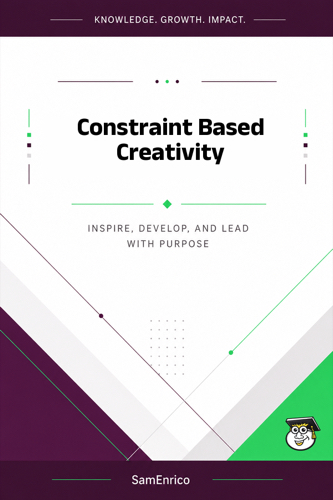
Constraint Based Creativity eBook
Use limitations to spark innovative business solut
Use limitations to spark innovative business solutions.
Formats
Free sample
Chapter 1: The Scarcity Paradox--–- In the summer of 1970, three astronauts found themselves 205,000 miles from Earth with a dying spaceship, a square carbon dioxide filter, and a pile of irregularly shaped canisters, plastic bags, duct tape, and flight manuals. They had exactly seventy-two hours of oxygen left, a lunar module designed for two people now carrying three, and no working primary propulsion. By every logical measure, Jim Lovell, Fred Haise, and Jack Swigert should have died in space.Instead, they became the most celebrated case study in constraint-based creativity ever recorded.What happened aboard Apollo 13 was not a miracle. It was not luck. It was a master class in what happens when the human brain is forced to solve a problem with exactly what it has, exactly where it is, exactly when it matters most.
Mission Control engineers on the ground dumped a box of “available parts” onto a table—items that were already onboard the spacecraft—and told the astronauts to build a CO₂ scrubber adapter using nothing else. No new materials. No resupply. No second chances. The square filter had to fit into a round hole, and the only tools available were those designed for entirely different tasks.Within hours, the astronauts had rigged a working adapter using a suit hose, a sock, a flight manual cover, and copious amounts of duct tape.
They lived. The world watched. And virtually every business book since has cited Apollo 13 as the definitive proof that constraints work.But here is what those books miss: the Apollo 13 crew succeeded not because they faced a constraint, but because they faced exactly one binding constraint at a time. The CO₂ problem was singular. Everything else—navigation, power, water, temperature—was temporarily bracketed.
The engineers did not try to solve five crises simultaneously. They solved the square-peg-round-hole problem first, then moved to the next constraint, then the next. One tight limit, one creative breakthrough, one sequence.That distinction—between one productive constraint and five paralyzing ones—is the entire foundation of this chapter.The Scarcity Paradox: Why Less Becomes More Every business leader has felt the sting of scarcity. A budget gets cut. A deadline moves up.
A key team member leaves. A supply chain breaks. The instinctive reaction is almost universal: panic, then lobbying for more resources, then resignation. “If only we had more time, more money, more people,” the lament goes, “we could really innovate.”This is wrong. Not slightly inaccurate.
Not situationally dependent. Fundamentally, empirically, repeatedly wrong.The psychology of “having less” operates very differently than most executives assume. When resources are abundant, the human brain shifts into what researchers call “opportunity scanning mode.” You look for more options, more features, more possibilities. This sounds productive, but in practice it leads to what the psychologist Barry Schwartz famously termed “the paradox of choice.” More options do not yield better decisions; they yield indecision, second-guessing, and diminished satisfaction with whatever choice is eventually made.When resources are scarce, however, the brain flips into “problem-solving mode.” You stop asking “What else could we do?” and start asking “How must we do this one thing?” The difference is not subtle. Opportunity scanning diffuses attention across dozens of possibilities.
Problem-solving focuses attention on a single, unavoidable challenge. And that focus—that forced, uncomfortable, boundary-setting focus—is where creativity actually lives.Consider the research of Kathleen Vohs at the University of Minnesota. In a series of experiments, participants given limited time or limited materials consistently produced more creative solutions than those given abundant resources. Not occasionally. Not in certain domains.
Consistently. The group told “you have five minutes” generated more novel ideas than the group told “you have as much time as you need.” The group given three Lego bricks generated more inventive structures than the group given fifty bricks. Scarcity did not starve creativity; it provoked it.This is the Scarcity Paradox: the less you have, the more inventive you become, provided the scarcity applies to a single dimension of the problem.Apollo 13 as a Case Study in Singular Constraints Let us return to the spacecraft, because the details matter. When the oxygen tank exploded, Apollo 13 faced at least seven simultaneous life-threatening constraints: loss of electrical power, loss of water, loss of propulsion, rising CO₂ levels, falling temperature, a damaged command module, and a trajectory that required a specific re-entry angle. Seven constraints.
Seven potential points of failure. Seven ways to die.But Gene Kranz, the flight director, did something remarkable. He did not try to solve all seven. He sequenced them.First constraint: keep the astronauts alive in the immediate term, which meant getting them into the lunar module (designed for two) as a lifeboat. Solved.
Second constraint: conserve power for re-entry, which meant shutting down every non-essential system. Solved. Third constraint: manage CO₂ before it reached lethal levels. This was the square-peg-round-hole problem. Solved.
Then the next. Then the next.The genius of Kranz’s approach—and the reason Apollo 13 succeeded while other complex failures have failed—was his insistence on identifying a single primary constraint at each stage of the crisis. He did not allow his team to be overwhelmed by the totality of the disaster. He broke the disaster into a sequence of singular problems, each with its own tight constraint, each solved before moving to the next.This is the first and most important lesson of constraint-based creativity: you cannot leverage five constraints at once. You can leverage one.
Sometimes two, if they align. Never three or more. The human brain has limited working memory, and each additional constraint increases cognitive load exponentially, not linearly. When teams face four or five binding limits simultaneously—as they often do in large corporate initiatives—the typical response is not breakthrough creativity. It is paralysis, followed by平庸 compromises, followed by abandonment.The Difference Between Scarcity and Starvation Let me be precise about what I am not saying.
I am not saying that all scarcity is good. I am not saying that starving a project of resources will always produce innovation. I am not saying that constraints are magic.There is a critical difference between scarcity and starvation. Scarcity is the condition of having one tight limit—one missing resource, one immovable deadline, one non-negotiable rule—while other resources remain adequate. Starvation is the condition of having multiple limits simultaneously: no money, no time, no talent, no tools, no permission.
Starvation does not spark creativity. Starvation kills it.The research on this distinction is clear. In a landmark study of creative problem-solving under resource constraints, researchers Teresa Amabile and Bethany S. Briggs found that “moderate resource constraints” enhanced creativity, while “severe resource constraints” reduced it. What counts as moderate?
The study defined it as a 40–60% reduction in a single resource dimension. What counts as severe? A 70% or greater reduction, or reductions across three or more dimensions at once.This is why the 50% Rule—which we will explore in depth later in this book—works so consistently. Reducing a project’s budget by half is scarcity. Reducing it by ninety percent, while simultaneously cutting the timeline by seventy percent and losing two key team members, is starvation.
The first forces creative trade-offs. The second forces failure.The Apollo 13 astronauts never faced starvation. They faced a series of…
This is the end of the free sample. Get the eBook to keep going. Buy now
About this book
Details
- Author
- Meador Britteny
- Publisher
- SamEnrico
- Language
- English
- Genre
- Non-Fiction, Self-Help, Constraints
- Released
- 2026-06-09
- Pages (approx.)
- 131
- Available as
- eBook, Audiobook

Read better in the ZLOADR app
Your eBooks on your phone or tablet. Sign in with your SamEnrico account and start reading.
More by Meador Britteny
 HIIT for Men Over 50Meador Britteny$11.99
 MBSR for Hypertension GuideMeador Britteny$11.99
 Survey Data Retention Policies AIMeador Britteny$11.99
 OCD And Executive FunctioningMeador Britteny$11.99
 The War Room: How a Tech Titan Outmaneuvered Wall StreetMeador Britteny$11.99
 The Silent Takeover: How a Tech Mogul Bought the WorldMeador Britteny$11.99
 Human Factors ConsultantMeador Britteny$11.99
 Computer Science Master EuropeMeador Britteny$12.99
 Secondary Data Analysis Without PubsMeador Britteny$12.99
 How to Become a Destaticizer FeederMeador Britteny$11.99
 Understanding Caplan's SyndromeMeador Britteny$17.99